
Museum Choreographies: A Review of Annie Wenstrup’s The Museum of Unnatural Histories
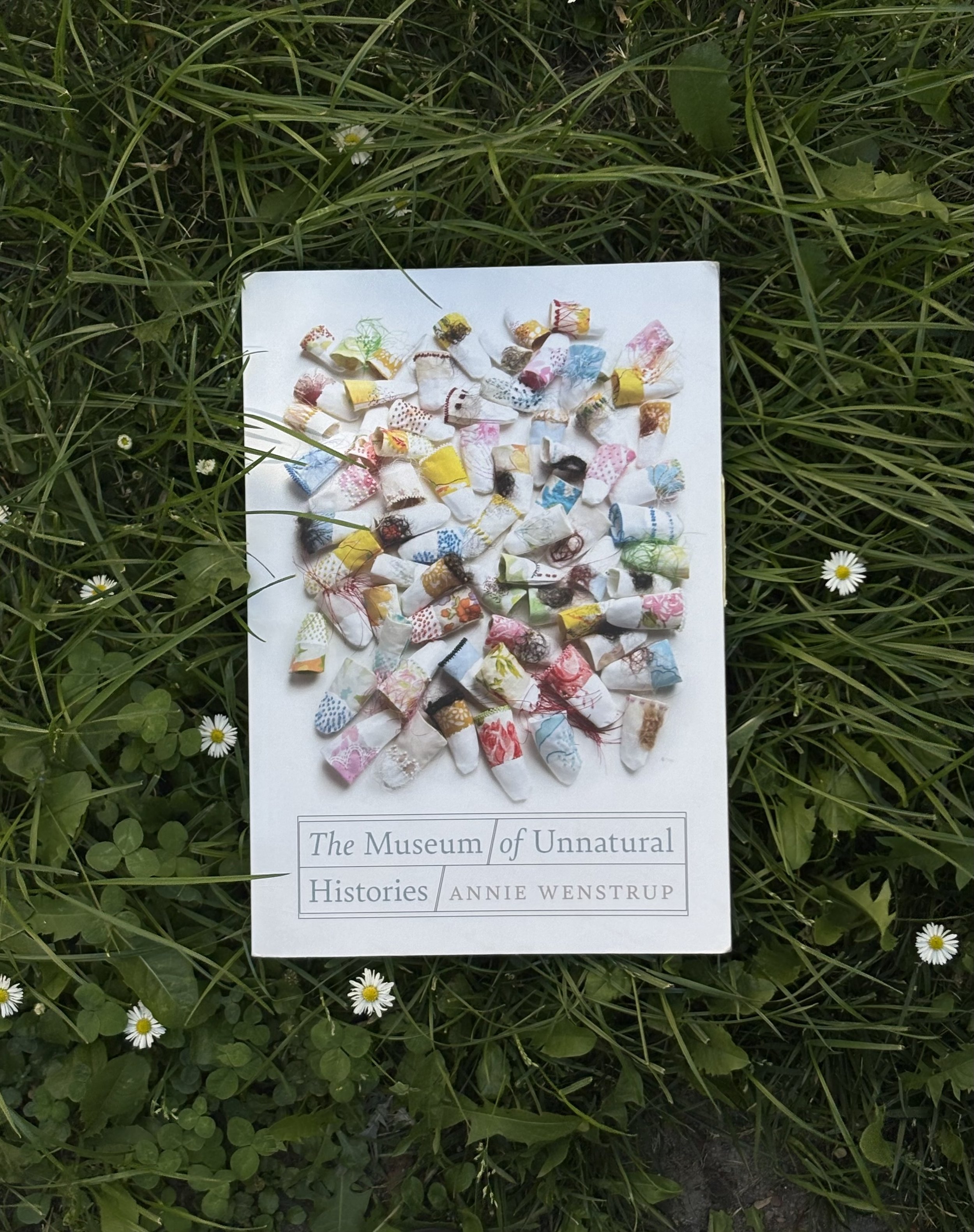
Museum Choreographies
A Review of Annie Wenstrup’s The Museum of Unnatural Histories
by Oona Uishama Narváez
by Oona Ui
In The Museum of Unnatural Histories, Annie Wenstrup pries open the deceptively simple construct of museums as a means to reconfigure gaze. As a poet deeply concerned with the politics of public attention and the violences embedded within archival systems, Wenstrup’s understanding of the museum as a technology of vision before knowledge becomes central to how the collection reads. Museums organize vision before they organize knowledge; their authority derives from the ways they condition how, when, and what viewers learn to see. Wenstrup inherits this visual architecture ready to rupture it, transforming the museum from a space of ordered observation into a constellatory field where objects, bodies, archives, and histories remain unstable in relation to one another.
The collection repeatedly destabilizes expectations of institutional coherence. Exhibit texts, blackout poems, event scores, layered poems, visual interruptions, and fragments of archival language emerge as competing systems of perception. Poems interrupt poems. Histories surface only partially before dissolving into another textual register. The reading experience resists stable orientation, forcing continual reconsideration of how the page itself is being navigated. The effect is choreographic. Wenstrup constructs a lyric environment in which observation becomes implicated within the violences of classification and display.
This concern emerges explicitly in “Exhibit D: Un-sent Memo,” where Wenstrup writes, “Every time we meet, there’s always the problem / with image: it perpetually appears in the present tense.” The line identifies one of the collection’s central tensions: the image carries historical forms of seeing forward into the present. Museums promise historical distance and interpretive stability, yet Wenstrup’s poems unsettle both. Images, artifacts, and narratives exert pressure on the bodies that encounter them.
Across multiple readings, this line continues to reshape the temporality of the archive. The image never settles into inert history. It continues acting upon the living. By the later sections of the collection, the poems feel as though they reverse the direction of looking, exposing the habits of attention brought into museums, literary spaces, and cultural discourse more broadly.
That pressure extends beyond institutional critique into an examination of the racialized structures of perception embedded within daily life for Native individuals. In an interview with Rey M. Rodríguez, Wenstrup describes the museum as “a space of authority” that “tells you how to look,” linking that authority to “the gaze that decides what is worth preserving, what is worth displaying, and how it is interpreted.” The poems implicate readers within the racialized structures through which visibility itself is distributed and controlled. Indigeneity appears not as stable representation but as a field shaped by ongoing regimes of visibility and erasure.
The recurring distinction between “blue” and “green” women becomes especially resonant here. In “Ghost Pixels,” Wenstrup writes: “Sometimes I envy the beautifully seen dead / women—I a green woman among the blue.” The precision and unease of this image condense the collection’s concerns with legibility, preservation, and racialized visibility. “Beautifully seen” becomes a form of conditional recognition shaped through aesthetic and racial frameworks. The dead women are rendered visible according to institutional and cultural terms of preservation, while the speaker remains suspended outside those structures of legibility. Throughout the collection, whiteness operates as a visual regime shaping who appears centered, preserved, aestheticized, or mourned.
What gives the collection its force is its refusal to position the reader outside these structures of looking. Perception itself becomes implicated. Readers move through unstable arrangements of display, encountering overlapping personal archives, historical fragments, pop-cultural references, Indigenous histories, and visual disjunctions. During reading, the collection often resembles a fragmented arcade where meaning emerges through fleeting juxtapositions and echoes between texts.
As someone deeply engaged with documentary poetics and archival fragmentation, Wenstrup’s formal strategies stand out for their resistance to any fantasy of seamless historical recovery. The collection repeatedly interrupts its own legibility. Reading produces a sustained disorientation, as though each page requires recalibrating not interpretation alone but perception itself. Poems refuse singular meaning before another textual layer interrupts or reframes them. Blackout poems, visual fragmentation, and overlapping textual registers slow reading down, forcing the eye to navigate competing systems of attention simultaneously. Pages often continue to resonate beyond their endings; lyric and visual textures unfold after closure. Formal instability becomes one of the collection’s deepest historical methods: memory appears fractured, recursive, and continually mediated through institutional forms of display.
The formal experimentation throughout the collection feels rigorously composed and deliberately controlled. Interruption and distortion operate as historical method. The “unnatural history” of the title names not the contents of the museum, but the mechanisms through which historical narratives are assembled, aestheticized, and made authoritative in the first place.
The Museum of Unnatural Histories participates in ongoing conversations within Indigenous futurism, though Wenstrup approaches futurity through disruptions of perception, archival time, and institutional authority rather than through conventional speculative world-building. The collection engages broader traditions of documentary and hybrid poetics concerned with the archive as both aesthetic material and site of violence. Colonial notions of historical linearity are refused in favor of temporal overlap, where ancestral presence, memory, and image coexist across registers. Wenstrup’s hybrid structures, documentary fragments, and procedural experimentation also place the book in conversation with contemporary experimental poetics concerned with who gets preserved inside official history. Across these conversations, vision itself becomes contested terrain.
Wenstrup writes: “Silence becomes my body: a bell echoes another’s / story. Ring it. Ring it. How else can I face / what’s become of my absence.” Echo becomes the book’s governing structure. Histories recur unevenly. Images persist beyond their original contexts. Bodies appear through traces, distortions, repetitions, and interruptions. The collection reveals the conditions that fracture these histories and sustain their instability. Fragmentation becomes an ethical and historical condition rather than a formal effect. The question the book leaves open is what forms of perception might still become possible once institutional ways of seeing begin to fracture.
In an era increasingly shaped by curated histories, algorithmic visibility, and institutional forms of narrative control, The Museum of Unnatural Histories feels urgent. Wenstrup constructs lyric architectures that resist the mechanisms through which histories are organized and displayed. The collection suggests that perception itself is never neutral; to look is already to participate within structures of power, memory, and erasure. What emerges is a poetics of unstable seeing, one that refuses coherence in favor of a fractured and ethically attentive encounter with history.
Oona Uishama Narváez (she/they) is a writer and artist from El Paso, Texas, and has an MFA in Poetry from the Institute of American Indian Arts. Her fascinations lie in affect theory, hybrid narrative structures, and translingual poetics. Currently, she is working on a mixed-media project that interrogates the lineages and limitations of language and illness.