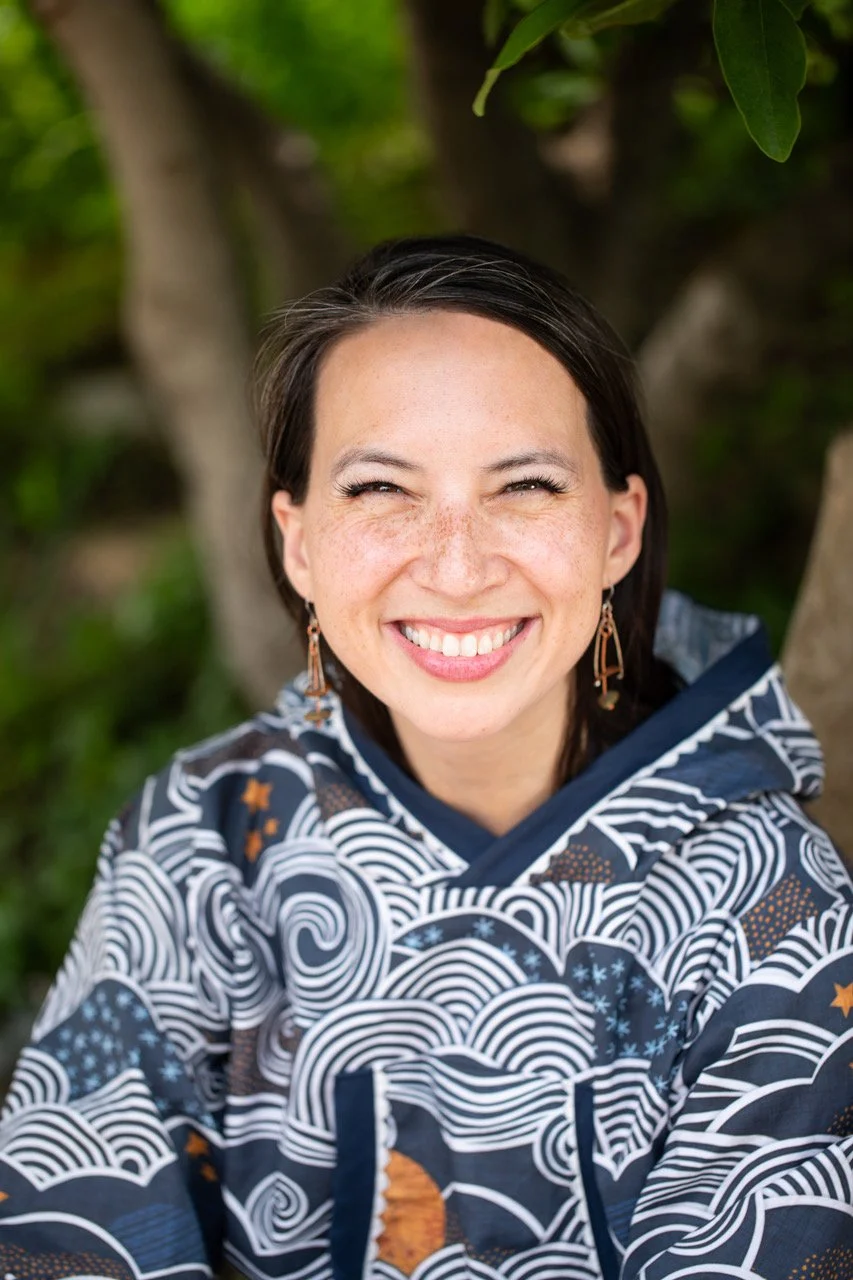
Interview with Annie Wenstrup, author of “The Museum of Unnatural Histories.”
By Rey M. Rodríguez
The creativity and imagination needed to create The Museum of Unnatural Histories (Wesleyan University Press) could only come from the mind of a poet who has experienced the world through Indigenous eyes and who is demanding that we reimagine it so that it includes all histories with dignity and respect. When Annie Wenstrup agreed to be interviewed by Storyteller’s Corner, we could not be more excited because she brings such brilliance and grace to the craft of poetry. Debra Magpie Earling said it best when she wrote, “There is a grace beyond musicality in these poems, beyond dance, beyond earthly substance. . . The Museum of Unnatural Histories is nothing short of a wonder bridge to the other side. Be still. Listen.”
Annie Wenstrup is the author of The Museum of Unnatural Histories and the recipient of a 2025 Whiting Award in poetry. She held a Museum Sovereignty Fellowship with the Alaska Office of the Smithsonian Arctic Studies Center, supported through a Journey to What Matters grant from the CIRI Foundation, and was an Indigenous Nations Poets Fellow in 2022 and 2023. Her poems have been published in Alaska Quarterly Review, the New England Review,Poetry, and elsewhere.
We hope that you will be still and listen to this interview, where we discuss her writing career, craft, museums (how they get it wrong and how they should strive to get it better), and the meaning of poetry, among many other topics.
Annie Wenstrup, welcome to Storyteller’s Corner at Chapter House, the literary journal for the Institute of American Indian Arts. We’re honored to have you here.
Thank you so much, Rey. It’s really good to see you again. I’m grateful to be here.
How did you come to writing? And if you could, tell us a bit about yourself.
I always wanted to be a writer. That part feels very clear to me now, even if it didn’t feel actionable for a long time. As a kid, I wrote constantly—stories, fragments, things that felt important even if I didn’t yet have language for why.
But as I got older, I developed this idea that writing required a kind of ideal condition—time, quiet, permission. And I kept postponing it. I would tell myself: I’ll write when things settle down. Which is funny, because there was a period in my life when I was working at a bookstore, didn’t have children yet, and had very few responsibilities—and even then, I believed I didn’t have enough time.
Looking back, I think what I was really waiting for wasn’t time, but permission. Permission to take my own desire seriously.
Soon after, I had my second child. I took a creative writing workshop with Peggy Shumaker and Jeanne E. Clark, and they let me bring my newborn daughter with me. I remember sitting in that room, and people were passing her around in a circle so I could write. That act of being held in community was transformative. The care I experienced felt like permission to bring my whole self into writing.
There was also a moment in that workshop that I return to often. We were doing a close reading of a poem, and we were short one copy, so I ended up with the instructor’s annotated version. She had circled verbs, drawn arrows between them, underlined phrases, and connected ideas across the page. It was like seeing the internal wiring of a poem made visible.
And I remember thinking: that’s the shape of a feeling on the page. That’s what I want to learn how to do—not just express something, but structure it, give it form, make it move.
Up until then, I thought I was going to be a prose writer. I loved reading poetry, but I didn’t understand what made something a poem. Seeing those annotations changed my perception of what a poem could be, and I wanted to learn more about the engine that powered the poem.
That moment feels so pivotal—the recognition of form as something alive, something that can carry feeling. What happened after that? Did you decide to pursue writing more formally?
I did! First, I went back to school to complete my bachelor’s degree. It was a complicated experience. Because of health problems, I hadn’t completed high school. I carried a lot of shame about it. When I first returned to school, I spent a lot of time feeling like a fraud.
But I wanted to write a book, and to write the kind of book I wanted to write, I needed to go to school. At the time, I thought I just needed the creative writing classes, but the truth is, the art and science classes I took were just as important to the book’s creation as the writing classes.
After I graduated from the University of Alaska Fairbanks, I was accepted into the Stonecoast MFA program—the low-residency program at the University of Southern Maine. I started in 2020, which meant that most of my experience took place over Zoom. It was a difficult time; there was so much uncertainty and isolation. And yet, within that, I had a cohort that was deeply committed and connected. Working with them pushed me to practice vulnerability and to take risks in my writing.
At the same time, my son was learning to write. We’d work on our assignments while sitting at the table together. He would look over and say, “You wrote three lines? That’s a lot. Good job.” It was such a gentle reframing of success.
The trick to being a student or writer is so mundane it’s painful. It’s showing up for the work and for yourself, even (especially) when it’s uncomfortable.
And during that time, you were working on what would become The Museum of Unnatural Histories?
Yes. The first version of the manuscript was my thesis. But it was very different from the book that eventually emerged.
After I graduated, I had the opportunity to meet my cohort in person for the first time. We went to Maine for the graduation ceremony. Afterward, one of my mentors, Katherine Larson, had lunch with me.
She told me she was proud of me and that completing the program was an achievement. And then she said, “Your thesis isn’t your book.”
I was devastated! I’d worked so hard just to get to that point—to reach the minimum page count, to assemble something that felt coherent. To hear that it wasn’t a book was heartbreaking.
But she was right.
I put the manuscript away for about six months. I needed distance, and I needed to grieve the gap between what I made and what I wanted to create. After six months, I finally heard and processed the rest of what Katherine had said during lunch: “You only get one first book,” and “I think you have more in you.” At first, I’d only heard the critique; I hadn’t heard her confidence that the project was worth investing more of myself in.
When I returned to the manuscript, I could see what she’d seen. The ideas were there, but they weren’t fully developed. I needed to strengthen the manuscript’s structure while pushing the language and imagery into a more expansive space.
I spent the next two years revising the manuscript. That period taught me so much—both about craft, but also about process.
Let’s talk about the title—The Museum of Unnatural Histories. It suggests a curated space, one that is ordered, selective, perhaps even deceptive. What kind of museum are you building in this collection?
The title came first, which is unusual for me. I was thankful it arrived early on because it gave me a framework that generated poem prompts.
A museum is a space of authority. It tells you what matters. It tells you how to look. It creates relationships between objects and narratives.
I became interested in that authority—particularly in the gaze that underlies it. The gaze that decides what is worth preserving, what is worth displaying, and how it is interpreted.
For me, that gaze is often shaped by whiteness. I don’t mean that in a reductive way—I mean it as a system, a structure of power that informs how we see and understand the world. My understanding of the gaze (and the whole book) is indebted to Tema Okun’s work on White Supremacy Culture, which details how whiteness is a system of values that elevates adherents while subjugating those outside its system.
Okun’s work encouraged me to explore how I’ve experienced that gaze. It helped me understand that I’ve internalized it and used it to evaluate myself.
The museum became a space where I could interrogate that—where I could examine how that gaze operates, how it objectifies, and how it categorizes what it lands on.
Because objects are often stand-ins for bodies, they became a useful entry point. They carry meaning, but they are also acted upon. In a museum space, they are placed, labeled, and contextualized.
Each poem became a kind of exhibit—a discrete moment of inquiry about an aspect of white supremacy culture. From there, the project radiated outward into exploring alternatives to the white gaze.
So the museum isn’t neutral—it’s inherently political.
Absolutely. The act of curation is political. It involves choices—what to include, what to exclude, how to frame what’s presented.
I kept returning to an experience I had at the National Museum of the American Indian in Washington, D.C. It’s a complicated space. There’s a lot of Indigenous leadership and intention behind it. But there were also moments where I felt a disconnect between representation and engagement.
There were displays that reproduced images—like the “Crying Indian” or scenes from Pocahontas—without fully interrogating them. And then there were statements that felt jarring in their framing.
At one point, I encountered a wall text that read: “Pocahontas didn’t save John Smith. She saved America.”
And I remember thinking—what is this doing?
What is being reinforced here? What is being left unexamined?
And then I saw how people were interacting with the exhibit. I saw a teenager mimicking what he had seen on screen—performing a caricature of Indigeneity. It became clear that the museum had not provided the tools necessary for critical engagement.
That failure stayed with me.
It made me think about how museums juggle multiple demands—both to present information, and to create spaces where visitors are invited into deeper forms of understanding.
One of the things that really struck me as I moved through the collection was the presence of space—asteroids, deep time, this sense of movement across billions of years. There’s almost an element of Indigenous futurism at work. Was that intentional?
I love that you read it that way, because it became intentional over time, even if it didn’t begin that way.
At first, the presence of space came out of something almost accidental—or maybe resistant. I was working through a set of poems that felt heavy to me. They were grounded in trauma, history, in the weight of the museum itself. I remember feeling overwhelmed by the project’s tone.
I complained to my friend Lauren Camp, “I don’t want to be in this museum anymore.” It felt like a place that was too serious and full of grief.
And she asked me: If you don’t want to be in your museum, why would anyone else want to visit? What are you going to do to bring joy or hope into that space?
At first, I was offended. I am a very serious writer after all. And I’m a little immature, so I passive-aggressively wrote a poem that I thought would prove to Lauren that suffering through the museum was the point, that anything lighthearted would detract from the work’s larger goals. I decided to write about the most non-poetic subject I could think of, StarTrek. Fortunately, Lauren was right, and I was wrong.
The StarTrek poems became an extension of the book’s concerns, but they didn’t feel heavy to work on. Part of it was personal—I grew up watching Star Trek: Voyager with my family. It was something we did together, something that felt expansive and imaginative. It offered an escape, but also a way of thinking about identity, belonging, and displacement.
The more I engaged with that world, the more the work opened to questions about the relationship between time, place, and identity—especially when I used the character Chakotay as a focal point for exploration.
What I love about sci-fi narratives is that they destabilize linear narratives. They work across scales—billions of years, cosmic movement, the formation and dissolution of worlds.
In turn, that opens up a different way of thinking about Indigenous identity—not as something fixed in the past, but as something that exists across time and into the future.
That thread throughout the book became a form of Indigenous futurism as well as a way of pushing back against the museum’s tendency to locate Indigenous people only in history.
That feels so crucial—the refusal to be archived, to be fixed in the past.
Exactly.
One of my biggest concerns with the museum as a metaphor was that it might replicate that dynamic—the idea that Indigenous people belong to history, that they are objects of study rather than participants in the present or the future.
And that’s something we see repeatedly—in museums, in textbooks, in popular culture.
I wanted to disrupt that and create a sense of temporal movement—past, present, future, all interacting with one another—I wanted to suggest that the poems participate in scales that exceed the boundaries of museum and narrative.
I want to talk about the dioramas. Because I found them fascinating—and honestly, a little funny in a way that felt intentional.
There’s something about those empty spaces, those withheld images, that invites the reader in. I found myself wanting to draw inside them, to imagine what should be there.
And at the same time, I felt like there was an underlying critique—almost an anger—about how dioramas traditionally represent Indigenous life.
That’s a really generous reading, and I think it gets at what I was trying to do.
Dioramas are such a specific form of representation. They create these contained, miniature worlds that are meant to stand in for something larger—something living.
But they’re inherently limited. They freeze time and simplify complexity. They present a version of reality that is mediated and curated.
I was interested in what would happen if I removed the image.
What happens to the structure—the frame of the diorama remains while the content is withheld?
On one level, it creates space for the reader. It invites participation. It says: you can enter here, you can imagine, you can engage with this rectangle. It also draws a line. I won’t provide this image for you. I won’t reproduce images that have objectified Indigenous people.
The dioramas are interested in highlighting a structure where colonization has taken stories, images, and artifacts for settler benefit. Instead of offering images to define Indigeneity, they point back to defining characteristics of whiteness. In that, withholding becomes a way of reasserting agency.
That makes me think about the figure of the curator in the book. It feels like there’s a presence moving through the museum—a consciousness that is both guiding and questioning.
Yes, the curator became an important figure for me.
At first, I didn’t think of the poems as being connected through a single speaker. But over time, I realized that there was a through-line—a perspective that was moving through the space, encountering different objects, asking different questions.
The curator is not neutral; they are part of the system they’re working within, and they’re also capable of questioning it. I was interested in that tension.
What happens when the person responsible for organizing and presenting the museum begins to doubt the framework itself? What happens when they start to see the limitations of the system they’re operating within?
The dioramas, the footnotes, the shifts in form—those are all moments where the curator is experimenting. with new ways of presenting and engaging with images.
Let’s talk about “My Heart is a Rube Goldberg Machine.” I loved that poem. And I’ll admit—I didn’t even know what a Rube Goldberg machine was until I read it.
But once I did, everything clicked. The form, the movement, the logic—it all made sense in this beautifully intricate way.
That poem came out of an exercise that I still use regularly.
The prompt is simple: you take an object and do a sensory inventory. What does it look like? What does it smell like? What does it feel like?
At first, the responses are literal.
But as you work through the exercise, the connective tissue between associations loosens and moves laterally. I think that’s where the figurative language and imagery moves in, when charting the sensory overlap between images and ideas.
The Rube Goldberg machine became a way of thinking about the body—specifically the heart—as something that operates through a series of interconnected, sometimes overly complex processes. That felt right to me because emotions often work that way.
They’re not linear or direct, they move through unexpected pathways, and the form of the poem became a reflection of that. Each line leads to another, which leads to another—like the chain reaction of a Rube Goldberg machine. The heart not just an anatomical object, but an experiential one.
Your work often exists at this threshold—between the familiar and the strange, the natural and the unnatural.
What draws you to that space?
I think part of it comes from thinking about climate change, honestly.
When I was working on the early drafts of the book (and still now) entire communities in Alaska are being forced to relocate because of anthropomorphic climate change. Not all the consequences of climate change are as dramatic as a literal uprooting, but they’re still heavy. My great-grandfather’s hunting grounds are now underwater. Alaska’s fisheries are devastated.
I had a literal sense of disorientation because the world I thought I understood was upended. It felt unfamiliar, even uncanny.
And I think that tension, as well as the question of perspective, found its way into the work. The definition of “natural” is shaped by cultural frameworks. The problem is that those frameworks often obscure how human actions affect the more-than-human world. For example, when we talk about natural disasters, we focus on discrete moments in time, what the more-than-human world’s conditions were like during an evening or a season. In doing so, we ignore the relationship between humans and the world. We focus on the flood, not the conditions that led to the flood, or the federal policies that led to a village being built in a flood zone. It’s a framework that allows us to evade culpability for suffering and harm.
I hope that when I’m writing, those frameworks are disrupted, that the familiar becomes strange. I’m interested in dismantling those frameworks because the unfamiliar and strange demand a re-evaluation of how we encounter the world.
As I sit with your work, what stays with me is this sense of openness. You’re not trying to resolve things—you’re trying to hold them.
Thank you, I sure hope so! I would like to be a writer who is less interested in answers than in questions. I want to work in spaces governed by multiplicity and contradiction.
I think poetry is uniquely suited to that; it allows for ambiguity, for multiplicity.
It holds space for silence that isn’t absence.
Rey M. Rodríguez is a writer, advocate, and attorney. He lives in Pasadena, California. He is working on a novel set in Mexico City. His poetry collection, Todos Somos Sagrados/All Are Sacred (El Martillo Press), released in May 2026. He has attended the Yale Writers' Workshop multiple times and the Palabras de Pueblo workshop once. He participated in Story Studio's Novel in a Year Program. He is a second-year MFA student in fiction at the Institute of American Indian Arts. His poetry is published in Huizache, Anger is a Gift, and Altadena Poetry Review. His other interviews and book reviews can be found at La Bloga, Chapter House's Storyteller’s Corner, Full Stop, Pleiades Magazine, and the Los Angeles Review. He is a graduate of Cornell, Princeton, and U.C. Berkeley Law School.