Exclusive Interview with Raquel Gutiérrez, author of “Southwest Reconstruction”
By Rey M. Rodríguez
Raquel Gutiérrez is a poet, essayist, performer, faculty mentor at the Institute of American Indian Arts, and the author of Brown Neon: Essays (Coffee House Press). Their book was named as one of the best books of 2022 by The New Yorker and listed in The Best Art Books of 2022 by Hyperallergic. Brown Neon was a 2023 Finalist for the Lambda Literary Prize for Best Lesbian Biography/Memoir, a 2023 Finalist for the Community of Literary Magazines and Presses' Firework Award in Creative Nonfiction and Recipient of The Publishing Triangle Judy Grahn Award for Lesbian Nonfiction. They are a 2025 recipient of the United States Artist Fellowship and the Foundation for Contemporary Arts Fellowship in Poetry. Their first poetry collection, Southwest Reconstruction, was published December 2, 2025 by Noemi Press.
Raquel Gutiérrez, welcome to Storyteller's Corner of Chapter House, the literary journal for the Institute of American Indian Arts.
It's a pleasure to be here, Rey.
How did you get into writing, and why do you write?
I love books. Growing up, I would go to the book section of the toy department at the old Sears on Olympic and Soto. I gravitated to the little golden books. My mom started taking us [my sister and I] to the library in Huntington Park. In Bell. We had great libraries in Southeast Los Angeles. And so, I just loved narrative, I loved watching television, because it was a cool window into worlds.
I went to Catholic school in Maywood, California, also in Southeast Los Angeles. I didn't know that I had an aptitude for writing until 5th grade in Catholic school. There was an essay contest, and it was something very specific to Catholicism and the Catholic school system, and I don't even remember what the prompt was, but I ended up winning an archdiocese-wide, second-place contest in this essay writing project. It took me by surprise.
I was told that my mom or my dad both had to take me to St. Vibiana's Cathedral in downtown Los Angeles to receive my certificate from Archbishop Roger Mahoney.
And so I was like, whoa, whoa, whoa, what is happening? Everything is going too fast! This feels like a snowball into something I'm not even aware of or familiar with, but essentially, that was the first time, in 5th grade, that I was recognized for my writing. I thought everybody was able to write an essay. Are we not all the same? That experience was my first indication that there was something about my ability to write that I should probably start paying attention to.
I had an aptitude early on for reading. They would send me from kindergarten to go read with the first graders, and then similarly, in 6th, 7th, and 8th, I would go to the next grade up to read with whatever English courses and books we were reading. I was always geared for that. And that introduced me to modes of expressing myself. In Catholic school, you have to write essays for your applications. Children of various immigrant communities attended, like Latino, Asian, Ukrainian, Polish, Korean, Mexicanos, Central Americano, and Cuban folks, and so it was a very mixed school, but it was very working class, and a lot of us were first-generation students.
So then I went to St. Joseph High School in Lakewood, California, all-girl, one gender class, and then I started going to school. That was my first contact with white students, Caucasian girls.
When I was in high school, I was into punk and Riot Grrl. I don't know if you remember Reynaldo Reynoso, who used to do a Spanish-language show on KPFK.
I've heard of him.
His family, I believe, lived close to the Ukrainian Cultural Center on Melrose and Heliotrope, behind Los Angeles City College. And so, the Reynosos had this cultural space called Macondo.
Rey Sr. would do events related to the affinity community network things connected with his public radio show. He was a Spanish-language journalist, and he was great. But then his kids were all into straight-edge punk, and so they would host afternoon punk shows on the weekends, or sometimes in the evenings. That experience was my entry point into the do-it-yourself culture and people expressing themselves through music.
And so, it was analogous to hip-hop and rap. If you weren't an MC, maybe you were a breakdancer. If you weren't a breakdancer, you did graffiti. If you didn't do graffiti, you would be a DJ.
So in punk, if you didn't play in a band, maybe you did zines, or fanzines, or maybe you were more business savvy, and you had your very own independent music label. Vinyl was king back then; this was very pre-Internet. This is the early 90s, sort of the last gasp of analog, centered expression, and I was all about it. I loved cutting with scissors, and pasting with glue, and making fanzines, and expressing myself about whether it was gender equality, or my own dishy, record reviews of bands, or live music reviews. It was a way to sort of express myself and establish myself as an expert.
It was fun, and I was around a lot of people who did fanzines, and there was a lot of trading.
How many zines would you make?
If I were going to a couple of shows that weekend, I would try to leave the Kinko’s with at least 25 copies.
That's awesome.
I would either sell them for two bucks or trade them with other folks. I got into that type of exchange. It was a peer-to-peer exchange of ideas. From there, it just snowballed into more formal pursuits. I took a long time to finish my undergrad because I was working full-time, and I had a couple of jobs in the music industry in Burbank and then in Santa Monica. Those experiences were cool for somebody my age who really loved music. But seeing how the sausage is made helped me see where I didn’t want to be.
Yes.
I didn't have the stomach for it.
But when you're in your early 20s, and you have an office job, you're around musician and producer-type people, it feels like, okay, let me see how long I can hang, because I don't have a paycheck coming with college, and my job is at least kind of interesting, cool, and fun.
Until it was, like, you know, clear to me that I was more interested in, like, you know, I really want to know about Latin American social movements, and I want to know why people are wearing Che Guevara on their t-shirts, or why is a big rock band like Rage Against the Machine putting Che Guevara on their merchandise?
Because I was between two worlds of politically conscious punks and musicians and music industry types, there were many of us–in my friendship circles–who were just getting turned on to ideas by the likes of Eduardo Galeano and Roque Dalton.
I recently interviewed Jason De Leon, and he discussed how punk impacted his identity and his academic work. What was it that you gravitated to in punk? And how did that change you?
I had a problem with authority. Punk introduced me to a way of doing a power analysis.
At the root of its history, young people agitated because of the lack of economic opportunities. Let's go start a punk band and scream our heads off about it! Today, the equivalent is let's start a podcast.
Which is not that different, right? We're in a different digital age, where for podcasts, you need microphones and a soundboard, and many people hire producers to do their podcasts. When I was in high school, I had a 4-track recorder, and I would set it up and play guitar, or set it up on a drum set, and my friends would sing, and we would record ourselves and try to mix the tracks in a four-track recorder.
Otherwise, you're listening to the voice on the left side of your headphone, and the drum track on the right side. It was challenging work, demanding patience, to master your tools.
But it's a way of expressing yourself, the way a graffiti artist wants to see some sense of their own creative artistic legibility, and sometimes that means bombing a wall near their neighborhood.
In that sense, we're all working towards specific signatures in the genres and media.
I appreciate it. That's great. Okay, so you get into Latin American history and identity.
For sure! I graduated in 1994. And on January 1st, 1994, the Zapatistas emerged, and showed themselves to the world after many years of training and education and understanding that this action was going to call forth a whole different set of criteria of consequences. But it was so powerful, and I regret not being one of those college kids that went to Chiapas, you know, I knew so many, so many Chicanos that went down to Chiapas. So many funny stories. I remember this one anarchist bloc from the downtown area.
The rumor was that they had gone to Chiapas to meet with the Zapatistas in a gesture of goodwill and radical fellowship. They killed a cow or a goat to feed the comrades, and the anarchists said no, because they were vegan.
These things were in my orbit as a young adult.
Yes, I was there in 1992. I went to Chiapas de San Cristobal de las Casas, and I guess now you can't go. It's pretty dangerous.
Oh, well, yeah, I feel like, you know, those things are cyclical.
Why do you write?
As a musician, I used to play drums, so I just have syncopation, scansion, and meter in me already, like a little hummingbird in my rib cage. It's already part of my language, sound, and meter.
As a then-younger person, I was taken under the wings of others. I had people who were a bit older than me who were modeling new ways of expressing yourself: writing zines, making music, and creating networks. It was a radical, creative output.
And being in contact with people, and finding your fellow travelers, people who you can talk to who are also similarly curious and disaffected by whatever dominant paradigms that were oppressing people. It was sort of the post-Clinton, pre-Bush era.
I was in a space where all this permission was being given to express myself, and so I did.
And then, once I left the working world and transferred to Cal State Northridge. Cal State Northridge is sort of the Chicano Studies, Central American Studies capital of Southern California. Being in that space also inspired me to pursue my own searches for identity and understand the social and geopolitical implications of U.S. imperialism in Latin America.
A lot of the cultural output from those social movements and revolutionary movements blew my mind. I thought these were the bravest people I have ever encountered on the page. I was introduced to La Nueva Cancion, many of the big 20th-century Central American poets, Ernesto Cardenal, Roque Dalton, and Claribel Alegría.
That was very cool to me, and then reading testimonies like Rigoberta Menchú and Elvia Alvarado out of Honduras. I was being exposed to this interesting genre of nonfiction, of the testimony of getting a direct first-hand account of surviving genocidal violence.
That was very inspiring.
And then meeting folks like my friend Beatriz Cortez, who was my Central American Literature Professor at Cal State Northridge.
And reading and learning about Horacio Castellanos Moya, and Jacinta Escudos, just all these really cool writers that have had their work translated at places like New Directions.
I write because I've just been pulled into a very exciting creative ecosystem in Southern California, and so there are a lot of places to try things out.
All right, so let's get to your book, Southwest Reconstruction. How do you arrive at the book's format, or the formal shape? And what freedoms or constraints did it give you as a poet?
I have been working on it for a little over 10 years. I got into my MFA program in poetry, and so this became an early thesis project, and then I put it in the drawer for several years, after which I re-encountered it. I tried to see this as an opportunity to communicate by way of poetry. What am I interested in communicating? And also, a lot of the themes and images here are emerging in my time in, just living here in Tucson, in southern Arizona, and traveling to the Southwest, through the Southwest, Southern California, Nevada, Arizona, Utah, New Mexico, Texas, and how interesting all of those travels are, and how these travels are tethered to some sort of historical ignition. My historical awareness of these regions became more heightened and I began to interrogate these sites of violence, the sites of labor exploitation, sites of dispossession, and ultimately realizing that the landscape is never really just the landscape. The landscape is often a place that contains these contexts, always and forever.
And so that felt very interesting to me, and in some ways, this book is like a companion piece to Brown Neon, my first publication, a collection of essays.
But I'm not so much concerned with what it means to be a Latino artist, Latinx artist, in the Trump era. It's more just an interrogation through movement. It's a companion piece because we're taking the idea of the road trip, traveling in a car on Interstate 10 and all of the other highways it intersects, and thinking about the infrastructural intimacies that emerge.
I don't get the same sensation anywhere else, the way that I do with a road trip. I'm literally moving through time and place, and that is amazing. Look at the way that those movements lean into the historical pulses that are animating my experience through the Southwest, and all of the changing biomes, and built-in environments, and how each region, section, terrain is already suffused with its own name, cultural identity, and various cultural convergences. How do they show up in places like Deming, New Mexico, or how do they show up in Truth or Consequences, New Mexico, or Bowie, Arizona, or El Paso?
So, the book is structured as an experience of leaving, an experience of entering, an experience of ascending, and trying to think through those established motifs, but they're sort of the motifs that I'm interested in considering when thinking about movement as a poetic, metaphorical thread that brings a story of becoming together.
And so, many of the poems are almost constructed through repetition, fragments, and return. How do you think about structure when you're writing a poem? And, how do you engage in history and landscape?
I've tried very hard to refine the book in such a way that the image and the line can stand alone.
And so, in a series of repetition of the image and the line, ultimately creating a larger picture, a panorama. I do a lot of research, arriving at a range of salient histories of the region, and trying to inform myself so much in that sense. I do enough research until I feel my intuition is informed. I read enough of it to feel like, oh, okay, so this is now living inside me, and feeling like I can tune into these historical events. Do you remember Phantom Sightings? You know that exhibition, Phantom Sightings?
And how the internal premise for that show was essentially the way that these histories and identities are projected as a phantom.
In that sense, we know that they're in the room with us, and it's the artist's job to find the forms for this content to fill.
Similarly, I called them ancestral seizures. To be seized by some sort of ancestral link. And it's all divining and divinatory, because I don't have access to these histories, these internal personal histories, just because of the way that immigrant trajectories include what we are leaving behind. What we're leaving behind is often the record of our existences. But I wanted to do a little more speculative, detective work, and think of the way that histories of settler colonialism and indigeneity, and state-making out of frontiers, making the state…the Mexican state…the U.S. state out of these frontiers that demand all kinds of dispossession, enslavement, and extermination campaigns to exist.
And feeling like traveling through these locales in the Southwest, it just made clear that these histories aren't really that far away. There may be seven generations for some people, fourteen generations for some people. But we're never too far away from this historical memory of violence.
And then how do you balance precision of language with the emotional weight of the histories that you're working with?
Yes, there is a certain technical move in that balance. I'm not counting syllables when I write, but I definitely do have a background in drumming, and I will do a 1-2 beat, or a 2-3, or a 3-2, and so in the sense that beat counting helps me figure out how the meters are to be directed.
Also, word choices are super important. I feel like in southern Arizona, we have a lot of flash floods. And so, you need something to forward the harsh currents. And so I feel like “ford” as a verb is great. So I write, “this desert forded love.”
So, in the sense, it is about landing on the right word, landing on the right language. Landing on the right image.
Is there a poem where you felt like, oh, I got it?
Yeah, there are a lot of poems that I'm happy with, and there are some poems that I feel I achieved what my friend Jared Stanley calls “stronking.” These poems are atonal in the way that reminds me of my favorite parts of free jazz.
But the more you stay with free jazz, the more it finally gets you back on the rhythm, in the sense that sometimes it's why free jazz is satisfying. You're listening to all of the polyrhythms that converge, overlap, and collide, but then eventually it will crosshatch in a really satisfying way. And so, I feel like that informed my stronking. So I think my second poem feels a little stronking in that way.
Cool. And does it have a beat that you have talked about?
Let's read from my copy.
So if I said,
“And You Wanted to Show Me the Mexico of Slauson Avenue.
I missed you every day I lived there
I wanted to show you
exactly how
Food For Less
sits on top of
Sleepy Lagoon.
Azteca TV, Chicanx hotspot
pink wi-fi calibration,
a neon green brought
back and forth the border is painted a roof of paisa monstrosity
that's what makes loving me
the rawest material, wood made flesh
and the corrugated metal
that makes our ailing brain dulcet
no longer the barbarity
that comes with insolvency; a credit rating
ready to drop upon me, that when I wake
only to dream again, that you were not fragile this time,
or Slauson Avenue is Mexico, an isle of noise worth waiting for”
Thank you for reading that portion.
So, in a sense, that's a little stronking, imagine Pharaoh Sanders just blowing his nose with his saxophone.
Great.
So the title of the book is Southwest Reconstruction. What does it mean to reconstruct the Southwest?
To reconstruct is to put the self back together, in the sense that there are moments in your life where you are unmoored, and a lot of that time, that unmooring comes from loss and grief. And so, when you're grieving something, it's an opportunity to evaluate and re-evaluate things, and to take inventory of the values that are serving you. What are the values that could use some weeding? Coming to southern Arizona, Tucson, at the beginning of my 40th year was a reckoning.
What does it mean to be taken out of the home context and everything you've ever known? Is there sustainability there in terms of the values, or what are… or how are the values now sort of coming in handy to approach whatever the next set of challenges are?
The challenge was to pursue a creative life, an artistic career, and to learn to be a writer, to lean into that as the core identity.
It also means to interrogate power structures. The book is ultimately a critical inquiry into the intersections between settler colonialism, misogyny, and all sorts of violence that emerge in dispossessing different Indigenous tribal entities, in the name of strengthening and making far and wide the Mexican state.
I grew up in California, and I think we remember the fourth-grade curriculum was on the California mission system and so we, as kids, made them for a 4th grade social studies unit. We studied the mission system, and the sanitized narration of Júnipero Serra’s presence on El Camino Real.
We learned about his divine mission to make missions and the Indigenous enslavement it necessitated in the creation of this system. It was a system that emerged along El Camino Real, which became the 101 freeway. Much like the way that this freeway has become such a huge mercantilistic corridor of the state.
So the Southwest Reconstruction is both personal to you and also more of a metaphor for the area. Is that fair to say?
For sure.
Okay, and then… How do colonial borders, political, linguistic, and psychic, shape the poems in your collection?
I am thinking of the long-running presence of the Spanish, even the Portuguese colonial presence in the Southwest. I think about parts of New Mexico, northern New Mexico, where there's a continuous thread from the 1700s of Spanish presence and all the violence. The way that the violence from that colonial encounter continued to reverberate, and the way that people today are struggling with addiction and other forms of social death and marginalization making it difficult to disrupt and break these violent cycles.
And so, I wrote an essay recently for the Harwood Museum in Taos, New Mexico, on an exhibition that's coming up in the summer there on Adobe and earthen architecture.
We did a research tour through Taos in northern New Mexico and parts of southern Colorado, and it was amazing just to see the diversity of historical Adobe architecture in that region of these two states.
When we were learning about the sort of historical context that contained these structures, or these structures were built in relation to, there's a lot of cornerstone narrative that is essentially the story of the Genízaro, the tribalized indigenous person who essentially was trafficked into the Spanish Hacienda system.
The spectrum of enslavement, whether it was just indentured servitude or paid domestic and physical labor.
And then, how in this event of the Genízaro, often the trafficked Navajo person, who becomes central to the story of many Hispano or Chicana/o/x families that feature a grandmother or great-grandmother, who was often Diné, for example. And it's because Indigenous people were stolen, essentially, and absorbed into a system that needs to be interrogated as well as our role–as Latinos–as mestizo settlers.
That is so powerful.
How did you decide when a poem should resist coherence or closure as a political or ethical choice?
Well, I think it's also an aesthetic choice, in the sense that it just sounds cool. Oh, that's an interesting image. Oh, that's a series of interesting associative leaps, between some present A-B conversation and then the ghosts of history that emerge in the ethers of relationality.
So, in the sense, whatever I'm resisting in terms of coherence or incoherence, I feel like that people want to trust themselves when they're reading something that feels a little more experimental, and that readers should give themselves more credit. You get it. You understand what I'm saying.
Maybe it's just in staccato outbursts, maybe it's in just a different rhythm, but that the images are always about some sort of haunting taking place.
And so, in working with erased or marginalized histories, what responsibilities do you feel as a poet?
And where do you allow yourself to take risks?
The risk is actually in assuming the forms that I take in trying to narrate some of these poems.
I wouldn't say they're obscure histories, but I would say they're histories that one has to dig a little to find. The responsibility is just to be as thorough a researcher as I can be, but also balancing that out the historic with my poetic creative intuition.
And at the same time, not privileging one over the other.
I felt very excited to write my notes on the text. This is what was animating my thinking when I was putting this thing together, or here's a little more context to offer the reader, so in case you're wondering who Eskiminzin was, and what part of the Apache tribe he led. This is his story here, and it is so interesting and powerful. It is just one of those vexing dynamics of relation… relationality, in the sense, like that that's a poem, Us vs. Us, that kind of calls in Eskiminzin killing his friend, who was, like, a high-ranked member of the army.
And they had mutual respect. They were friends. So a big massacre happens, and Eskiminzin essentially has to show his tribal followers that I'm here for you, so I'm going to kill my friend, so you know that I'm here for you.
Anyone can kill their enemy, but it takes a strong man to kill their friend.
Mmm.
And, thinking about the way it leaves that imprint. It's all horrifying. It's all haunting, it's all terrifying.
If I'm reading about Latin American solidarity movements, and revolutionary movements, and the Civil War, and the fierce Sandinista women, and the fierce FMLN, women soldiers, and all these things, like, I'm also just kind of like, oh, these people were absolutely risking their lives for change.
So, you know, thinking about the way that people risk their lives for change, just is echoing and reverberating in my head now about everything here now? In that sense, we're in a dire situation, the most dire situation we've been in our lifetimes.
Definitely.
And how do you imagine your reader for Southwest Reconstruction? Are you writing towards a community, or against a dominant narrative, or into a silence?
I'm writing the book I want to see. I'm writing the book that feels like I'm just transmitting messages from my research and ancestral antennas.
They seem a little Morse code-ish.
But they're also, again, trying to isolate the image, and also write about artists and other sorts of aspects of a creative ecosystem that has raised me. But am I writing for the community? Yeah, I feel like there are a lot of poems in this collection that speak to my own sort of biographical upbringing, especially the poems that call in “The University of El Camino Real” and “Gestational Emissions on Sunset Blvd.”
They talk about how I was raised in California.
There's a lot of biographical stuff in there, too.
That feels like an offer to the community to come and connect with. And are there writers, artists, or thinkers who are from the Southwest who helped shape the book?
I really loved everyone who blurbed my book. They were essentially lights in the dark for me, like Brandon Som, Jennifer Forrester, and Nathan Osorio. Brandon Som's last few collections, especially Tripas is incredible. It told such a beautiful, specific narrative about fiber optics, communication, and growing up in a Chinese-Mexican family in a West Phoenix barrio.
Of course, Roberto Tejada's been a guiding light for me.
Bojan Louis has been an incredible source of inspiration.
And then folks like Mike Davis and Wanda Coleman. Los Angeles has definitely been a good literary education.
What did the book teach you about poetry that you didn't know before?
I always feel like I learned that the book is essentially always improvisational and that you're always improvising the line.
And then, has the book changed you, how you think about poetry? Like, what it can do politically, spiritually, or communally?
Yes, we had Renée Nicole Macklin Good pass, and then we learned that she was a poet. Or, Andrea Gibson's passing away, and offering us these lessons on what it is to live a full life.
And to strive for the world that we want. We really have to work to call it in.
So I think of poetry as a language is a way to imagine a better, safer, saner, more respectful way of being with one another.
Poetry is ultimately the language of humanity. It is the language of humanizing ourselves back to each other.
What is poetry to you?
Poetry is song. Poetry is a lyrical gesture. Poetry is also a thumbnail lesson in being a better member, friend, partner, or comrade.
I love it.
And what questions are you carrying into your next project that you feel unresolved in this book?
Well, I mean, it's hard because of the poetry project, and even my nonfiction essay projects.
I think I am at an impasse with both genres, so I've been working on a screenplay. So I've just been doing some screenwriting and kind of trying to track my parents' immigration trajectory from the 70s, 80s, 90s, and have it feel like it's going to be more impressionistic and image-oriented, versus dialogue-heavy. But, in the sense, like, that's what's calling me right now.
But in terms of poetry, it hasn't emerged yet, and that is a familiar feeling for me. It happens when it happens to me.
After the essay, after Brown Neon, I'm like, okay, let me pivot into some poems, or some art criticism. Now, with the poetry collection, I'm like, alright, let me pivot back into some memoir and some screenplay.
Thank you, Raquel, for this wide-ranging, exclusive interview. I am so honored that you decided to offer this interview to the Storyteller’s Corner of Chapter House.
Rey M. Rodríguez is a writer, advocate, and attorney. He lives in Pasadena, California. He is working on a novel set in Mexico City. His poetry collection, Todos Somos Sagrados/All Are Sacred (El Martillo Press), will debut in May 2026. He has attended the Yale Writers' Workshop multiple times and the Palabras de Pueblo workshop once. He participated in Story Studio's Novel in a Year Program. He is a second-year fiction writing MFA student at the Institute of American Indian Arts. His poetry is published in Huizache. His other interviews and book reviews can be found at La Bloga, Chapter House's Storyteller’s Corner, Full Stop, Pleiades Magazine, and the Los Angeles Review. He is a graduate of Cornell, Princeton, and U.C. Berkeley Law School.
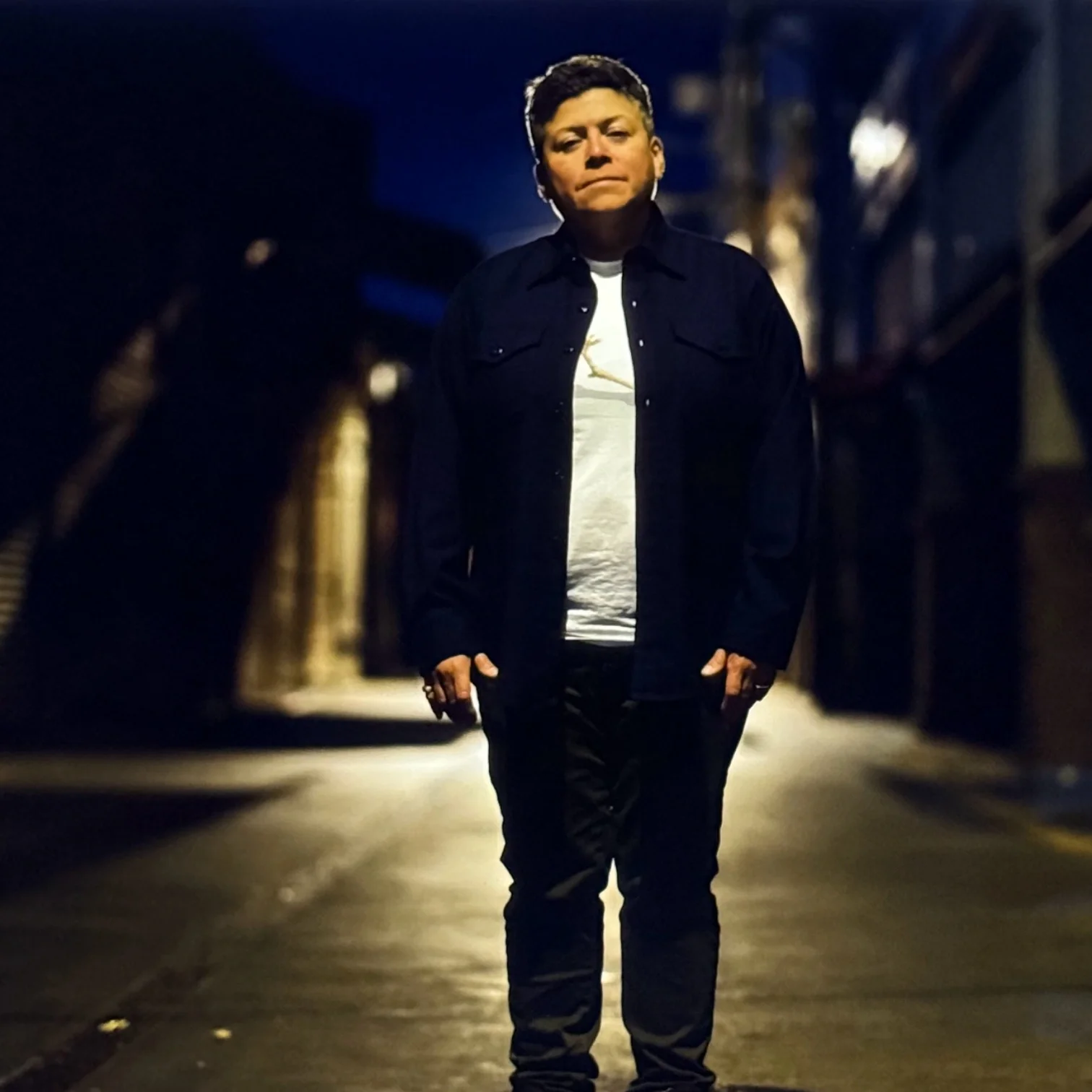
Photo by Reynaldo Rivera