Interview with José Olivarez, author of “Promises of Gold.”
By Rey M. Rodríguez
José Olivarez, born and raised in the Mexican and Mexican American neighborhoods of Calumet City, Illinois, has emerged as one of the most distinctive voices of a new generation of Chicano and Latino poets whose work insists that poetry speak not only to the page but to the lived realities of community.
Olivarez first came to national attention with his celebrated debut collection, Citizen Illegal, a book that moves fluidly between satire, memory, and cultural critique to explore the complexities of immigration, assimilation, and the everyday poetry of working-class Mexican American life. In his newest collection, Promises of Gold, Olivarez turns his attention to the need for love, and its found expression in unexpected places.
In Promises of Gold, Olivarez writes with a voice that is at once playful and profound, moving between the intimate space of the family home and the broader economic structures that shape our lives. The collection asks urgent questions: What do we inherit from our parents besides language and memory? How do we express love? And how do we imagine abundance in a world that often denies it to us?
Like much of the most powerful contemporary Chicano and Latino writing, Olivarez’s work expands the boundaries of what poetry can do. His poems are grounded in neighborhood, culture, and family, yet they reach toward universal questions about value, dignity, and kinship.
In this conversation, we speak with José Olivarez about Promises of Gold, the poetry of working-class life, Chicago and its role in his poetry, the power of poetry to transcend, and the ways humor, tenderness, and love allow poetry to transform even the hardest stories into something luminous.
José Olivarez, welcome to Storyteller's Corner of Chapter House, the literary journal for the Institute of American Indian Arts in Santa Fe, New Mexico.
Thank you for having me. I'm doing great. I'm happy to be here.
Tell me about your writer's journey. How did you get into writing, and why do you write?
Before I started writing, I was a super quiet, nerdy kid who loved reading. But I didn't know that people like me could become writers. Both of my parents were undocumented when they immigrated to the United States. English was not my first language. Spanish was my first language. My parents taught us to keep our heads down, try not to draw too much attention to ourselves, and do our best.
The city that I grew up in, Calumet City, Illinois, a south suburb of Chicago, was an industrial city. Steel mills were the primary job supplier. So, I didn't read a lot of books that were about workers. The books that I read all took place in England, or they dealt with royalty. The characters were either from the very faraway past, or they were from wealthy places that I couldn't imagine. So, I never dreamed of being a writer, and then in high school, I got to go to a performance from our high school poetry slam team.
I was totally blown away.
The poems that my classmates read were about sex. They were about politics. They were about our neighborhoods. It was the first time that it occurred to me, like, oh, you can make art out of our neighborhood, out of our people, and out of our stories. And so I decided to sign up and see what it was about, and it totally transformed my life. And so that was the beginning for me.
Tell me about your working-class neighborhood and sensibility. You do it in your poetry, but how would you describe it?
In retrospect, things become a lot easier to understand than in the moment. Growing up, I didn't have any real understanding of what it meant to be working class, because the whole city was working class. The people that we thought were well off were people who could afford new-ish sneakers. Not even the new sneakers. I grew up going to flea markets and getting knock-off Filas and knock-off Adidas. If you had real, authentic Jordans, you were doing okay. Or if you had the latest video game console, you were good. Growing up, we always had the old ones. When the Super Nintendo was out, we were just getting the Nintendo, so that's the way it was.
But people in Calumet City, they worked in steel mills. My dad worked in a steel mill. My mom was a janitor growing up. Before that, she worked in a sock factory. She worked at McDonald's for a time, so you hustled and found a job wherever you could.
One of the things that I think about is when I didn't know that we were not rich. When you grow up in a community like that, people look out for each other. Before school started, the Catholic Church in our city was St. Victor's. They would always have a school supply drive, and so we would get pens and pencils and the things that we needed for school. My parents always found a way to make things stretch and figure it out, and look out for each other. When my mom started working, I remember we would come home from school, and she would still be at work, so we went to this lady's house in our community, and she watched not just us, but she watched a whole host of kids from the neighborhood. All the kids whose moms were at work, and whose parents were at work, she watched all the neighborhood kids.
You just figured it out. It wasn't until undergrad that I went to Harvard University, and that's when I started to understand, like, oh…there are levels to wealth. I met one of my classmates, and we had a class together. We would study from time to time.
And I asked her if she wanted to study one time, and she was like, I can't, because I'm going to Florida. She was like, I don't do the winter. I'm going to Florida every weekend. She just had money to go down to Florida every single weekend, whenever she got done with classes.
That's when I started to understand, like, there are levels to money and wealth, and it's not just about whether you are eating Lunchables or are you eating these brand Lunchables? There's much more money in the world than just those decisions.
How did it come to be that you applied to Harvard? Many in our communities won't even think about doing that, and yet many in our community should be applying. I came from a small town in Colorado, and I got a slip in the mail, and it said, hey, apply to Cornell. And I applied, and that's how I got in. Otherwise, I would have never even thought of it.
That's an incredible story. I wonder if more people in our communities should be applying to Harvard or not, I don't know.
That's true. I agree with you. I guess my thing is just aspiring to higher levels of education, but you're right, I hear you. That's a very complicated question. There's a lot of trauma that can happen from that decision. But if we don't have our own institutions, then we're going to have to try to get into these other places, because they do open doors in a certain way, but I hear you.
Absolutely, I mean, for me, it has definitely helped me out in my life to have a degree from Harvard University, and so that part is very true.
What going there made me realize is the power of having our own institutions. When I would go back home, and they'd ask me, like, oh, how is it? Is everybody there a genius? It's like . . .No, no, not at all.
So many in our communities are as smart or much smarter.
It’s not even that, like, oh, the people back home are smarter, it's just like… It's just people, but they figured out how to make up the rules in such a way that if you have the right circumstances and you go to the right institutions, you learn how to talk the language, and you can get in there, and it gives you this prestige. But I saw people do all sorts of dumb things at Harvard University. It's 18-year-olds at the end of the day; people are not just concerned with chemistry, they're trying to figure out how to make jello shots, you know? Like, they're just 18-year-olds.
But how did I end up there? So when I was going to high school, they had just started launching the Common Application, right? And so you apply to school online, and you just select the schools that you want to apply to, and I had really good grades. I was a straight-A student in high school.
But I went to public schools my whole life. I never thought that I could get into Harvard. I didn't even understand what it was. I never visited before applying. The only time I saw Harvard was in How High, the movie that came out when I was in high school, and so that was, like, okay, that's the school Method Man and Redman went to.
I was applying to schools, and so I wanted to apply to the University of Illinois, the University of Chicago, and Northwestern University. The University of Wisconsin-Madison had a hip-hop arts program that they were launching, so I applied there.
I could just check a box and apply to Harvard, so why not? I was so sure they were going to reject me, I didn't even send in my FAFSA. It was easy. I just click a box, and it's done, and so I did it, and then I ended up getting accepted. Then I had to scramble and send in all of my financial aid information and make sure that I was able to take care of that. And the reason why I thought to check the box was that I had read in Time magazine or something like that, they had just adopted this program where if your family made less than $48,000 a year. If you were under that income threshold, your tuition was waived. And I knew my family was under that threshold, and so I was like, why not? See what happens, and maybe I'll get to go to college for no tuition. And so that's what ended up happening. At the end of the day, it ended up being the cheapest for me as a student.
So let's get into your book. Promises of Gold is a deeply invested book in inheritance, culture, emotion, economics, but you call it a love letter, or that you wanted to prepare these love letters. Tell me about what you mean by that.
I wanted to write a book of love letters or a book of love poems because after my first collection of poems, Citizen Illegal, I visited many schools, colleges, and high schools all over the country.
And there are a few love poems in that book, so I would ask them to make some noise if they're in love, and it'd be silent. And so, it was very curious to me that I would have these events with young people, and they seemed to me reluctant to talk about love, or maybe dismissive about love.
And so I thought it was interesting. Why is that, and what does love mean? And at the same time, it also coincided with all of these big moments in my own life, right? I got engaged while writing Promises of Gold. A few of my best friends from growing up also got engaged and got married during this time.
We were moving on to this next chapter of their lives that is more grounded in traditional nuclear family dynamics. And it's not quite that, because we're still all tight, but the days when we would gather in groups of 20, we're a little bit rarer, right? Because none of us had significant others waiting up for us, or children waiting up for us to come home and do bedtime or whatever.
And so it was a transitional time. And then, of course, the pandemic started as I was writing this book, too, and so I was also nostalgic, and thinking about what it meant to be in close community with people. So all those factors led me to think about writing love letters and love poems specifically for this collection.
I'm curious. Tell me about the title. What does gold mean to you in the context of this book?
So the title, Promises of Gold, was not the original title. The original title was Translating the Heart. And so, again, thinking about love and thinking about what it meant. And Promises of Gold came about, because when we looked at the collection. I worked with two people to structure the collection. One is the poet Nate Marshall, who at the time was a professor at Colorado College, in Colorado Springs. And then one of his students, Yumiko González, who just graduated.
Together, we sat with all the poems that I had written and figured out how to structure the book. And when we looked at the book, we were trying to figure out what the best title was, so we just started picking phrases from the poems. We kept coming to Promises of Gold, and what I liked about it was that I was interested in colonial history; even so many years later, it can continue to show up in small moments, interactions between people, in big moments too, but even in interpersonal moments, right? And so, the idea of gold being rooted in the Spanish colonization of what we now call the Americas, right? North America, South America, and their pursuit of gold, which was aplenty here, but didn't necessarily mean the same things that it meant to the Spanish, right?
And so, the idea of what gold was to them, and then trying to imagine what is gold to me, right? To come back to your question, what does gold mean? And I think it really is, to me, a way to come back to that question of love, and to me, the most valuable parts of my life are my relationships, that's the most meaningful stuff of my life, more than any material good. So, those were the reasons we came back to it. And then promises made sense, because I write about this in the introduction to the book, but a promise doesn't mean that something is going to happen. All it is is somebody's word. They can try to keep it, but at the end of the day, there are no guarantees that they're going to succeed. It was also a way to think about the promise of migration, right? And all of the hopes that my parents, their generation, generations before them put into migration, but also the possibilities that this thing might not actually be what we dreamt it to be, what it was promised to us, that it might actually be different, and that the gold that we seek might also have some other consequences that are not all good.
So, how does Chicago shape the voice and worldview of this collection?
Chicago is how I see the world. It's such a different and unique place, especially for the Chicano community, the Mexican-American community. When people who are not Mexican imagine Mexicans, right? How do they imagine Mexican-Americans? They think about the southern border, and they think about California, right? The reality is that there are strong and big Mexican-American communities all over the United States, right? Kansas City has one, Detroit, Michigan has one. And in Chicago, there is a huge Mexican-American community
So much so that the most common shared ancestry among people in Chicago is Mexico. Mexico is the place that the largest number of people can trace their descendancy towards from Chicago.
It's not Poland, or Ukraine, or…?
No, not anymore. I think maybe at one time… and there are still big Polish populations and big Ukrainian populations. In fact, I think the biggest Polish community outside of Warsaw is still in Chicago, but that is a smaller community by number than the number of Mexican-Americans.
We have our own panaderias. We have our own weekend tradition as a family, which was to get birria, and we had our own birria spot that we would go to.
I would love to eat there.
What it means to be a Mexican-American from Chicago is to be working class. Like, all of these things shape my particular perspective and how it makes my writing distinct in some ways from other writers. Luis Rodríguez was one of the writers whom I look up to. We have our own distinct tradition in Chicago, too, right? Sandra Cisneros is another writer that I adore, and she's from Chicago. It helps to think about how I put together my list of influences. It's rooted in Chicago and some of the traditions that are specific to that city.
Your poems, they feel conversational while doing very precise formal work. How do you balance accessibility and experimentation on the page?
I take pride in that. When I started writing, I was into the poetry slam, and my biggest influences early on were people who were incredibly successful at the slam, right? So, people like Style Williams, and Maida del Valle, and Mums, and these people that I would see on Deaf Poetry, or maybe they would tour in Chicago, and I'd catch them if I was lucky. And so my early poems were imitations of trying to be very dramatic, very loud, not at all conversational, but trying to be like my favorite poetry slam poets. And what I found was that the audience didn't blow anybody away, right?
But when I'm not trying to be hyperpoetic during a show, I learned the audience was more receptive. I could feel their energy coming to me, right? I can feel that. And so I started thinking about how do I craft a poem that feels intimate, but is still rich in imagery and all of the things that I've been taught. Something that feels a little bit more relaxed, that doesn't try to put on this kind of performance that I adored, right? But that felt like a cloak that I couldn't quite put on for myself, right?
And so that's how I started to develop the kind of conversational voice that I think is pretty key to my poems now, while still engaging in different methods of play and experimenting. I'll always try and experiment.
Is there a particular poem in Promises of Gold that gets to the real Jose?
One of the things that feels true to me is that there is not one real Jose, right? But there are more. It doesn't need to be one authentic one, but there are many. Off the top of my head, a poem like “Ode to Tortillas” is one that I'm proud of. I think it does so many of the things that I love about poetry. I think it's at times funny. The narrator in that poem is also a liar. He keeps saying there's one way to do this thing, and then he lists, like, 4 or 5 different ways.
Another poem, “Let's Get Married,” is also successful in capturing the real Jose.
There's a different José in Spanish than there is in English, right?
Yes, well, the poems in Spanish are translated by David Ruano González. I didn't do the translation, so to me, when I read those poems, they almost feel like David's poems. And even though we worked collaboratively to make sure that the language was on point, and I have all these emails where David and I go back and forth, and he's like, do you want this word, or do you want that word? And he would break it down to me sometimes.
This is the most correct translation, but musically, this translation makes more sense poetically, and together, we would always be on the same page. Let's go with the more musical translation, the more poetic translation. So when I read the poems, I feel much more emotional reading the poems in Spanish than I do in English.
Totally, yes. And I think part of it is the difference between the English language and the Spanish language. I think part of it is my relationship to Spanish, as opposed to my relationship with English. English is my language of study; it's the one I have the most formal training in, but Spanish is my very first language. It's still the language that feels most natural to me. To me, as much as I talk English, when I speak English, it feels like there's a rock in my mouth. My jaw gets tired of speaking English. It feels unnatural, in a sense.
And then the other part of it is that because of those two things in part, and maybe part of it being David's translations, it feels like whatever defenses I can put up when I'm writing my own poem and reading my own poem, whatever kind of separation I can do, I cannot put up those defenses in the Spanish translations. I'm reading them as if I'm reading someone else's writing, and so I experience them as if I'm experiencing them for the first time. Even though I know the poems, there's still a way that theyfind a way to surprise me and make me emotional in a way that doesn’t happen in English.
There's a poet, Layli Long Soldier, who's Lakota. She talks about how words are weak vessels for describing emotions. And if you're going to talk about poetry, you have to understand the weakness of the vessel. She will often say that poetry is the feeling one gets looking at a field of grass.
Also, words may have different meanings in different languages.
In Spanish, there's something about one’s connection, maybe to one’s mom or dad, that may not translate into English, because there's a directness to English that may not happen in Spanish.
If you say “tortillas” but anglicize it in any way, it's a horrible thing. It pains the ear.
But if you hear “tortillas” in Spanish, it's a whole other thing.
I wanted to write “Ode to Tortillas” because I felt the opposite, which was that I had never written about tortillas before, and part of it is that it felt too easy, or too on the nose, or too cliché.
So the challenge was, like, Why don't we write about tortillas more?
Yes!
I grew up eating tortillas every day of my life. I've eaten so many tortillas, and I will continue to eat them, so why pretend that it's not the case?
When you left Chicago to head to Boston, the first thing you did was to look for tortillas, right? And you couldn't find them. Or could you?
I could not. In Chicago, I grew up eating El Milagro brand tortillas, and they're very good. When my mom would make tortillas on occasion, and even when we didn't, luckily, we had a local place that would make tortillas. They were always good, even packaged. And I could not figure out what the good brand was in Boston. But the worst, though, was that periodically, the school would serve us tortillas, and they wouldn't even heat the tortillas, like, they would serve us cold tortillas.
It was not great.
That's very painful. I can feel you.
I want to talk about your collection. It offers a tender, complicated portrait of masculinity. What models of masculinity were you writing toward or away from?
When I was young, the way that I tried to plot out my masculinity was going away from the kind of masculinity I was taught by my dad, right? Which was to be very stern, unemotional, and solemn.
When I was 18 or 19, it was just trying to be the anti of that, and so my dad drank, and so I did not drink, and my dad was stern, and so I tried to be talkative and emotional. The problem with writing against something is that it is still very much shaped by the original.
I am now trying to work towards a masculinity that is open-hearted. That is embracing. That is unafraid to be loving. Those are maybe the two foundational pieces: being open-hearted and being open to receiving love.
Not being stubborn, being open to change, and the possibility of change, and being open to the possibility of discovering new facets of the self.
Those are some of the things that I think were important to me when I was sitting down to write Promises of Gold.
How does forgiveness fit in?
Forgiveness is a good one, too.
Part of it was just getting older. Now that I'm 37. I would think about my relationship with my dad, and I would think about where my dad was at when he started to have kids, and I would just think about when I was that age.
The last thing that I wanted to do was be inside of the house, babysitting, or whatever, you know? Like, I wanted to be at the bar with my friends, flirting, doing whatever, right? My dad and my mom couldn't.
They were very quickly closed off from those opportunities. I know on my mom's part that I think she felt called early on to be a mother, and for her, it's the most important thing to her. My dad wanted to aspire to that relationship with himself.
Studying my dad from my position, it was always clear that he liked being a dad just fine, but he also liked being a young man. He liked being the life of the party, having drinks with his buddies, and doing all of that. When I reached that age, and then I passed that age, it was easier to forgive them and be like, I get it. That's also what I wanted to do.
Maybe, all of the ways that my dad wasn't perfect, at the end of the day, he did try to balance those two loves of his, right? Being a party person, wanting to be like a young man, and then also being a father. I write in the poem, whatever it's called, Arrepentimiento, my dad says love.
He always came home, even when he didn't want to come home.
He wanted to stay outside and drink. He always came back to the house. So, I think that made it easier to forgive. And I think forgiveness is an important part of masculinity, too. Both of our parents and other people, but also of ourselves, for the ways that we will fail on occasion to live into our own ideals, right?
Have you read, James Baldwin's definition of what it is to be a man?
I don't know it off the top of my head.
Yes, he was always wrestling, I think, with what it was to be a man, but ultimately, I think it comes on in this idea that to be a man is to be someone who loves.
Mmm.
I guess that's just being human, but it's interesting that the question of what it is to be a man is now being questioned in so many different ways. Your father may have had a specific model of what it was to be a man. A man did X, Y, and Z, and one didn't really question it. But there was also probably this search for liberation. In a sense, because he was probably trapped in this role. And one way of liberating himself was to try to be free, which is what we're all trying to do. Vulnerability feels central to the emotional stakes of these poems.
Was that vulnerability easy to claim, or did it feel risky?
It's both. There is real risk in writing some of the poems, and especially for Promises of Gold, because it was translated into Spanish, so it meant that when I was beginning to write poems, there was comfort that I could take in knowing that, because I write so much about my family, they wouldn't necessarily read those poems, right?
I don't write mean or cruel things about my parents, whatever our relationships are.
I always try to ground those poems in understanding, and in compassion, and then forgiveness.
Because I wouldn't want someone, I think about how I would feel if someone just wrote about me without my permission, really, and without… really… taking into account my own position in the world, or whatever. So I always try to write about them with compassion, but I knew they would be reading these poems.
And so there is definitely a risk in that. And at the same time, when I write the poems, it's not like I'm crying when I'm writing the poems. I have enough distance and enough base to write the poems in a way that it can be precise.
And not just reach, maybe, for, like, the most emotional language. I can try to reach for poetic language, and so it's a little bit of both.
Do you see your poetry as a form of resistance, of witness, or something else entirely?
My relationship to this question is changing in real time. When I was asked this in the past, I said that I didn't want to have my poetry determined by the state, so I didn't just want to be writing reaction pieces to whatever new executive order was published by Donald Trump, right?
Because I didn't want to feel like I was giving him permission to control my writing, my brain, my heart, and my mind in that way.
And that's still true.
But at the same time, I've also been really inspired by reading older poetry, and particularly movement poetry. I've been going back to reading early Nikki Giovanni, Sada Shakur, and Audre Lorde.
I've noticed something that is interesting to me. My own poetry is rooted in personal experience. And there's something that can be very powerful about that, but also something limiting, right? And when I go back and read a poem like “A Litany for Survival” by Audre Lorde, it is written in the collective voice, right?
I am trying to figure out how to write something more collective, something that can be more useful, is what I've been thinking about. So does that mean that I think about my poetry as a poetry of witness, a poetry of resistance?
I don't know those categories, It is less important to me than thinking about trying to write towards a collective poetry, a poetry that might be useful to people in movement work, that might be useful to people who are looking for a way to voice their own frustrations, whatever you want to call that, that's the poetry that I've been writing most recently.
Thank you for that, because it's very easy for people to put people in boxes, for example, you're only a Chicano writer or some other category. I was interviewing Octavio Quintanilla, and everybody should be reading his work. It touches every idea of what it is to be human, and yet…people may not pick it up because he is a poet, and they say to themselves I don’t read poetry. Similar to the case that a reader may not pick up Olivia Butler, because they think she's a science fiction writer. And that was a mistake that I made. I don't really like science fiction.
I feel your poetry is so important, and folks may think because it's written in Spanish that it's not really for them. And it's quite the opposite. What advice do you give emerging writers about writing practice, and why is it important to have one?
There are two pieces of advice that I would give. The most important one is to be a good writer, you need to be a good reader. Reading is the most important part of writing to me. It's how you develop your own sense of aesthetics and what you like and what you don't like.
And then the other piece of advice for me, in terms of any kind of ritual you're going to do.
Ultimately, you have to find out what works for you. Like, I can tell you how my writing routines work for me, but that doesn't mean it's going to work for you. For me, what I've learned over time and practice and it also changes. But I need to be someone who gets my writing done early in the morning, because late at night my brain becomes clouded with everything that happens during the day, all of the emails I need to write, all of that stuff kind of blocks me creatively, so when I'm writing, I write early in the mornings, to the best of my ability.
But everyone has to figure out what works best for them and what's realistic for them.
There have been periods in my life where I've needed accountability partners, or to be part of a writing program, and so you have to figure it out for yourself, because at the end of the day, no one is going to make you. You have to figure out how to make yourself do it and stick to a plan and a ritual.
Why do you write?
I love the process of writing. I love being in conversations with elders and ancestors through writing. I love the puzzle of it, when I'm looking for a particular piece of language, and I'm working with the line, and changing it, and breaking it one place, and then breaking it another. And the moment where it clicks into place is such a rush of euphoria. There's nothing like it. I love all the rituals of it. I love how it helps me see the world. It's brand new again.
Even now, I'm thinking about what you mentioned about Layli Long Soldier. That words are weak vessels and how grass floating in the wind is poetry. It makes me look forward to the next time I'll see that, and I'll think about that, right? So I think of language for all of the ways it can be a weak vessel. There's also something where, when you see something in language, and you're just like, wow, I've never seen that before. It opens up something to the world, and a way of being with the world that is beautiful to me, so those are the reasons why I write, I think to be a part of that, to participate, to stay in community with elders and ancestors that I deeply admire.
I would like to push the question a bit more. Let's say someone said, “I'm going to take away your ability to write.” What would that mean to you?
When I don't write, I devolve, almost. I become so much grumpier. It's like I'm carrying all this extra weight.
Is it a way of healing for you?
I don't know if healing is the right word, because I go to therapy, and I have a therapist, and so for me, that is maybe where the healing happens.
But there is maybe a piece of writing that begins the process of healing, that at least helps me process. It does feel like there's a way, sometimes some of the discomfort in carrying hard emotions.
When you put language to it, and you can figure out exactly what that discomfort is, exactly what about a situation is causing pain, then it feels like you can take it off, right? You named it, you said it, and so even if it's not fixed, at least you have a better, clearer picture of what exactly it is, right?
And so, does that kill you? Not necessarily, but at least you've said it, and at least it's in the world, and at least you can go about moving towards healing, right?
So, if I were taken by an authoritarian regime, and they said, you can't write it would be painful to me, because to your point, I do believe that I must write.
There's a poem written by an American poet, but they're in Italy. And, they're at dinner, and they're having thiscasual conversation like poets do from time to time, and the question is, what is poetry?
And you know, one of the poets…answers very quickly, like, everything is poetry. And, you know, they're cheery and happy for a second. Then, their Italian host is silences them very quickly, and says, I'll tell you what poetry is. And he points to this statue of a man outside wearing an iron mask.
And he says that man was a poet, and his poems were causing riots in the town, and so they put an iron mask on him. To make sure that he couldn't write any more poems, and they burned him that way, and I'll never forgetthe last lines of the poem.
Poetry is everything he wanted to say, but could not.
And so, I think about that when I think about what poetry is, and I think about that when I think about your question about what it would it be to be stripped of writing.
I would feel like the man in that iron mask. I'll send you the poem when we're done talking. I'll look it up real quick.
Oh, please do, because we could include it in the interview.
That's one of my fundamental questions, and it emerged when I interviewed m.s. RedCherries. She's a great teacher and mentor of mine, and she wrote the book, mother. It was shortlisted in poetry for the National Book Award, and then she just won the American Book Award. But she doesn't consider her book poetry. It's just her way of storytelling.
It was called poetry mainly from a capitalistic perspective; it had to be sold in a certain way, so it had to be commodified. But she was rebelling against that notion. It's like, no, I'm just telling my story. And that's… that's how we tell stories.
Which I thought was really profound, so then almost every person I have interviewed, I ask them, so what is poetry? So I'm so grateful that you shared this poem.
Yeah, I'm sending it to you right now. I found it. https://poets.org/poem/what-he-thought
All right, we'll insert it into the interview. Wow, that's good. Thank you so much for your time and kindness.
Rey M. Rodríguez is a writer, advocate, and attorney. He lives in Pasadena, California. He is working on a novel set in Mexico City. His poetry collection, Todos Somos Sagrados/All Are Sacred (El Martillo Press), will debut in May 2026. He has attended the Yale Writers' Workshop multiple times and the Palabras de Pueblo workshop once. He participated in Story Studio's Novel in a Year Program. He is a second-year fiction writing MFA student at the Institute of American Indian Arts. His poetry is published in Huizache. His other interviews and book reviews can be found at La Bloga, Chapter House's Storyteller’s Corner, Full Stop, Pleiades Magazine, and the Los Angeles Review. He is a graduate of Cornell, Princeton, and U.C. Berkeley Law School.
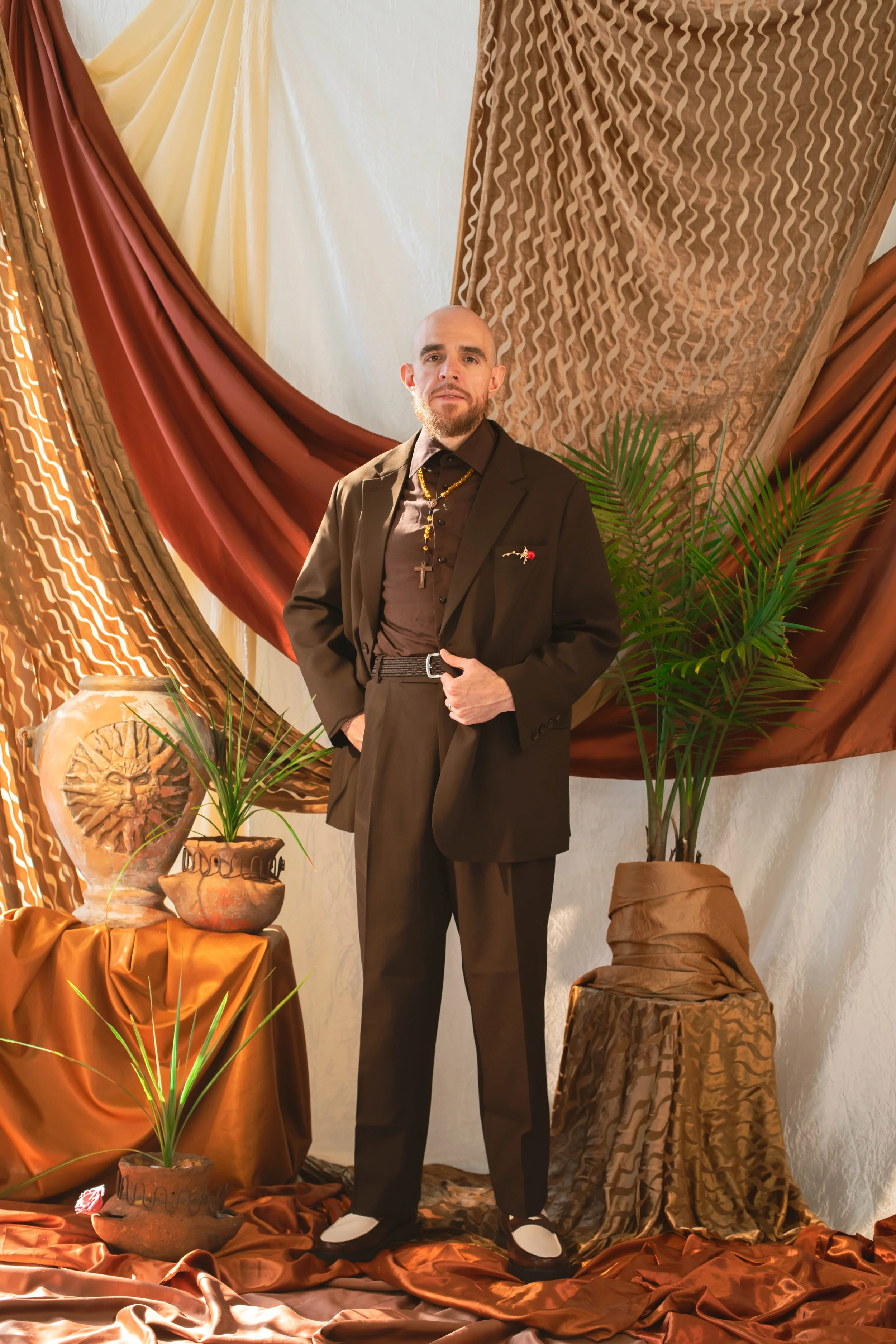
Photo by Mercedes Zapata