Interview with IAIA alumna Kara Briggs, author of “Rivers in My Veins”
by Rey M. Rodríguez
Kara Briggs, an extraordinary poet and journalist, graduated from the Institute of American Indian Arts (IAIA) with a Master of Fine Arts in Creative Writing. We are thrilled that she agreed to be interviewed to discuss her debut poetry collection, Rivers in My Veins, published by Saint Julian Press in Houston.
Kara's unique background as a journalist with over two decades of telling stories about the Western United States informs her poetry, which is both lyrical and as necessary as water, helping us understand an Indigenous history that may have been lost had she not written this collection. Her poem “Acknowledgement Two” in the collection won the James Welch Prize in 2024.
In addition to her journalist career, she launched a popular column in Indian Country Today about cancer in tribal communities, while she battled cancer and survived. Her dedication to her community is profound, having worked with tribes from Arizona to Alaska in various professional roles. According to her website, she now serves as Vice President of Tribal Lands and Waters Stewardship at Ecotrust, a nonprofit organization with which she works with tribes across the West Coast. Her other graduate degree is a Master of Public/Tribal Administration from The Evergreen State College.
Please enjoy this interview with Kara, in which we discuss everything from her beginnings as a writer to her poetry and to the connection that is made between writer and reader.
Welcome Kara. Thank you for agreeing to be interviewed.
Thank you for inviting me.
How did you get into writing?
I have written or aspired to write since I learned to write letters. I studied poetry in my bachelor’s degree. I have written poems, short stories, essays, and all types of journalism and opinion writing. I am a professional writer with two decades of experience in daily newspapers and more years in public affairs. When I was a young journalist, I thought what I wanted to be was the equivalent of a journeyman in writing. I think I am now, even though I no longer rely on writing for my job. Still, I am confident that I can write in any form, any style. At the start of the pandemic shutdown, I knew I had many things to say. But when I thought about what form I wanted to write in, I returned to where I started: poetry. From there, I applied and was accepted to IAIA’s Master of Fine Arts in Creative Writing: Poetry.
Why do you write?
It is almost like you are asking why do you, “Why do you breathe?” I think it's more central to who I am, to my identity, than simply an activity. I exercise writing across many media, many formats. It has been part of me for so long that I cannot separate it from myself.
That's beautiful. Rivers in My Veins is a work of lyrical courage that celebrates the connections between people and Earth. When did you first begin this manuscript, and what question or feeling were you writing toward?
I wrote the first poems that would become part of the manuscript of “Rivers in My Veins.” It was about 2019, and I was very angry about the first Trump Administration, not anywhere near as upset as I and many of us are now, but still angry. I wanted to express something about the humanity of my Sauk-Suiattle people, of my Yakama relatives, and all Native peoples. I wanted to reassess the history of my tribes engagements with the state and the federal governments. And in this time, I had spent four years in an intensive study with my tribal elders of my Sauk-Suiattle history, cultures, land, and water rights. After having been a journalist, having written opinion columns, and having written history, I wanted to write in a form that cut through the echo chamber of mass media and touch readers’ hearts. I felt this was poetry.
Do you remember the first poem that let you know this is a book, or what shifted for you in that moment?
It's “By the Creekside,” which is directed to the late and feminist poet, Carolyn Kizer, because we are from the same city, Spokane, Washington. We're from almost the same neighborhood in the same city. In her 1958 book, she has a poem, “By the Riverside,” that references a creek that runs behind our neighborhood. On that creek in the U.S. War against Yakama and other tribes across the region, the U.S. Army executed one of my non-linear ancestors and assassinated his father. Both were great leaders for their tribes in the war.
This history is more widely known now than it was in the past century. It was silenced history in the 20th Century, and in her poem Kizer steps into history by turning those killed into thieves and alluding to Christ being crucified with two thieves. The allusion is false because it belies this nationally important and local history, which to me is more compelling if we are talking about the creek outside the current city where I grew up.
At the same time, Kizer is a feminist poet and translator who had a long career, and she has written many important poems. And who I have read since I was a child. What I am saying in the poem is that this is a poet in my poetic lineage, as Joy Harjo calls it. I shared a neighborhood with her, even if she was decades older than me. In the poem, I am bringing this 20th-century poet into relationship and context with me as an Indigenous poet, as an Indigenous feminist. I find we have more in common, but that we disagreed on this factual point, a small fact in the context of her career. A big point in terms of the reassessment of Yakama/Wenatchee tribal history in the Northwest.
There has been a lot of work in Spokane around this history; a street was renamed, and other work was done to overcome a racist part of the history of that city.
Readers may not understand why this poem is written as almost a children’s story. To me, that was where I first connected to Carolyn Kizer, as a poet who grew up in almost the same neighborhood in a beautiful city named for the children of the sun.
You have spent decades as a journalist and a strategist working with tribal communities before publishing this debut. How did a lifetime of storytelling prepare you or complicate things for becoming a poet on the page?
I am not sure I have lived a whole lifetime yet; I feel I have a lot of decades to go. As a journalist, I am trained to process information, policy, and history very quickly and efficiently. I tend to reach conclusions quickly, because in opinion writing that is what I was trained to do.
Creative writing, unlike opinion writing, takes a longer path. It works in a space of conflicting facts, of gray spaces, of unknowns and realizations, of sometimes spiritual understandings and nuances. I have to turn off part of my thinking to get to this space, because in workday I need to be able to assess situations quickly and come up with solutions. The shift from my work life in an environmental non-profit and my creative writing is substantial; some days the shift may be near impossible. But more of the time, separated by hours, by exercise, and by being outdoors, I can turn my mind to creativity. I am participating in the Stafford Challenge, which I commit to writing a poem a day for a year. This helps my discipline.
When I began my MFA, instructor Esther Belin got after me for having a big agenda of ideas to put into poems, it's more the way an opinion journalist writes than a creative writer.
Is there a particular poem where you felt like, I got it? Like, that you had let the journalist part behind, and you are now a poet. Is that what you were able to accomplish in all of the poems?
I never leave the journalism behind. The art of observation, the ear for dialogue from conducting hundreds of interviews, the ability to write on schedule, and to write quickly, all of those skills are part of a creative writing process. I am a former president of the Native American Journalist Association, which is now called the Indigenous Journalist Association. One of my hopes is to find a way back to having a news column in a news outlet.
What I find in my poetry practice is that as I've gotten deeper into the rhythm, even the cadence of poetry, in that I have delved into the mechanics of poetic form, and the linguistics that underlie all of it. Some of the time, poems do not begin in words but rather begin in beats. I will, in a sort of song, mumble a beat for hours or days before I find the words that go with it. I think this must be how songwriters write and maybe how songs come to people for ceremony, and maybe I should try that sometime. For now, I have a poem in a new book that will be published in 2026 that came from this very spiritual beat that occurred to me. The poem that took a long time to write is called “A Prayer for Missing Indigenous Peoples.”
What I love about your book is all the history included in it that is so important to be told. And you do it, lyrically, which invites the reader to be exposed to it. Your work teaches us how profound it is and how important it is for us all to know it. I am particularly drawn to your Acknowledgement poems. Would you walk us through these poems and what you were trying to accomplish?
My poem “Acknowledgement Two: won the James Welch Prize in 2024.
The poem begins with a line that just came to me, which is “America is my home and my hammer, and it is hammering me.” The poem is told from the perspective of my Yakama uncle’s oral history, which he told to me as he was dying, that he asked me to record and retell.
The poem turns the history of this Yakama man who fished the last season at Celilo Falls, this massive falls with a more massive salmon run, that the U.S. blasted a hole in with dynamite, then inundated behind The Dalles Dam. And the poem lyrically describes the feeling of this, and subsequently the feeling of learning to fish on an altered river, and of what is called now, “The Fish War.” The Fish War was the extended Oregon and Washington states opposition to treaty fishing, which the tribes were fighting in court and winning more often than not. But the states fought in court and fought on the riverbanks of the Columbia and the Puyallup rivers, to name two. The state police would come to fish landings and arrest treaty fishers. It was not so unlike what we see ICE doing today, including the brutality in some cases. There were also local fishermen and a whole lexicon of anti-Indian bias.
The poem goes from 1958 to 2008, when my uncle died. By which time, the plight of treaty fishers was celebrated in documentaries and history books told from the tribes’ perspectives. It was a crazy turn of attitudes, where many, many urban people in cities like Seattle and Portland would say they supported treaty fishing. Of course, it’s all more complicated, but the poem is about these conflicting points of view, these conflicting histories and facts.
The Acknowledgement series is itself a commentary on land acknowledgements, and how they often, through ignorance or shallowness, fail to honor the actual local tribal people whose lands they are about. The series is like, well, if I, as one tribal person, could make the acknowledgment really speak to my experience, then this is how it might be written.
The “Acknowledgement One” is a haibun. It references real policy discussion about land acknowledgements and about what many of these acknowledgements really mean if you listen to them. It ends with this couplet, “Erase the land, will the people still exist?/ Erase the people, you can take the land.”
“Acknowledgement Three” is being taught at Heritage University on the Yakima Nation. It is being taught to help Yakima's writing students begin to write their own memoirs, their own family stories.
I love this “Acknowledgement Three.” It’s so vulnerable, beautiful, and powerful. It’s extraordinary. I could see why they would put it to that use.
Thank you. In “Acknowledgement Three,” I take some creative license in telling the story of my grandmother’s early life before she was sent to boarding and clearly in her boarding school experience. I want to get across how we understand language and gifted children today. That a child who could speak three languages might be put in an advanced classroom today. And for how gifted these children were, for how important the knowledge and gifting of tribes was, that boarding schools were more like prison camps than schools.
And how much better off would we be? If one fully realizes oneself in all these different ways of expression. Imagine the poetry.
It is hard to imagine, but in 1992, I was invited as a young journalist to the “Our Visions” gathering near Taos, New Mexico, which the Morning Star Institute and its executive director/founder, Suzan Shown Harjo, hosted. It was a gathering on the quincentennial of Columbia of 100 tribal thinkers, philosophers, artists, and writers. It was a who’s who of Indigenous intellectuals and literati of the day. And the focus was if it took 500 years to get this bad, what could it look like in 500 years if our communities began at that time and continuously reclaimed our cultures, our knowledge, our arts, our languages. We are only 35 years into this theory, but the progress has been outstanding, the prevalence of tribal language classes, the fact of the Smithsonian’s National Museum of American Indian and how that has inspired in terms of museums and tribal museums, the growth of IAIA, the acceptance of traditional ecological knowledge of tribes even as thing, every one of these things has been a marker of progress toward who will be in the future. It's mind-blowing progress from 35 to 75 years ago.
Despite current domestic troubles, I continue to believe we are on this path.
Yes, imagine the poetry that a Sauk-Suiattle person born 500 years from now will be able to create.
For me, that is why the book is so powerful, because lyrically it's beautiful, but it's also very didactic. After I read your book, I came away with this feeling of great sorrow for what was lost, but also great joy from your voice and how powerful it was to start elevating this culture that must be preserved, and how it continues to endure. And how much we can all learn from this knowledge.
I think what stands out to me is the resilience of Indigenous peoples and their culture, the resilience that allows us to reinvent ourselves in all different ways and still remain true to our identities as tribal peoples.
I was moderating at this Indigenous award event recently, and as I look at all the Indigenous leaders in the audience, I thought, who we really are – we are futurists. We are looking seven to 100 generations in the future, saying if I just preserve this seed, if I plant that tree, if I create this art piece, it will mean something to future generations of my tribe.
Yes. That's great, it's your grace that you're able to express. Do you want to go to “Acknowledgement Four”?
“Acknowledgement Four” is the audience participation poem. And amazingly, they do participate. I think poetry listening could be a whole lot more engaged if we invite our audience to co-express.
I say that Rivers in My Veins doubles as a land claim for the Sauk-Suaittle Indian Tribe. This poem is a claim on houses, cultural items, and personal effects on tribal allotments that were illegally destroyed when the U.S. Forest Service burned the houses down, giving some people 20 minutes to evacuate. This occurred in the 1960s. It is my contention, and for that matter, my communication to the Washington State Senators, that the value of these homes and contents is a debt that the U.S. owes with interest to these Sauk-Suaittle families. Here I am doing what I said I wouldn’t do, putting political issues into poems.
That's great.
“Acknowledgement Five” is just me. I'm standing in my driveway on the Tulalip Tribes Reservation. We live on an original allotment under the Treaty of Point Elliott to my husband’s grandfather. The poem says I am standing in these hills, knowing ancestors stood here before, so many ancestors that I can’t count them any more than I can count the stars. I cannot see them all the way I cannot see all the stars that are in the sky.
How do specific rivers or places shape the cadence and imagery of the poems in your book?
Or do they?
The book is focused on two river systems, the Columbia, which is the fourth largest river system in the U.S., and the Skagit. The Skagit River system is where the Sauk-Suiattle live; each of those names is for a river, the Sauk and Suiattle rivers, that our tribe created and the tribes that lived on each of these neighboring rivers. Many of the poems are from my Sauk-Suiattle family and history, others from my Yakama, or specifically my Wenatchee family. Wenatchee is another river. Many of our tribal names are taken from our names for rivers that our people lived along, from which they fished, and on which they traveled.
I love the poetic forms.
Forms of poetry, like a sonnet, are time-honored styles of poetry that have been used by poets for in some case centuries to write poems. The form somehow works deeply with language. I look for forms of poetry that I don’t know. When I find one, I use it to write a poem.
My poem, “Nch’i-Wana,” is a name for the Columbia River from the Yakama language. The form is called a riddle; it is pre-Renaissance. I found it in a linguistic book. Meditating on the riddle form, this poem came to me. The central image of an elder or a spirit keeping time with the river current came to me in my thinking.
In this particular poem, you could read the first column down, right? Or you could read across…
I think the modern reader could do that.
Exactly.
The medieval people, mostly men, who could read would stick to reading across.
And then it's as if there's a river in between, right?
For me, the form has two columns to be read across. I follow the form. Generally, it is similar to the phrase trust the process. But you don’t seem to believe this.
Mmm, I see.
Sure, the imagery of the poem seems to hold together, however people decide to read it. To me, that is some of the mystery of how a form of poetry can work.
Yes.
It gets back to how does the reader want to interact with a poem. The reader is the silent partner from the writing to the reading. I learn so much from readers when I read them my work. I learn when a line isn’t working, I can see when they get confused. I can see when they catch on, too.
The description of the collection emphasizes our kinship with Earth. How do you see poetry as a way to restore or deepen that kinship in a time of climate change and ecological grief?
I've been on book tour during readings for going on a year and a half. But a lot of that is in my region. Some of that is national, but what happens in the Q&As is that I'm talking about things that are usually local to the audience, like crabs, historic crabapple orchards, or Celilo Falls, which are very historic in the Northwest.
Or I'm talking about principles of land ownership and rights. And so it relates to all people and not just people in the region.
In conversations about the book, there are people who ask about the poetics, but more often, the book inspires these deep conversations about place. In the Northwest, elder people, and more often than not elder white people than Native, will talk about visiting the falls, which were submerged in 1957. So these are pretty old people who remember this, and they're holding this collective memory for all of us who were born after that. And they will very emotionally talk about their experience of the falls when they were children, and when their parents took them there, because they could buy salmon or whatever.
In another reading that was local to my tribe in the nearby public library, I read about the historic crabapple orchards, which were a practice not only of my tribes but also of other tribes in the region, to plant crabapples near where you would harvest the salmon, so the crabapples would ripen at the same time as you were harvesting the salmon.
At one reading, people began to remark that they had these old crabapple trees in their yard, next to a stream, and a light went on that connected the history to the present people living on the land.
It was important to me to read the book in the tribal communities that the poems related to, so I read at the public library near Sauk-Suiattle, and I read at the Whitefoot Studio on the Yakama Nation to a group of elders, including my elder auntie.
The Yakama elders said, it is important that you're writing about the fish wars, even though I don't say that in the poem, I don't think I use the terminology at all.
And then they talked about how important it is that we remember our recent tribal histories, recent as in what happened one, two, three generations before us.
I was reading in Northern California, and there were these tribal ladies from Northern California who came up to me, and one said, this is what our uncles went through on the Klamath River and these other rivers. So these are touching real family experiences, real family history, and I like to connect to people, whether they're tribal or non-tribal.
They have experiences, and I'm really trying to connect with whatever your personal experience is. I'm hoping that something in the details of this poem is going to connect to you.
That's beautiful.
But that might be the journalist's idea. The poet might say there is a reciprocity between the writer and the reader, sometimes the writer, the reader, and the listener. Tribal poetry, spoken poetry to listeners’ ears that is the essential transformation, the transformer, like the tricksters of our Native cultures that change the landscape in what they do. The poet can change a personal landscape or perspective with the poetry.
Deborah Magpie Erling talks about this conjuring, or this magic that occurs when you write. Ideas emerge that translate to someone else, and you don't know exactly how they're going to translate. But this magic happens.
Yes, I don’t believe in magic. I believe in connection. My imagination to the reader’s imagination, what it is to the reader may be different from what it is to me. I suspect it is no less real.
In the past little more than a year since Rivers in My Veins was published, I have traveled primarily through the Northwestern United States, reading these poems. The poems are about the lands and waters where I do most of my readings. I have found that the poems in this book bring readers to re-evaluate the history that they know about the rivers and lands that we call home. I have read poems about our historic gathering place and fishery at Celilo Falls, one of our most sacred places. I have readers who are old enough to remember the falls before it was inundated behind a dam, and to these readers who are old enough to remember the 1950s, they share a memory of the falls that I can only call sacred. As they talk about it they are transformed by the memory, and those of us who are younger witness quietly. The transformational power of poetry, its ability to touch people’s hearts and, in that, to change their understanding, I can only understand as mystical. As I have traveled the countryside and cities reading from this book, I have been to readings where hundreds of poets, not all of these MFA graduates, but dedicated poets of all backgrounds, all professional and educational backgrounds, all generations, all languages…and in this I have begun to believe that through arts such as poetry we can begin the difficult work of healing our divides. If I can see this in rural Washington state, I believe this groundswell of the poetry and other arts and the local organizations that support them will help to heal our nation.
Kara, thank you so much. I really appreciate your time discussing your important collection.
Rey M. Rodríguez is a writer, advocate, and attorney. He lives in Pasadena, California. He is working on a novel set in Mexico City. His poetry collection, Todos Somos Sagrados/All Are Sacred (El Martillo Press), will debut in May 2026. He has attended the Yale Writers' Workshop multiple times and the Palabras de Pueblo workshop once. He participated in Story Studio's Novel in a Year Program. He is a second-year fiction writing MFA student at the Institute of American Indian Arts. His poetry is published in Huizache. His other interviews and book reviews can be found at La Bloga, Chapter House's Storyteller’s Corner, Full Stop, Pleiades Magazine, and the Los Angeles Review. He is a graduate of Cornell, Princeton, and U.C. Berkeley Law School.
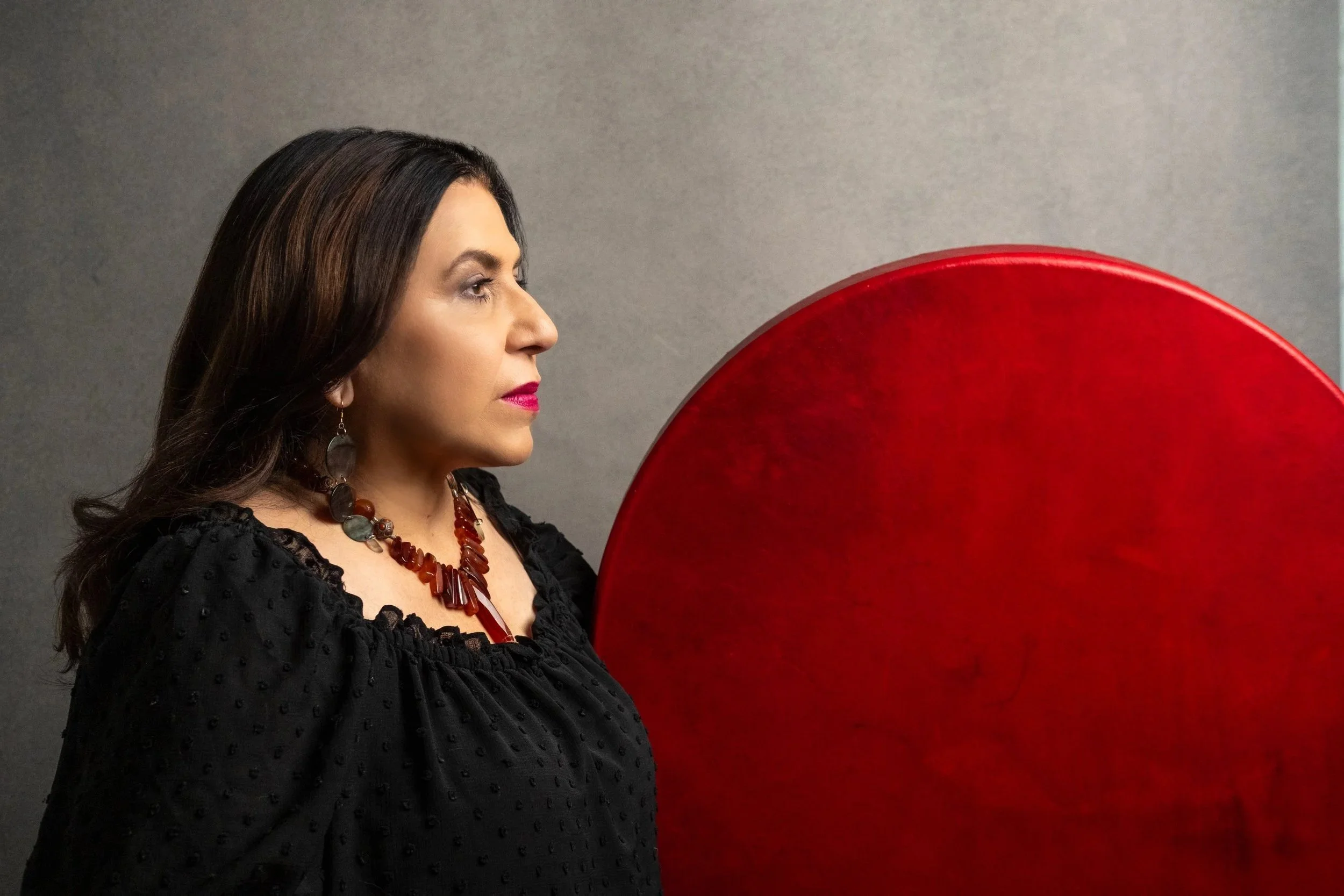
Photo by Rachel Rousch in the Seattle. Drum by Brenda Crabtree, Nlaka’pamux and Stó:lō ancestry.