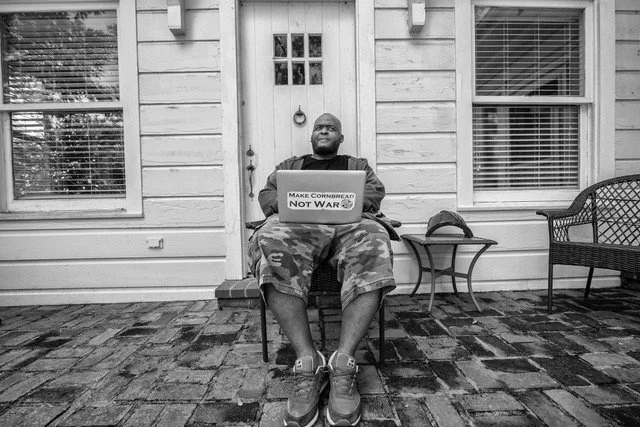
Interview with Kiese Laymon, author of “Heavy: An American Memoir.”
by Rey M. Rodríguez
Kiese Laymon is a Black Southern writer from Jackson, Mississippi. Much of his writings, laughter, and wisdom spring from here. It is from this well of joy and complexity that he writes extraordinary works, such as Long Division, How to Slowly Kill Yourself and Others in America, and Heavy: An American Memoir.
In addition to his writings, he is also the Libbie Shearn Moody Professor of English and Creative Writing at Rice University.
Among many awards and accomplishments, Laymon is the recipient of the 2020-2021 Radcliffe Fellowship at Harvard, and in 2022, Kiese Laymon was awarded a MacArthur Fellowship.
He is currently releasing a new book titled Good, God, and he is working on several other film and television projects.
He is the founder of The Catherine Coleman Literary Arts and Justice Initiative, a program based out of the Margaret Walker Center at Jackson State University, aimed at aiding young people in Jackson get more comfortable reading, writing, revising, and sharing on their own terms, in their own communities. He is the co-host of “Reckon True Stories” with Deesha Philyaw.
Sometimes in an interview, time seems to collapse into one joyous moment because everything surrounding the conversation disappears. I felt this way speaking with Laymon as we talked about how he got started writing, Mississippi, poetry, basketball, authors, time, his new book, Good, God, James Baldwin, Ross Gay, Michelangelo, Rasheedah Phillips, and so much more. After reading this piece, I hope that you experience the same feeling.
Kiese Laymon, what a pleasure. Welcome to Storyteller’s Corner of Chapter House.
I’m happy to be here, Rey. Thank you for having me.
We like to begin with writing itself. How did you become a writer? What was it about writing that you gravitated toward?
Well, my mama made me write all the time. So I didn’t like it because she made me do it.
Then I started writing for my high school newspaper, and I wrote an essay that my friends—my basketball team—liked. That pretty much made me want that feeling. My mother had made me write since I was four, five, six years old, but there’s a difference between writing and writing something that your friends feel.
I wrote this essay my friends liked in eleventh grade, and I just wanted to keep feeling that feeling.
What was the essay about?
It’s so stupid, man. It was about the music they played at the dances.
I went to this school in Mississippi that was maybe sixty percent Black and thirty or thirty-five percent white. The whole point was that we weren’t dancing to each other’s music. When the white music came on, we would sit down. The teachers would tell us, “Y’all have to dance,” because when our music came on, the white kids were dancing.
I wrote this essay about why certain people dance to certain music and how the teachers wanted us to dance to all the music all the time. But we get to have taste, too.
Anyway, my friends liked it. It made me feel good. So I kept trying to write stuff that could make us feel good.
Paint a picture of Mississippi for us. I feel like Mississippi is profoundly misunderstood. From the outside, we can miss the beauty and joy that exist there, both of which come through in your work. What is Mississippi to you?
The thing about Mississippi is that Mississippi’s art is moving all of us every day. That’s where rock and roll comes from. That’s where the blues comes from—and for a particular reason.
It’s the Blackest state in the union. It was the last state to technically allow, quote-unquote, Black people to be free. I was the first generation in my family born free—meaning born after the Voting Rights Act, born after legal segregation. My mother couldn’t go into the bathrooms that white kids went into. Obviously, my grandmother couldn’t.
So historically, I’m that first generation born when technically we have rights.
But culturally, Mississippi is as artistically abundant as it is politically regressive. I don’t want to say we created so much art and so many different art forms because of that regression, but I know political aggression sometimes necessitates people fighting back in different ways.
And we fought back through art, culture, music, food, dance.
I grew up in Jackson, which is the city in the center of Mississippi, and my grandmother grew up in Forest, in eastern Mississippi. Most people who grow up in Jackson—or any city in Mississippi—also have one foot in the country.
We’re city people by Mississippi standards, but country people by everybody else’s standards. And we really are country people because we’ve got a foot in the country. But if you went to those country towns and told them you were from Jackson, at least back then, they’d look at you like you were from fucking New York or something.
It’s paradoxical.
If you were born on the coast, the city for you might have been New Orleans. If you were born in northern Mississippi, the city might have been Memphis. So we have a lot of reverence for New Orleans and a lot of reverence for Memphis. There’s no competition. There’s absolute reverence because it’s the same people.
That’s a short primer on Mississippi.
You’ve talked about growing up with writers like Faulkner and Eudora Welty being presented as models of what Mississippi writing was supposed to look like. But who were the writers who actually moved you? How did your reading shape the writer you became?
I didn’t like Faulkner, but I liked some of what Faulkner was trying to do. And I actually liked Eudora Welty’s stuff. Those are the two authors pushed down your throat if you grew up in Mississippi in the eighties and nineties.
But there was also Richard Wright. Richard Wright was Mississippi-born and raised.
Richard Wright wrote everything. He was a poet. He was an essayist. He was a fiction writer. He was a journalist. At some point, he tried to do ethnography.
And in poetry, there was Etheridge Knight. Margaret Walker Alexander, who wrote For My People, was my mother’s mentor.
I read a whole lot of people from Mississippi coming up. Most of that shit was in my mama’s house. At school, they made us read a little Richard Wright, but they didn’t make us read much literature about Black people—which is crazy because there’s so much of it down there.
My mama had a library. She was a teacher. She taught at Jackson State.
Sometimes she tried to keep me away from some of those books because she didn’t want me to get radicalized in Mississippi. These were some of the books she had read in college. They had given her political dimension, but she was afraid of her child getting that political dimension because she knew what Mississippi did to Black people who wanted to tell the truth with some force.
So I read a lot of Mississippi writers coming up, thanks to my mother.
Did you return to those writers later?
I never left them, bro.
I was reading Richard Wright all through high school. I was reading Margaret Walker. Then I went to Millsaps College, got kicked out, went to Jackson State, eventually left Jackson State, and went to Oberlin College in Ohio.
And that cliché thing happens: you go to another state, another place, and you start to really understand the place that made you.
I started reading interviews with Richard Wright, Margaret Walker, James Baldwin, Alice Walker, Malcolm X. All these people had relationships with Mississippi. All these people talked about Mississippi.
But you wouldn’t know it unless you went looking. This was before the internet was really popular. You had to go to the fucking library.
Going north made me start thinking about the literary ingredients of who made me. I never stopped being fascinated by the artists who came out of Mississippi.
And not just literary artists. When I left Mississippi, my friends started rapping. My friend Kamikaze and this group called Crooked Lettaz with David Banner were incredible influences. They started making incredible work.
When I went north, I became even more committed to the art of where I was from.
How does the music of Mississippi influence your writing? Because there’s a rhythm in your prose.
For sure, man.
I push back against traditional notions of Christianity, but I’m a child born in gospel. My grandmama, my auntie, my mama, and my other auntie had a group. They sang all through the church and all through the community.
My mother had me when she was nineteen, so she was very young, and my aunties were really young. I saw them in church singing all the time. My auntie was just the most incredible preacher and singer ever.
I didn’t love church at all, but I loved the sound of church, man. I loved how a song could make somebody catch the Holy Ghost. Just people singing could do that.
And of course, that’s what concerts are, too—people catching the Holy Ghost.
So first there was gospel.
Then, like most Black boys growing up in the eighties, I got addicted to hip-hop, bruh.
We knew hip-hop supposedly started in New York. Run-DMC at one point was like God to us. But LA Dream Team was, too. They were doing call-and-response rapping.
Rapping hit me in a place that no other art had hit me. I became fucking addicted to that shit, in the best possible way.
And then I started thinking about how I could bring the best of that into the essays I was writing.
Is music itself a form of poetry for you? I once spoke with Layli Long Soldier about poetry, and she described something as elemental as looking out her window and watching the wind move through the grass—the feeling that creates. Does music work that way for you? Is it a place where you find poetic truth?
Yeah.
The thing about hip-hop—back then, we just called it rap music—was that you went to school and teachers gave you all this literature that you weren’t the audience for.
There weren’t many things in American culture in the eighties and nineties where Black kids from Mississippi were at the center.
We were the center of our own worlds, but there wasn’t much packaged art created with us in mind.
Then you heard hip-hop.
Of course those New York dudes and women, those LA dudes and women, weren’t specifically thinking about Mississippi. But they were thinking about the young Black kid inside themselves.
And we were young Black kids, too.
Hip-hop was so dope, man. Yeah, it was poetry, but it was also the best poetry because it wasn’t poetry trying to be accepted as Poetry with a capital P.
It was poetry saying: Everything in front of me, everything I can feel and sense, I’m going to use to fucking convey some shit to you.
That, to me, is poetry.
You could hear young Black boys laugh. You could hear a song where somebody was talking about his best friend and the whole song was about how these two motherfuckers liked each other. Or two MCs would make a song about how much they loved their DJ.
People talk about hip-hop being hard—the violence, the sex, all that shit. But some of what got us was how friendly it was.
Bigging up your block. Bigging up your friendships.
The best poetry makes art out of the shit that makes you that nobody else takes the time to make into art.
That’s what hip-hop did for us.
It consistently let me know that the world and the stuff we see every day should be ritualized into art.
Literature did that, too, but a lot of that literature had been written decades before we were born, so it didn’t feel like they were writing to us.
Those MCs, those writers, those poets?
I felt like they were writing to us.
Even though much of hip-hop emerged from an urban experience different from Mississippi, you still recognized yourselves in it?
Part of it was that we were in the United States. But we were also Black kids who didn’t have a lot of money and had a lot of voice and a lot of fucking shit to say.
Where else were you hearing Black kids with a lot of voice have shit to say?
Nowhere.
This was the era when we loved Diff’rent Strokes just because there was a fucking Black boy on television. We loved Punky Brewster because there was a kid on television.
Then hip-hop came along, and those kids who were being directed in a few television shows suddenly had the fucking microphone and the technology. They got to create some shit themselves.
It felt freeing to know there was an art form that loved the part of you that nobody else really saw in popular culture.
It moved us, bro.
It moved me.
And it still moves me.
I understand that hunger. When I was growing up, if a Latino name appeared anywhere in popular culture, it almost didn’t matter what the context was. You were hungry just to find something of yourself.
And I think that’s part of why your work is so exciting. So many people can recognize something of themselves in it.
I want to turn to memoir. Writing memoir can be extraordinarily difficult, particularly when the material involves grief and trauma. For Indigenous writers, Black writers, and other writers whose histories carry enormous violence, how do you protect yourself while writing?
People often talk about memoir as healing, but there can also be tremendous pain in returning to these experiences. Many of our readers are emerging writers being asked to enter painful memories and trust that someone will hear their voices. How should they approach that work?
First of all, the culture is trying to get us not to feel.
It’s trying to get us not to feel deeply about anything.
So if your readers feel a deep sense of mourning, trauma, or despair, on one hand I want to say: Thank you for pushing back. Because this motherfucker wants to numb you out until you don’t feel shit—the world, the country, the nation.
But the problem is you can’t write a memoir out of despair. Or joy. Or mourning. Or grief.
There has to be some organizing principle.
If we allow ourselves to feel, we’re all walking around like balls of fucking fire. We put on clothes to put the fire out. We talk to people to put the fire out. We watch a little TV to put the fire out. We get on our phones to put the fire out.
But if we allow ourselves to remain sensitive to this shit, the fire is always there.
The problem is you can’t simply convey fire to another person. You can’t say, “I feel fire, so now you have to feel it.”
You still have to make decisions about structure.
About form.
So the first thing I want to say is: Feel. Thank God you can feel.
Now: What form is that feeling going to take?
For Heavy, I had all this shit I was feeling, and I had to ask: What do I do with it?
I decided I was going to make a book built around direct address—to my mama, my grandmama, my unborn child, and an ex-partner.
That was the form.
Then I asked: What’s the hardest part?
The part addressed to my mother.
So: Can you write to your mother in four sections? Can each section do something different?
I had to find the form that could contain all that fucking heat—part trauma, part joy, part experience, part imagination.
You have to find the form so the material doesn’t burn you up and overwhelm you.
But you also have to keep it from overwhelming the reader.
If you just put the fire on the page, it’s just fucking fire. Readers don’t know where the beginning is, where the end is, what the fuck is going on.
Readers think they want that shit until you give it to them.
So for yourself, too, you have to think about form.
Part of the art is asking:
What form can most fully express this heat that I have?
How does a writer find that form?
You’ve got to read.
You’ve got to listen.
You’ve got to watch.
But I also think you can make forms out of shit you’ve never seen before.
I’ve read a lot of memoir—damn near every memoir I could get my hands on for the last twenty years. With this new book I wrote, Good, God, I knew some of what I wanted to do, but I kept being fascinated with the idea of a fan.
I don’t know if y’all did this in LA, but we used to make these fans out of a piece of paper. You fold it forward. Fold it backward. Forward. Backward.
And it’s hot as fuck in Mississippi, so we’re just fanning ourselves.
I started wondering: Can I make a form out of that?
What the fuck would that even mean?
Then I thought: You fold the story forward, and then you fold it backward.
So in this new book, embedded in every chapter is a story folded into the larger story. And that fold is supposed to make the subject and the writing feel good—but also make the reader and writer feel good.
I don’t know if I invented a form or not. I just knew I wanted the form of a fan.
I wanted to make a literary fan.
Sometimes you read something somebody does that you love and you try to imitate it.
But you also have to be kind of crazy and try shit you’ve never seen.
That’s why you have to read a lot, though. Because sometimes you think you’re trying some new shit and everybody and their mama is already doing it.
That idea of folding is beautiful. My mother knew origami, and she taught it to my children, so folding has a particular resonance for me. And stories really do fold into one another.
That’s what I think.
I wanted to lean into the way stories fold into each other even more explicitly.
The first sentence of the new book is: I know why you’re here. You want to feel good.
Even inside that first sentence, something is folded in.
I’m telling you hard shit, but inside all that shit I’m folding in a story of pleasure.
And hopefully those stories of pleasure avalanche into something meaningful by the end of the book.
But who knows?
That’s the dope thing about writing. You’re experimenting.
You don’t really know if that shit works until you put it out there in the world.
Your description of folding pleasure into difficult material makes me think of Ross Gay and Inciting Joy. I love his idea of joy as something that includes an acknowledgment of each other’s pain.
Yes, man. Ross Gay is a miracle.
As I’ve gotten older, that’s some of what I’m trying to write through in this new book. It’s amazing how older people sometimes find ways to remain soft.
Ross Gay is somebody I need to read every day because he reminds me. That’s what good artists do. They remind you, remind you, remind you.
So much of the culture is trying to pull you away from what Ross is talking about. So much of the culture is saying, “Fuck everybody else. Fuck their pain. Fuck their joy.”
But family—that’s life. Can we sit in each other’s stuff for a little while?
We should.
That’s what interests me. Your work often seems to move through extraordinarily difficult material toward some form of joy.
Absolutely, fam. That’s a great, clean, clear way to say it.
The process of making art is scary, but it’s also the place where I feel like I have the least amount of constraints.
Ultimately, I’m trying to feel joy in the thing that I’m creating with the audience.
And that distinction is important.
I’m not creating it for the audience.
If I share the art with y’all, I’m creating it with you. I’m anticipating some of your readerly responses, and I’m taking that anticipation into the making of the art.
We’re making it together.
I think that’s especially important in a transactional society, where everything is: You do something for me, I pay you. I pay you, you do something for me.
If we really look deeply at how labor works, though, for better or worse, we’re often working with one another.
Or we should be.
That connects to something I’ve been learning from reading more Indigenous writers—the importance of reciprocity. I sometimes think one reason we read is to build the muscles necessary for empathy. I wouldn’t have any real sense of your experience had I not encountered your work.
Absolutely. That’s right.
And that’s some of what scares me about AI.
It feels like this consolidation of what an experience—and the rendering of an experience—is supposed to be.
Because education has failed us so dramatically, we can become moved by bullshit summations of feelings. Summations of people. Summations of experiences.
Staying with craft, you’ve spoken often about revision. What role does revision play in your writing practice?
On the most basic level, I’m somebody who has to get the words down.
Once I accepted that my first drafts are just so bad, dude, everything changed.
I have to write thirty-five sentences to find maybe one good word, two good words. I have to write thirty-five pages to find half a page.
Once I realized that, I understood that so much of the art of being alive—and the art of making art on the page—is having to revisit the art and, in that revisitation, make the shit holier.
And I don’t mean that in a traditional religious sense.
I mean: How do you make that shit holier?
I think the same thing about life.
That’s why it scares me when people say they don’t regret anything. “If I could go back and do anything differently, I wouldn’t change a thing.”
What the fuck are you talking about?
That’s wild.
There are so many people I haven’t done right by in my life. If I could go back, I would do right by them.
And there are so many sentences I thought were doing good work. Maybe at that time they were. But retrospectively, I can make that sentence do better work.
I can make that sentence do holier work.
For me, the art is never really done.
You have a responsibility to go back and texture it and layer it—or take things away from it—and perpetually try to make it holier, or more fully whatever you are trying to make it.
I think the same thing applies to life.
That makes me think of something I once heard about Michelangelo. Supposedly, when he looked at a block of marble, he didn’t believe he was imposing a sculpture upon it. He believed the sculpture was already inside the marble, and his responsibility was to release it.
I believe that. Absolutely, fam.
But you can’t do it in one shot. Or two shots. Or three shots. Or five shots.
That’s the whole point of revision.
I always tell my students: It’s hard to have a revision if you don’t have a fucking initial vision.
That’s the thing about what you just said about Michelangelo. There’s a vision for the thing in there.
I feel the same way about memoir writing.
I can feel it. I can see the form.
Sometimes I’ll get somewhere and people I trust will say, “Man, that’s it.”
And I’ll say, “Fam, I understand that you like it—or dislike it—but that’s not it.”
I have to keep going until I get to that vision.
Then you want to go beyond the vision.
As writers, sometimes we know: Oh shit, I did what I thought I had to do.
Then the question becomes: Can I do even better than that?
But it’s so hard just to get the art to match the vision in the first place. Going beyond the vision sometimes feels like a pipe dream.
Still, I think you have to want to do it.
Did you feel that with Heavy? Did you know you had reached the vision?
Honestly, I have this new book coming out, so I feel like you can’t really talk honestly about your old book until the new book comes out.
But I knew I did something in Heavy that some people were going to feel.
I knew it.
I didn’t really know until the last draft.
Actually, I knew when I was recording the audiobook.
At that point, the book was done.
Yes, the audiobook. How did you feel when you read that last chapter aloud? I heard you read the last chapter in Santa Fe, and then I listened to the audiobook. Each time I get chills because the ending leaves us with that terrible possibility: What if it isn’t true? What if we don’t choose differently?
Right.
At the end of a book, people want that happy shit.
They want to know it’s going to be okay.
And I was like: I can’t take y’all all this way and then lie to you, fam.
We know right from wrong.
And we’re probably going to choose wrong.
But Mama, I don’t want us to choose wrong.
Can we please not choose wrong?
I know we’re going to choose wrong, but—
When I read the book out loud for the audiobook, I was up in this attic in a makeshift studio in Mississippi.
It took me about three days.
And when I finished, I remember thinking—and I almost never feel this way—Man, you can go to sleep now.
You did what you came to do.
I felt that.
But I didn’t feel it until the audiobook.
I read my work aloud all the time, but I had never read the entire book out loud straight through.
And when I did, I could see the producers and the engineer. I could see the art fucking with them.
That’s when I thought: Oh shit.
Okay.
We might have something here.
So you regularly read your work aloud during revision?
Obsessively.
I read it. Then I record myself reading it. Then I play the recording back and revise from that.
That’s why I think all this shit is poetry.
Line by line, I’m listening: I’ve got to take that word out of the line.
With this new book, I’ve listened to it so many fucking times because what I’m trying to do is difficult, and I’m not sure I’ve pulled it off.
So I keep trying to make sure that at least the sentences are doing what I want them to do.
Reading aloud is crucial to my process.
That leads directly into something else I notice in your prose. You use lists. You use repetition. A phrase might build and build and then suddenly break its own pattern.
When I hear it, I hear poetry. Where does that come from?
That comes from poetry.
I didn’t take creative writing classes as an undergraduate. Then I went to graduate school for creative writing, and Yusef Komunyakaa was at Indiana. I wanted to work with him.
Of course, when I got there, he wasn’t there. That’s grad school: they dangle somebody in front of you to get you there, and then they’re not there.
But the wonderful thing about Indiana was that it didn’t matter whether you were a poet, novelist, memoirist, whatever the fuck.
They understood the foundation of poetry.
I took two or three poetry classes during my first year, and one of those classes introduced me to the list poem.
I started thinking: How can we make that list shit work in essay writing?
Essay writing can feel so stiff.
A list can appear more neon, more attractive, because it’s surrounded by forms that appear more conventional.
The thing about a list, though, is that it can also be robotic. It gets your mind to expect a particular rhythm.
And once you establish that rhythm, you can subvert it.
You can say: I laughed and laughed and laughed—
until I didn’t.
That’s playing with my human experience.
Where I’m from, we laugh at the hardest shit.
At funerals, we’re going to try to laugh in that motherfucker.
We’re going to laugh until we cannot anymore.
And then we can start back again.
I wanted to think about how lists work in life.
But yeah, I learned that from poetry.
I recently interviewed Héctor Tobar, who told me that he didn’t really consider himself an essayist until he encountered James Baldwin.
How did Baldwin form you as an essayist?
Woo. Man.
I grew up playing a lot of basketball.
When you’re a kid playing basketball, everybody has a favorite player. My favorite player was Charles Barkley. Almost all my friends loved Michael Jordan.
I knew Barkley wasn’t as good as Michael Jordan, but I also knew Barkley was a lot better than people thought. I thought he was closer to Jordan than people gave him credit for.
So because Barkley was my favorite, I looked up everything I could find about him.
This was before the internet. You had to find sports cards. You had to find VHS tapes.
Baldwin was the first writer I treated the way I treated basketball players and rappers.
I had to rewind.
Push play.
Rewind.
Push play.
Rewind.
How the fuck did he do that?
He was the first writer who made me think: Wait—how did he do this shit?
So I had to start studying that dude.
Baldwin is so fucking good at writing that he can say something that sounds so good you think it must be true.
That’s part of what makes him scary.
He’s incredibly honest and truthful, but he can also write a sentence so well that you believe him because of how beautifully the sentence is made.
As you get older, sometimes you have to say: I don’t actually believe that. He just wrote that shit really well.
Baldwin had this fascination with the United States and America that I understood.
When I was younger, I agreed with the younger Baldwin saying, essentially, that he believed America was the greatest country in the world and therefore insisted upon the right to criticize it.
I was like: Yes.
But I had never been out of the fucking country.
How the fuck did I know?
Baldwin said it, so I believed it.
For better or worse, Baldwin is the most important writer in my life.
He gave me something to aspire to.
I think Morrison is actually better than Baldwin—she has better books.
But as an essayistic talent, as somebody who dared, as somebody who had to fight the United States government in brutal ways that we’re still learning about, Baldwin is everything we should aspire to be as people and definitely as writers.
And the wonderful thing is that he was still a human being.
You can see flaws in his thinking.
I think that’s incredible.
I think that’s wonderful.
Is there a particular Baldwin essay you return to?
For the longest time, I always came back to “Autobiographical Notes.”
Notes of a Native Son is a masterpiece.
But The Fire Next Time, bro—that’s an essay.
I know people break it apart and say it’s two essays, but to me, that is one essay. Even today, it’s hard for me not to say that might be the greatest essay ever written.
And I’ve read all of Baldwin.
I think “Many Thousands Gone” is one of his most underrated essays.
Some of the speeches that became essays are really good, too, especially the ones about education and teachers.
But if you asked me his greatest work, I’d probably say The Fire Next Time.
And after that, maybe “Notes of a Native Son,” where he’s writing about his father.
He lands on that metaphor of gangrene and amputation.
What do you do?
Do you live with the fucking rot?
Or do you cut the rot out?
Either way, you’re going to experience pain.
And either way there might be some sort of ecstasy.
But you have to make that decision as a human being and as a writer:
Do you live with the pain?
Or do you cut the shit out?
And Baldwin speaks to that part of all of us that wants to say, “What pain? I’m not cutting shit out.”
But you can refuse to see it if you want.
That shit is still rotting.
Man.
Thank goodness for that dude.
Thank goodness for that man.
That makes me think of Rasheedah Phillips. I want to ask you about Black abundance and time abundance, and how her work intersects with your thinking.
I sit on the board of the Western Center on Law and Poverty, and she’s now working with the organization. We’re thinking about how ideas like hers can reshape the way we approach poverty.
That’s amazing, bruh.
Rasheedah’s work has a depth to it and an innovative, textured layering. I think we worked together—or maybe we did an interview—a long time ago.
I’ve always been fascinated with time and time travel. I wrote Long Division, which is a time book.
For me, I was trying to sit with what we ask of young kids in this country, particularly in Mississippi.
Black elders, white motherfuckers—we’re asking young people to become these perfect time travelers, and that shit is just not fair.
I wanted to narrativize what we are actually asking them to do.
On one level, we are asking young Black kids in Mississippi to write themselves off the face of the earth.
They have all these things they know are important. Then the educational system and policy tell them: All that shit you value—including your grandmama and your mama—is not important.
When people are trying to write your people out of fucking time, they’re trying to write you out of time.
So I’m interested in the ways young Black people try to take control of time through language and through sound.
Sound is all about time. There is no sound without time.
And I don’t think there’s language without time.
Look at the way we fuck around with tenses.
I’m from Mississippi. We might say, “That motherfucker be writing.”
That’s not just some vernacular construction.
Think about what it does.
“Does he write a lot?”
Yes.
“Is he going to continue writing?”
Yes.
“That motherfucker be writing.”
That means he was writing before this sentence, and he’ll still be writing after this sentence.
That is literally a time-language intervention.
There are hundreds of thousands of those interventions that we, as writers, need not simply display as precious things our communities do. We need to bring that shit to the art.
Bring it to the page.
My grandmama used to say, “studding.”
“I ain’t studding that.”
She’d say, “Key, I ain’t studding that.”
I knew what she meant, but for a long time I didn’t understand where it came from.
Then you realize it derives from “studying.”
“I’m not studying that person.”
“I’m not studying going to the store.”
And even that is fascinating. Why would “studying” take on that meaning? How did that develop?
I think about how we use language to push back against the ways conquering captors want us to live—to exist below time or completely according to their time.
Whether we’re doing it consciously or not, language lets us say: We’re not going to be bound entirely by your conception of time.
Sadly, we might have to be bound by some of it to keep a job.
But there are so many ways we’re going to break that time.
We’ve got to.
That leads into a larger question about decolonization.
I’ve asked Indigenous writers what it would really mean to decolonize the United States. Jake Skeets once gave me an answer that disrupted my assumptions completely: essentially, you have to dismantle the federal government that denies Indigenous sovereignty.
From a Diné perspective, sovereignty changes the whole framework of the question.
I’m wondering whether ideas like abundance are also connected to older forms of knowledge—knowledge coming from Mesoamerica, from Africa, from Indigenous cultures.
Because even after colonization, I feel your work is doing decolonizing work. It gives readers a way to see themselves abundantly—to see something like divinity in themselves.
Absolutely.
My parents were at Jackson State in the seventies. My father was in a group called the Republic of New Afrika. My mother went to college wanting to become a lawyer so she could help free Black people.
They were driven by Black Power.
They were driven by a connection to the continent.
My mother eventually became a political scientist. She did the DNA work and traced us back to West Africa.
But when I was growing up there was also this mantra connected to the Republic of New Afrika: Free the land.
I would hear my mother and them saying, “Free the land. Free the land.”
I didn’t really understand what the fuck it meant.
But it stayed with me.
Chokwe Lumumba’s father was one of my father’s mentors, and that phrase was everywhere in that political world.
From my mama, I learned that the captors stole the land from Indigenous people.
Then they stole the law.
And they stole the literature.
So our job is to free the land.
We’re supposed to free the law.
And as artists, we’re supposed to free the literature.
What the fuck does that mean?
I take that shit seriously.
I don’t think you can free American literature as a Black writer without what Toni Morrison calls Africanisms moving through the work.
Somebody else might say: I don’t just want to see Africanisms. I want to see the actual continent.
And I hear that.
But I’m also interested in the ways the continent moves through our work consciously and unconsciously.
The idea of Ubuntu.
The idea of abundance.
Those are things I learned partly from a Zimbabwean professor and activist named Kempton Makamure.
One of the extraordinary things about growing up in Mississippi with a mother who was a political scientist was that freedom fighters from all over the world would come through Jackson.
Jackson was one of the major sites of the Civil Rights Movement. The city held these enormous archives of Black resistance.
So I knew there were people on the African continent who were invested in our struggle because they would come to our fucking house.
They would stay at our house.
They would come to my grandmama’s house.
As a writer, you eventually have to make a decision about how important the continent is to the art.
And I’m so glad you brought this up because I don’t think many Black American writers have done that question justice yet.
I know I haven’t.
But it is a question I think about in every fucking chapter I make.
What do you do with it?
That thought is still incomplete for me.
I know I need to do more with my relationship to the continent. I just want it to be good art, too.
I don’t yet know how to make good art that is rooted in that question rather than merely looking at it from the periphery.
Because the truth is, there are no Africans in anything I’ve written.
By Africans, I mean people actually born on the continent.
There really aren’t.
And that says a lot.
Do you think that absence is partly a function of history—enslavement and the enormous rupture it created?
History, yes.
And fear.
Fear?
I don’t want to do it wrong.
That’s the blank.
What I really mean is: I don’t want to do the continent wrong.
It’s so fucking big.
How do you do that?
Do I write about the village my mama says we’re from? Do I even want to write about that village? Maybe I want to write about South Africa.
I don’t know, bruh.
I just know I haven’t done it.
But if I’m able to stay here long enough, I’m going to try something.
I don’t know if it’ll be good.
But I’m going to try because I’ve been thinking about it for twenty years.
And I’ve never done it.
I’ve never seen it done particularly well by Black American writers either.
So that’s something I still have to wrestle with.
I’d love to hear more about your next book. What can you tell us about Good, God?
My next book is called Good, God.
It’s about the last few years of my grandmother’s life.
She died two years ago.
I am sorry for your loss.
While I’m trying to mourn her, my partner is saying, “I want a baby.”
And I’m like: Oh shit.
I don’t really want to do that.
So the book confronts this question:
How do you create children while mourning?
How do you bring a child into the world while grieving the passing of somebody who was, in effect, God to you?
And how do we negotiate bringing children into a world that is dying in every way possible?
So, yeah.
It’s about the death of my grandmother and the birth of a little baby girl.
That resonates deeply with me.
I’ve written a book of poetry called Todos Somos Sagrados / All Are Sacred about women who formed a community organization forty years ago.
One of the things I keep coming back to is the idea that giving birth itself can be an act of resistance—particularly for people whose communities have been told that they do not belong or should disappear.
And that’s part of why I think we have to read more Black women, more Latina writers, more Indigenous women.
There is so much to learn from those traditions about how to arrive at hope.
That’s it.
Absolutely.
I’ve taken a lot of your time, so let me end with a question for the emerging writers who read Chapter House. What advice would you give them?
Man.
It’s tough out here right now.
I think you’ve got to find writing communities that are as expressive about the wonder of what you fucking do as they are about the clunky shit.
You need writing communities that will hold you up like nobody else will.
But they also cannot bullshit you.
That’s hard to find.
And you want to become that kind of writer for somebody else.
You want to become that kind of reader for somebody else.
You don’t want to be a reader who’s just jealous.
And if you are jealous, you need to talk through your jealousy.
You want to be supportive.
But you also want to be the reader who can say:
“Fam, this ain’t it.”
You need both.
That’s what you want in a writing community.
And on the page, even with all this technology now—technology that can dissuade people from being original—you’ve got to push back.
You’ve got to violate the machines.
You’ve got to push back against the machinery of all this shit and find new fucking ways to make readers’ hearts jump.
You have to see the machinery as a foe.
Some people will say, “Don’t even pay attention to the machinery.”
I’m like: Fam, we’ve got to fight them motherfuckers.
The problem is, whatever we create, they come along and swallow it.
But that doesn’t mean you shouldn’t make it.
There is so much shit here to make.
We are here because—as you were saying—Black and brown women decided not only to make babies, but to make this bullshit livable.
We have to do the same thing with art.
You have to make the art livable.
And you have to fight against the machines because the machines are programmed by the worst of us.
So you have to bring the best of yourself to the art.
That’s what I think.
And I assume you’re still writing what you must write.
I am.
I’m writing what I must write.
And what I must write at fifty-two is the shit I can’t forget—and the shit I can’t remember.
My mom and them will tell stories and say, “Do you remember this?”
And I’ll say, “Damn, I don’t remember that.”
Now I have to try to write into that.
And then there are those scenes, those tastes, those sounds we can’t forget.
That’s why I write.
Because the haunting is real.
And I want to fucking make use of the haunting.
The haunting. That’s the word. Kiese, thank you so much.
Rey, I appreciate it.
Rey M. Rodríguez has an MFA in fiction from the Institute of American Indian Arts. He recently released his debut book of poetry, Todos Somos Sagrados / All Are Sacred (El Martillo Press 2026), and he is working on a novel set in Mexico City.