
From Writer to Fighter: On Grief, Love, and What the Body Carries — A Conversation with Josh Corey
Interview by Chris Hoshnic
Aside from being Editor-in-Chief at Chapter House Journal, I’ve been taking up boxing. Nearly six years now. It began as a hobby—though hobby feels too small a word for what it has become. I began the sport as a way of entering my body again, of asking the body to become a place I could return from grief, from loss—
I start by adjusting my jab with my coach, learning to keep power in my legs. I’ve learned my hips are weak. That there are parts of my body I have neglected, places that have forgotten how to hold me. So I give them new exercises. Movements they do not recognize. I ask them to become stronger through the unfamiliar.
Then I return to the jab. Everything changes. The punch is no longer a punch. It carries the knowledge of the hips. It carries the work of rebuilding. The body remembers what the mind thinks it has finished.
I began to understand that boxing offers me something beyond physical strength. It offers an outlet. A way of approaching poetry from another direction. A different grammar for thinking. Like a good poem, language that begins in the feet (stressed and unstressed syllables) and moves upward (meter and rhythm).
Boxing began to enter my practice in ways I couldn’t imagine. As I come to create, to build, to make, to be among other people, I have found myself unconsciously building it into the work, the way I enter a room, the way I enter a poem. Into the way I listen, and into the way I make something and then make it again. It became a kind of obsession—or what I thought was obsession. A thing moving me toward something I cannot yet language.
Perhaps that is what grief and loss is: a thing the body knows before the mouth can name it.
I still cannot give language to the grief I carry as a son, a nephew, a grandson, even as a poet. It lives somewhere below speech. Somewhere in the body. Somewhere in the distance between one breath and the next. It felt somehow ritualistic.
My MFA thesis advisor, Layli Long Soldier, once told me there is a difference between obsession and ritual. One comes naturally—like making coffee every morning to drink on the terrace. Ritual asks nothing spectacular of us. It is simply the small act repeated, the hand returning to what the hand knows. To ask boxing to carry all of it, to carry every piece of grief, is to ask too much of one thing. Healing requires many little rituals, and boxing is just one of them.
Obsession, on the other hand, is impulsive. It causes distress. “I sense you are confusing obsession with ritual,” Longsoldier said to me, “Therefore, you may be asking a lot of boxing.”
I think often about this distinction, in the construction of my practice as a poet, and as a filmmaker. I came to study boxing not as metaphor, but as philosophy. Joyce Carol Oates, in On Boxing, gave me a way into this thinking. The ring became less a place where one person attempts to overcome another and more a place where composure is tested. Where thought must remain inside the body. Where the hand must become steady while everything else is moving.
Boxing taught me to recalibrate my thinking. It taught me that craft can be a kind of composure. A steady hand on the pulse of the work. The ability to remain present when something is coming toward you. The ability to move without abandoning yourself.
That is where Josh Corey’s From Writer to Fighter entered.
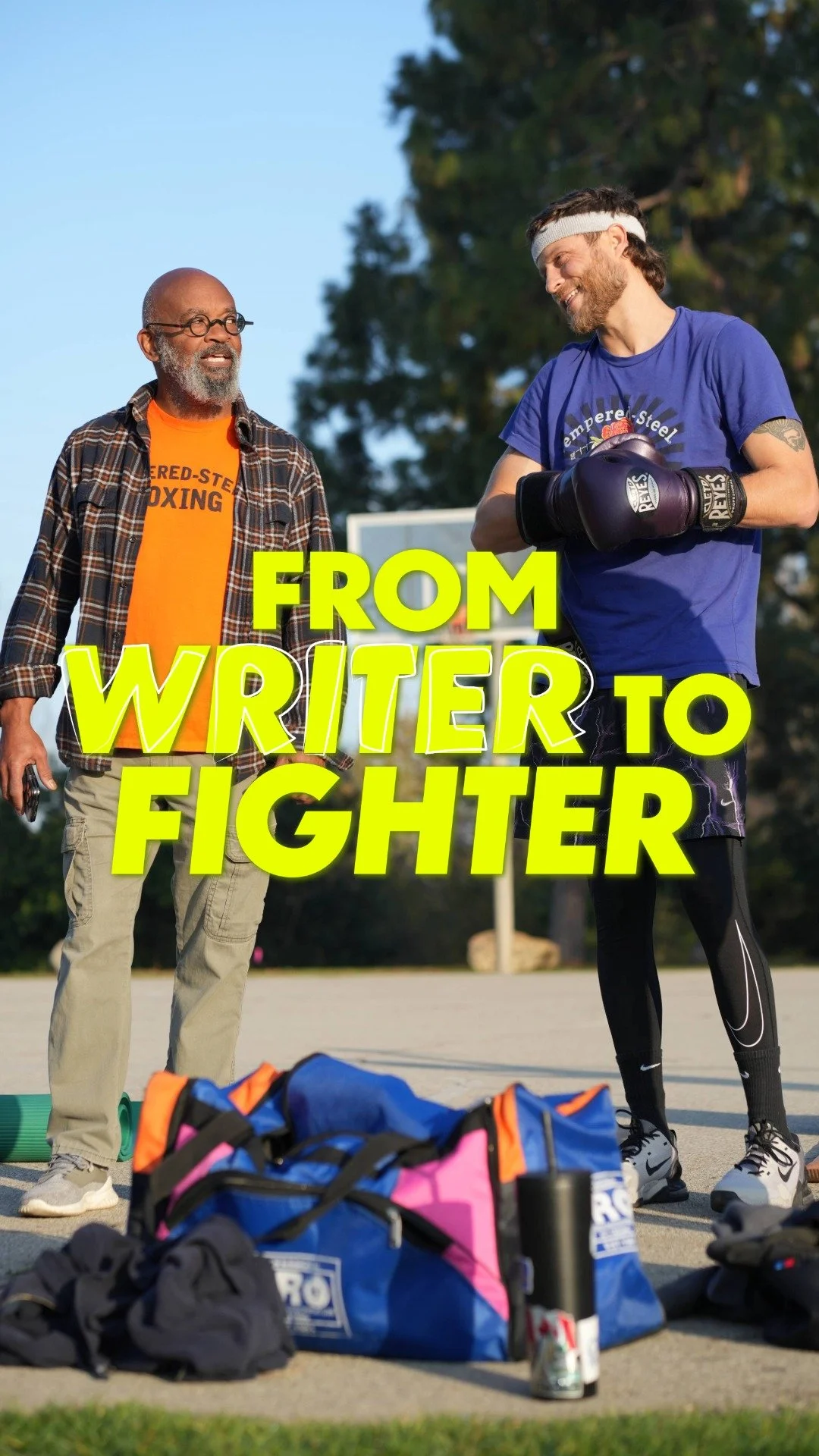
I stumbled upon his podcast series while searching for audio about boxing that wasn’t simply a rundown of previous fights. I wanted something that would invite me into the ring rather than explain the ring from a distance. Something that might allow the listener, or the reader, to inhabit the sport. As I looked it over, I saw the following:
Josh Corey is a comedy writer with a serious obsession: boxing. At age 37, with his wedding fast approaching, Josh gives himself six months to transform from writer... to fighter. What begins as a fun challenge leads to vulnerable conversations about identity, anger, love, and loss.
I listened intently. With an open ear. With my body. With my jab still intact. I found, in the listening, a fellow writer. A fellow boxer. Someone I might, if the distance held, call a friend.
The architecture of this podcast—its relation to his father, his coach, his late mother—keeps returning to the body. For Corey, the body is a tool, yes, but also an instrument: something struck, something carrying the vibration of a grief he has not yet found language for.
And then comedy enters. It has a strange way of entering grief. Not to soften it, but to give it another pulse. “From Writer to Fighter” is profound. Thoughtful. But more than that, it is human. It lets the body laugh where the body has not yet learned how to say what hurts.
I then followed Josh on Instagram. He followed me back, which felt like a small opening. I eventually messaged him to ask if he would be interested in an interview. What follows is the result:
Can you tell us a little bit about your podcast and what inspired you to make it? What drew you to this particular story?
“From Writer to Fighter” is an autobiographical story about the six months preceding my attempt to fight in a real, sanctioned amateur boxing match, which just so happened to be a month before my wedding. It all circled this idea:
Why would someone take on a challenge to this degree and with this kind of ferocity?
I think I chose to make the podcast because a friend of mine had just lost her mother, and she was saying how her mom left behind all this media that she found extremely valuable. I thought this might be one of the most interesting things I do in my life. So I might want to leave some records behind for my children or grandchildren.
I knew I couldn't carry a camera around while I was fighting every day, but I knew it would be cheap and logistically feasible to carry around a recorder. I would record everything. That's where it started. Where it ended is another story.
Can you talk about how this project came to life and why the podcast felt like the right medium—specifically for “From Writer to Fighter?”
I'm a big fan of This American Life and Heavyweight [by Jonathan Goldstein]. With podcasts, you want to give the audience enough so that they can imagine their own visuals.
Boxing is extraordinarily visual, and not many people listen to boxing matches on the radio. It can be extremely sonic. The audio of it is a tease for the visuals, and I thought people's imaginations might fill in those blanks.
I was also working with some natural storytellers, though they didn't necessarily know it. My coach is a natural storyteller. He has an excellent vocal quality, and he likes to tell long stories. In a way, I think the visual places he takes you works better if you can close your eyes.
The podcast medium was also for practicality. I wondered how I could tell this story in a way that I could always have a means to record it, and for no cost. My recorder was $180, but I got mine secondhand. This is something anyone could do for free. There was no downside if I recorded weeks of this and then it amounted to nothing; I could always say, "Well, it's not like I'm over my skis here.”
Many of us come to boxing because it provides something we aren't finding elsewhere, whether that's discipline, community, or a kind of therapy. Could you talk about your relationship with your coach—and why he became such an important thread in the story?
Coach is an incredible person. I don't know what I'd do without him. He is a bit of a godsend in my life, in that he's sort of a parental figure, but he stands far enough at a distance [in the podcast] that he's sort of a hard version of a parental figure. He's rooting for me, but he's also protecting me.
My father lives in the Carolinas right now, and my mother's deceased. I don't have parental figures in my immediate orbit. Not that I met Coach, and he was like, "Hey, I'll act like your dad.” It just grew into that because I see him three or four times a week.
Boxing became a gateway drug to his wisdom. The thing about Coach is he's had this relationship with lots of his students. In fact, he spent a lot of time with comedian/writer Gary Shandling [of the Larry Sanders Show]. Shandling wanted to make a documentary about Coach. The footage is somewhere, but I haven't found it.
I'm definitely in good company. I'm not the only person who thinks Coach has a story in him. He likes to share lessons, and he’s done so in the past with many of his students.
“From Writer to Fighter” features very remarkable conversations with men you encounter in your boxing journey. Can you talk about those encounters and what they reveal to you about masculinity, vulnerability, and yourself?
Junebug [David Miharis, Coach's son] was an undefeated Pro-Boxer. He retired due to a life-threatening liver issue [and a liver transplant]. I was just re-listening to the conversation I had with him, where he said, “I could go to therapy instead, but I’m not going to.”
I realized what he really said was that he likes to keep his anger and spend it in the ring, rather than go talk it out with a therapist. The subtext being: if one goes to therapy, one won’t be as good a boxer.
The way he accesses the need to win is by leaving that anger somewhere deep in his body. Where he can go grab it when he needs it. Searching for that “killer instinct” for me, when I hurt people, I couldn't move forward. It was like there was a pause, a breath between those things—and it was just enough time for my opponent to recover. I thought that when I got to be a good boxer, there would be no breath, there would be no pause; there would only be a wound—and a kill.
Sport is pretend war. Sport is also not a real battle. There's a referee. There's an audience. We know it has an endpoint. Being primarily raised by my mother—a single mother—who preached compassion, even in pretend war, I couldn't override compassion. A specific brand of masculinity had been instilled in me.
I dwelled on these masculine aspects of toughness—a lot. I talked to many men from different generations. Coach was guarded, but on the other hand, he wanted to tell you a lot. He just doesn't want to tell you a lot about his feelings. He wants to tell you a lot about life and how people feel.
My dad was even more guarded. My experience of my father, I held tight. Our conversations were incredible. I'm so glad I had that conversation with my dad about his regrets, his forgiveness. It was the biggest accomplishment in “From Writer to Fighter” for me—it didn’t matter how the podcast performed after that.
In documentary—and in creative nonfiction writing—there's often an ethical question of where to center people who may not want to be part of the story you’re telling.
How did you navigate constructing your relationships around your story, more specifically with your father?
I told my dad I was making a podcast about my relationship to sports, and I needed to record a conversation with him. He consented. He did not know that I was going to tell him I was boxing. So his reaction was natural.
I explained it to him as best I could. Ethically, it was easy. However, I have to admit, I did blindside him with certain questions. I followed up with, "Now you understand this is going to be part of the podcast?”
Where it got iffy was when I said, “The fight is over… I'm going to give you a call, and I want to tie up loose ends about how this all felt for you.”
I knew in that conversation I was going to offer him forgiveness. I wanted that closure. “From Writer to Fighter” is a lot more than about fighting. He got really emotional. I got really emotional. He was very vulnerable. He clearly forgot he was being recorded, and then I said, “I'm gonna show you a cut of this beforehand. So that you can approve things.”
I sent a cut of the last episode, and he called me, "Absolutely not!”
I said, "Really?” And he goes, "Why would you even record that? I didn't even know you were recording.” He did make me feel bad at first, like I duped him. But of course the reality was that I hadn't. We had to negotiate quite a bit. I made compromises. In general, he let me keep the meat of our conversation, and I give him a lot of credit for that.
For him, it was like I was displaying his emotions, and the thing that he said that I won't forget: "People are going to think I'm so weak. I sound so weak.” I said, on the contrary, I think people are going to be really impressed with this display of emotion—and find it rather courageous.
As Indigenous people, we are consistently aware of the central role mothers often play within our communities, even in the slightest. A mother figure is usually hidden somewhere in the margins of our work; the split second of a scene, a single line of a poem.
Could you speak about how you carry your mother with you between writing and boxing—and how her voice continues to shape that practice and your practice?
I did not realize how out of control my life had become before I started boxing, and a lot of that was about my mom. She had stage four cancer, which had metastasized into her bones and her lungs—which was to say, she was terminal. The process of navigating cancer is extraordinarily chaotic. Everyone is powerless. That lack of control was maddening for me.
For me, it was “Let me get in good shape. Let me eat healthy. Let me go to all these specialists. Let me try everything.”
People react to crises in different ways. When you don't have control, you try to find a way. The thing I miss most about my mom, who's passed away now, is the ease with which we could have conversations. My mom was extraordinarily encouraging. Whether I was playing middle linebacker at 65 pounds or fighting a boxing match with next to no experience. Even at age thirty-seven, six months before my wedding, she always believed in me.
I think, in a way, I took boxing seriously because it was something that I could control. I could get in a ring with another man and try to land punches, then have him try to land punches on me. There’s a simplicity. It felt like control. It felt like something I could handle.
Boxing became a metaphor for fighting for my mom.
Boxing has been utilized as a metaphor for a kind of American iconography. An image that says this person will do what it takes to get what he or she wants. Whatever that is, whether it be beating cancer or getting over grief, there's kind of a success story at the other end of it—a Cinderella story.
There's something patriotic in that construction of the Boxer in literature and film. Yet it doesn't feel that way here. I want to ask if you can speak a bit about your relationship to grief and the sport of boxing.
With grief comes anger. Whether we acknowledge that or not. Everyone feels some form of anger. With the injustice of losing someone, boxing is a great outlet for anger. It's not always an appropriate outlet, but you can certainly throw a body shot, and there is something cathartic about that.
To speak to Coach's grief, who lost his wife suddenly and tragically in the course of this story, he sees life as this one big fight we're in. And you're going to get hurt. Coach would say the boxing equivalent of grief is taking a hard body shot and figuring out what you're going to do next. Are you going to go down? How long are you going to go down? If you get back up, how long can you fake it before you can throw a return punch?
There are all these choices that we have, an array of reactions, and they're all grief responses. They're all pain responses, and they speak to one's resilience.
My grief is really fresh right now, and boxing doesn't always treat it. I have a wonderful grief group that helps me by getting things out, talking about them, and keeping the memory of my mom alive.
Boxing doesn't do that, so I don't want to give it too much credit.
Endnotes:
Josh Corey would like to give credit to those behind the scenes:
His producer, Xander Lott, who is also the sound engineer and supervising editor of “From Writer to Fighter.” Lott worked for Netflix and is a longtime collaborator of Corey. He wrote the score for Corey’s senior thesis film when he was twenty-two years old. Lott was also the sound supervisor for a parody podcast Corey created six years ago.
Corey’s goal was to make From Writer to Fighter a cinematic experience. Lott helped him accomplish that and contributed heavily to sound design.
Josh also wants to credit his story supervisor, Hillary Sterling, who had been working as a development executive at the CW. She's also part of Corey’s “boxing family.”
Corey would see Sterling three times a week, carrying a recorder. He presented her with a very early cut of the pilot episode. To which she responded, "This is good, but you know what's interesting about it? These parts where you're getting real.”
He would also like to credit his good friend, Tristan, who encouraged him to get into the personal story for “From Writer to Fighter.”
Corey stated, “Without them, I don't know if ‘From Writer to Fighter’ would have taken shape in the same way. So I just wanted to shout out those folks because when your name's not on something as small as a podcast, it can get lost. I couldn't have done it without them.”