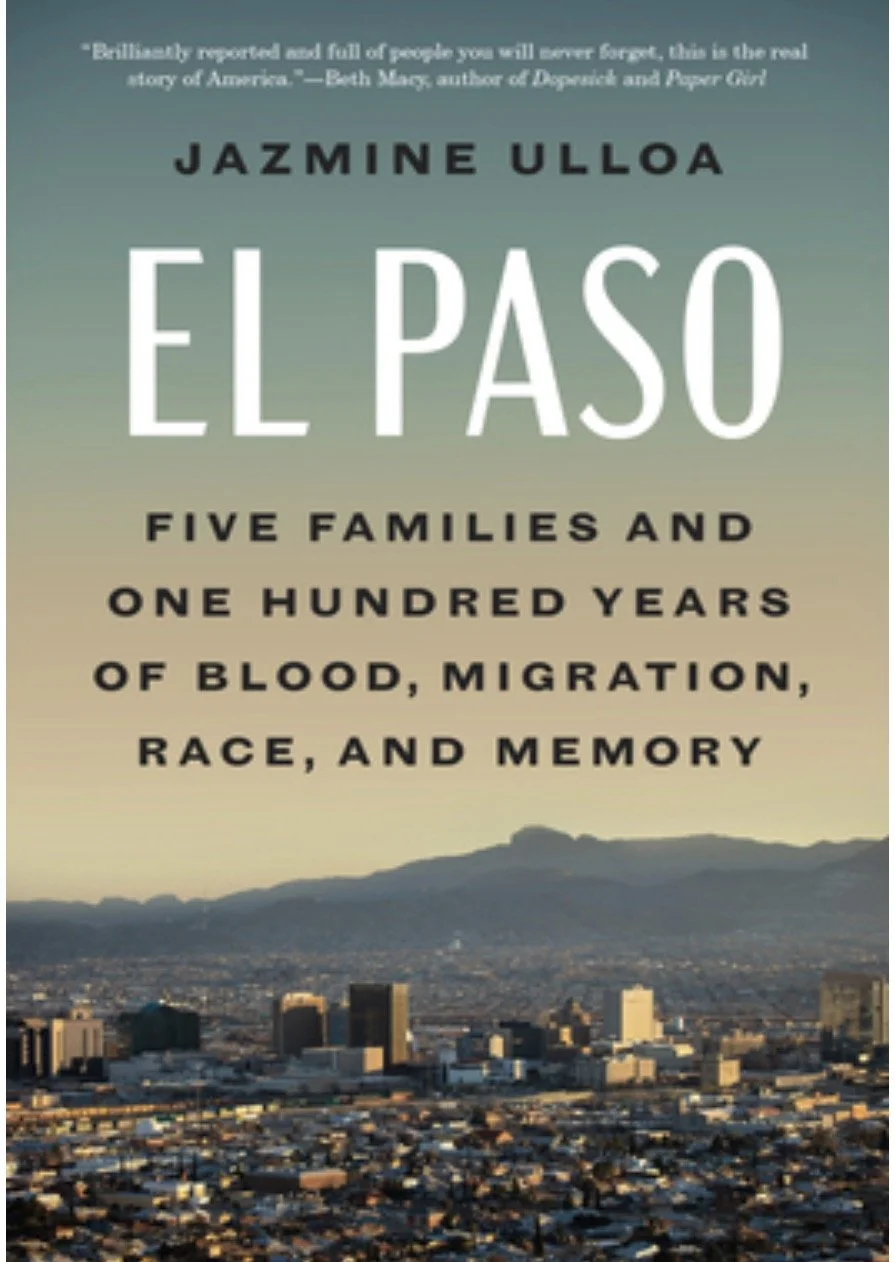
Book Review of “El Paso: Five Families and One Hundred Years of Blood, Migration, Race, and Memory
Book Review of El Paso: Five Families and One Hundred Years of Blood, Migration, Race, and Memory
Written by Jazmine Ulloa
Published by Dutton, an imprint of Penguin Random House
© 2026
337 pages
by Rey M. Rodríguez
El Paso: Five Families and One Hundred Years of Blood, Migration, Race, and Memory by Jazmine Ulloa proudly and forcefully argues that this city’s history, people, and binational nature must be brought directly into the center of U.S. history much like Ellis Island or the American Revolution are, instead of being relegated to the margins of our nation’s narrative and simply revisited every time an immigration crisis explodes.
As someone who was born in El Paso but later moved to Colorado, then to the East Coast, and finally to the West Coast, U.S. history seemed to always traverse time and space from the East to the West.
And, growing up, the history of the West always seemed incomplete. Mesa Verde National Park’s oldest human artifacts date back over 10,000 years. So-called Chaco Canyon in what is now called New Mexico features sacred structures that are roughly 1,000 to 1,200 years old. Santa Fe, the current capital of New Mexico, was founded in 1610. Yet, I never saw these facts referenced in any U.S. history books I read in high school or college. I did hear about the Pilgrims who landed in 1620.
Historians, almost uniformly white and male, ignored, mischaracterized, or erased Indigenous history. They often did the same regarding any history coming from the South to the North or West to the East.
So when I finished El Paso, Ulloa’s argument seemed so natural, refreshing, and rewarding to read after so many years of, at best, ignorance or neglect, and, at worst, “history’s” attempt to support a policy of manifest destiny or a white-nationalist storyline.
Ulloa’s book invites us to reconsider this incomplete narrative and warns that if we do not, then we do it at our peril. And not for all the obvious reasons one can imagine, but for a more urgent one: it puts people relegated to the margins in danger and, in turn, threatens the fabric of our democracy and society. To put a finer point on it, George Orwell once said, “The most effective way to destroy people is to deny and obliterate their own understanding of their history.”
The book's genesis emerges from a tragedy that haunts me still today because it seems to have been so quickly forgotten from the nation’s conscience — the wounding of many and the killing of 23 people at a Walmart in El Paso by a white supremacist traveling 10 hours across Texas because, as his lawyer explained, he did it to “dissuade Mexican and other Hispanic immigrants from coming to the United States.” The killer’s motivations naturally seemed to flow from a president’s words, who, at the time, fanned the flames of xenophobia with his warning that America was being invaded by immigrants from the South and crying out to build a wall on the border between Mexico and the U.S. to stop the hordes.
Ulloa devotes an entire chapter to the El Paso massacre. Indeed, she makes references to it throughout the book. The victims ranged in age from 15 to 90 years old and included U.S. citizens, Mexican citizens, and one German citizen. Many were shopping with family members on a busy back-to-school weekend. The attack is widely recognized as the deadliest anti-Latino mass shooting in modern U.S. history.
We must never forget their names: Javier Amir Rodríguez, 15; Andre Pablo Anchondo, 23; Jordan Anchondo, 24; Guillermo "Memo" García, 36; Leonardo Campos, 41; Ivan Filiberto Manzano, 46; Maribel Loya Hernández, 56; Elsa Mendoza Márquez, 57; Maria Eugenia Legarreta Rothe, 58; Arturo Benavidez, 60; Jorge Calvillo García, 61; Gloria Irma Márquez, 61; David Johnson, 63; Margie Reckard, 63; Alexander Gerhard Hoffmann, 66; Sara Ester Regalado Monreal, 66; Adolfo Cerros Hernández, 68; Maria Flores, 77; Raul Flores, 77; Juan de Dios Velázquez Chairez, 77; Teresa Sanchez, 82; Angelina Silva Englisbee, 86; and Luis Alfonso Juárez, 90.
Ulloa’s work honors them and begins to develop a more complex and rich story of a place where Mexican-Americans, Blacks, Anglos, Chicanos, Indigenous people, Mexicans have always lived, and immigrants who came to the U.S. from Latin America and other parts of the world, including those like the Chinese, are very much a part of the fabric of this country’s history and therefore very much belong to our narrative. The more we bring these stories to the center, the more all are protected from the violence directed at the other.
Ulloa’s success in centering El Paso stems from being raised in the city and from being a highly trained New York Times reporter. Her lived experience and training teach her to tell the story of this border area through stories of five families, because, among other reasons, we can all relate to the complexities of our families. They are messy, and who can resist hearing about family lore?
The family histories propel Ulloa's storytelling, creating a page-turner that encourages the reader to learn more about them and the historical context they must confront.
Throughout the book, we learn many things that we should know but have been generally untold in the national conversation. I invite readers to buy the book to learn them. But just a few to mention include the impact of the Mexican Revolution on U.S. history, the unnecessary delousing and chemical fumigation of Mexicans, especially poor Brown ones, at the U.S./Mexico border for over 50 years, which the Nazis studied and then used against Jews and others in Germany, the shifting immigration laws over the years including the Bracero Program, Operation Wetback, the immigration law of 1986 that gave amnesty to millions of undocumented immigrations, and the cruelty under the T**** administration’s tenure.
Ulloa’s book became personal to me because the day that I heard about the El Paso shooting, I cried during a talk at work I had been asked to give. The El Paso connection between this city and me, even though I was only born there, proved too powerful to forget that those lost could have been my parents, sons, or family. The killer’s motivation was too filled with hate, ignorance, and rage to imagine. It overwhelmed me. How could someone hate another to kill so indiscriminately? As I reflected on the moment during my talk, the tears fell easily and without apology.
So when I read El Paso, I connected with it at so many different levels. Ulloa’s book is an important brick in the construction of our country’s history; without it, the incomplete narrative of how this country emerged puts those on the margins in danger and, in turn, all of us because they are often what supports our democracy. Moreover, those on the margins have much to teach us.
In researching for this book review, I learned that the families of those who were killed decided against the death penalty. They did so for many reasons, including that some thought that it would be a greater punishment for the killer to live for the rest of his life with the horrific thought of what he had done than to be executed, but others did so as a specific kind of forgiveness. A forgiveness that would give them closure and help them to move on. One family actually asked to hug the killer during sentencing, and the judge permitted it. For them, there was enough hate in the world, and they had no intention of adding to it. El Paso has much to teach us above and beyond pure history, and Ulloa’s El Paso is an extraordinary place to start learning from it.
Published by permission of La Bloga
Rey M. Rodríguez has an MFA in fiction from the Institute of American Indian Arts. He recently released his debut book of poetry, Todos Somos Sagrados / All Are Sacred (El Martillo Press 2026), and he is working on a novel set in Mexico City.