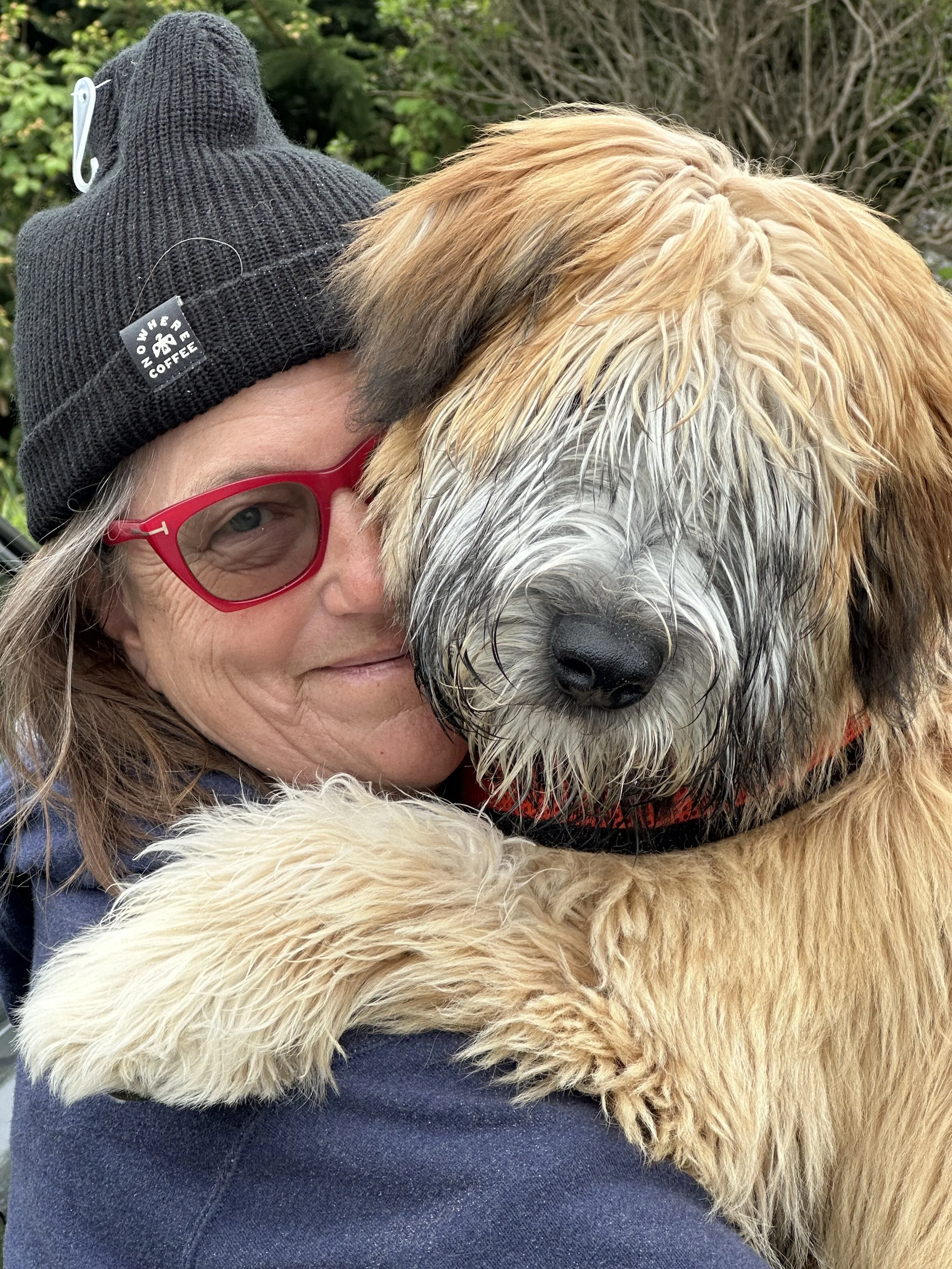
Interview with Pam Houston, author of “Animals Taught Me Everything.”
by Rey M. Rodríguez
The Institute of American Indian Arts has many extraordinary teachers. Pam Houston is one of them. She is the author of the memoir Deep Creek: Finding Hope in the High Country, as well as two novels, Contents May Have Shifted and Sight Hound, two collections of short stories, Cowboys Are My Weakness and Waltzing the Cat, a collection of essays, A Little More About Me, as well as a book of essays between Houston and environmental activist Amy Irvine, called Air Mail: Letters of Politics, Pandemics and Place, and Without Exception: Reclaiming Abortion, Personhood
Her stories have been selected for volumes of The O. Henry Awards, The Pushcart Prize, Best American Travel Writing, and Best American Short Stories of the Century, among other anthologies. She is the winner of the Western States Book Award, the WILLA Award for contemporary fiction, the Evil Companions Literary Award, and several teaching awards. She is also the Professor of English at UC Davis, and co-founder and creative director of the literary nonprofit Writing By Writers.
I had the privilege of being one of her students, so I was delighted to have a seemingly exclusive opportunity to interview her before the release of her transformative and highly acclaimed new book, Animals Taught Me Everything. The book and this interview give, in addition to many other lessons, more insight into how Houston achieves a sort of magic with her students and readers.
In the first chapter, she writes that animals taught her, among many other things, how to fly and how to work. As her student, she did the same for me. She taught me that writing is not all about the craft, although that is important, much like when riding a horse and we think it is all about the horse. Instead, it is about finding that flow into the truth of what you are writing, much like it is to “sink your sit bones into her [the horse’s] spine like some cosmic blow torch has melded the two of you together, . . . , finding her rhythm, and pushing her forward, into the next gear, into the next turn, into the sky if you are both lucky and brave enough.”
She also taught me how to work. One does it with your whole heart. This is what she learned from the animals. And so, she teaches with her whole heart, and the student in turn learns to write with purpose and meaning. As she mentions in the interview, she is not teaching so that the students write like Dostoyevsky. On the contrary, she is doing that so they write what they must write with vulnerability and honesty.
Animals and Houston have much to teach us if we open our hearts. I hope this interview invites you to do so, and to read her new book.
Pam Houston, welcome to Storyteller’s Corner at Chapter House, the literary journal of the Institute of American Indian Arts. Thank you for being here.
It’s my pleasure, Rey. It’s always a pleasure to talk with you.
You’re one of my literary heroes, so this is a real treat. I’m very grateful. I’d like to begin at the beginning: How did you come to writing? Have you always written?
Pretty much. I was the only child of parents who struggled with addiction, and I had a terrific caregiver named Martha Washington who taught me how to read when I was two or three years old. She paid me quarters and nickels to read cereal boxes, and then we graduated to books.
I call her a babysitter, but that isn’t quite right. We weren’t of an economic bracket where anyone would have used the word nanny, but she essentially never went home. She was deeply attached to me, and she knew I was in trouble in my household. She stayed around for eighteen years, until I got out of there.
Because she taught me to read so young, I read constantly. I also wrote silly little stories about animals—horses, mostly—and drew comic strips. That’s funny because I can’t draw to save my life now. I made little booklets and books.
The truth is, I have never not written. Reading and writing were as much a part of my childhood as eating, sleeping, and breathing. I didn’t think in those days that I would become a writer. I didn’t even know what that meant. But writing was a way to engage with the world. It was a way to tell what had happened to me during the day—the good things as well as the bad. It felt natural to keep track, in language, of what had happened.
When did you begin to consider yourself a writer?
It took a long time. I went to college and majored in English and geology because I loved the earth and rocks, too. Then I took a few years off before going to graduate school for writing.
At that point, I thought I might go to graduate school in literature—or even geology. I loved the physical sciences. I literally loved rocks and the earth, the layers and the stories they tell about time. I might also have studied animal biology, which was another subject I cared deeply about.
But I decided to pursue writing and went to the University of Utah. While I was there, I wrote Cowboys Are My Weakness, my first book. When it came out, it did surprisingly well. Everyone was surprised—nobody more than me. The book suddenly had this enormous life. I was appearing on NPR and experiencing things that were beyond my wildest dreams.
I remember being on an airplane on my way to a reading in the middle of all the Cowboys excitement. The woman sitting next to me asked what I did. Until then, I had always said, “I’m a student,” or, “I’m in graduate school.” But this time, I decided to try something new.
I said, “I’m a writer.”
She turned to her husband and said, “Did you hear that, Henry? This girl says she’s an underwriter—and she’s so young for that!”
I thought, Well, that didn’t go so well.
For a long time, I felt like someone was going to discover that I didn’t know what I was doing. Fraud might be too strong a word, because I wasn’t trying to fool anyone, but there was certainly a sense of doubt.
It took me a long time to write my second book, and I had a couple of manuscripts rejected between my first and second books. Throughout that period, I kept wondering whether what had happened with Cowboys was an accident. Had it succeeded simply because of the time and place? Was it not because I was talented or capable?
Learning to claim myself as an artist and a writer ran alongside the process of aging and acquiring some wisdom—the gradual end of apologizing for yourself and for who you are in the world. It isn’t a complete end, of course, but I have grown much more accepting of who I am and what I do.
Given how I feel now, it’s hard to imagine how insecure I once was about all of it. When a woman turns fifty, and then sixty—and perhaps this is true for men as well—so much of the noise quiets down. I would have been terribly sad if I hadn’t made it to fifty or sixty, because I am so much calmer now and so much more comfortable with who I am.
That includes being able to apologize when I’ve done something wrong without thinking, Well, that proves I’m a useless piece of shit. Everything feels so dramatic in your thirties and forties. I love this time of my life.
I could say I began to consider myself a writer sometime in my forties. But even now, saying “I’m an artist,” “I make art,” or “I write books” can be difficult. It is still much easier for me to say, “I’m a teacher.” That rolls right off my tongue. A great deal of my identity is bound up in teaching.
Calling myself a writer remains a little harder, partly because of the reactions you get. I have ten books now, but to this day I can tell someone I’m a writer and they’ll ask, “Have you published anything?”
And I’ll say, “Well, in fact, yes. Yes, I have.”
The world makes it difficult to claim that identity, so I don’t think it is entirely a matter of self-doubt. But more and more, I can say it.
What does it mean to be a writer—to you?
I can’t speak for all writers, or for writing in general, but I believe my job—what I am here to do, what my writing wants to do—is to celebrate and honor the beauty that is still here on Earth.
I mean natural beauty, which includes human beauty, but also the animals, the trees, and the earth that raised me. I say this all the time, and people roll their eyes, but I truly feel that I was mothered by the earth—that the earth is my mother.
I feel that very strongly. I was mothered by the earth much more than I was by my actual mother, though I loved my mother, and she loved me. I received mothering from Martha Washington, whom I mentioned earlier, and from the earth.
I feel that my job is to pay attention to the earth and to write about her at a time when we are harming her so incessantly and so deeply. At the same time, I want to notice how resilient she is—how she continues trying to heal herself in spite of us, and how much she still gives us.
That is what writing is for me: singing about the earth during this time of great sorrow.
That feels like a perfect transition to the Institute of American Indian Arts. You have taught there for many years. What does it mean to teach writing at IAIA? Is it different from teaching at UC Davis or the other places where you have taught?
First, I want to talk about what the Institute of American Indian Arts has given me: a community of people who have taught me so much—about the United States, about family, about survivance. We could make a very long list.
As it relates to this book, I have spent fifteen years in a community that believes what I have always believed: that all beings are sentient. The tree has an opinion and a voice. So do the bear, the fox, and the mountain.
For whatever reason, I knew that as a child riding my tricycle around my little New Jersey suburb. But in the culture I come from, that makes you a “crazy cat lady”—or, in my case, a crazy dog lady or a crazy horse lady.
Being immersed in the literature that is read and celebrated at IAIA has affirmed that understanding. I had read Leslie Marmon Silko, N. Scott Momaday, and Louise Erdrich before, of course, but it is different to live within the community for which those writers helped lay the groundwork—to be in community with writers such as Toni Jensen, Brandon Hobson, Chip Livingston, Jake Skeets, Layli Long Soldier, and Kimberly Blaeser, among so many others.
Those writers have a very different relationship with the natural world than my parents did, or than many of the non-Native teachers I had. Being part of this community for fifteen years created a space in which I could write Animals Taught Me Everything. It allowed me to think, I’m not just a crazy dog lady, even though I come from a culture that, generally speaking, does not honor the sentience of all beings in the way this community does.
That is one of the many gifts IAIA has given me.
Is your teaching different there?
Yes, it is. I’m trying to think about how to describe that difference. There is simply much less pretending.
At a place like the University of California, for instance, there can be a kind of forced intellectualism that reveals itself through an artificial language everyone decides to speak. That can exclude people from certain backgrounds—not necessarily because of race, but because there is a great deal of performance involved.
I don’t mean to paint IAIA as a utopia. We have our struggles and problems to solve, as you know. But there is an absence of mean-spirited competition. Even though the students come from many different nations and from vastly different backgrounds—urban, rural, reservation, and non-reservation—there is a common ground. I hesitate to call it a shared moral center, but there is something that prioritizes family, the natural world, acceptance, and goodness. That can be absent from more mainstream academic institutions.
You know how we are always crying at IAIA? There is always some crying. To me, that is simply evidence that we are allowed to be human beings together.
Early in my time at Davis, a fellow professor told me she didn’t want me to think of her as a human being.
I asked, “How should I think of you?”
She said, “Gray matter producing text.”
I have never forgotten that. The statement lives in my head and says, Don’t forget where you are. But when I go to IAIA, that feeling isn’t there. We are unquestionably human beings together.
That is very true. IAIA has changed me, too.
Let’s turn to your new book. How did you arrive at the title Animals Taught Me Everything?
In my own mind, I was calling the book by the title of its final long essay. Every now and then, someone says something and I think, Okay, now I have a book.
When an elderly Icelandic man said to me, “A horse will not make a suicide,” I thought, That’s my book. Now I have a book.
But these days, nobody wants to put the word suicide on a book cover. Even I didn’t necessarily want that. I am trying to be a force for positivity. Suicide is real, and I address it in the book, but I understood why the publisher would not want it in the title.
For a long time, we circulated lists of possible titles. Editorially, we used silly working titles—Paminals, for example—just so we would have something to call the manuscript.
As we approached the end of the process, I was on the phone with Will Neville, who is now the publisher of Torrey House Press. He kept asking questions, trying to pull a title out of me: What was it about the trip to Namibia? How did I feel when I was riding an Icelandic horse? We probably talked for an hour.
At one point, I said, “Well, you know, animals taught me everything.”
He stopped me. “Wait. Let’s go back. What about Animals Taught Me Everything?”
This is the part of the conversation I love, and one reason I love Torrey House. I said, “This may be a dumb question, but do you think it’s literary enough? It’s a little plainspoken.”
Will said, “Pam, I think we’re too late in the history of the world to worry about whether it’s literary enough.”
I thought, You’re exactly right. We should simply say what we mean.
I love that. The first essay is structured through those boldfaced lessons—“How to Fly,” “How to Work,” and others. Why did you begin with “How to Fly”?
You never know exactly why you do something when you are sitting at the keyboard. But I wrote that essay toward the end of the process, in part to touch many of the other essays in the collection.
There are many reasons I wrote this book. But if I had to choose the reason that rises to the top—the thing that made me need to tell these stories—it would be what happened when I developed long COVID.
I thought my life was over. At the very least, I believed my identity was gone. I was so sick for a year that I couldn’t do anything. I am usually as healthy as a horse. I go and go and go, but for that year, I could do nothing.
I kept trying to adjust. I told myself, If you’re really wise, you can adjust to this. But I couldn’t.
Then the Icelandic horses brought me back to life. They taught me that I could move again—that I could fly and live again. I think that is why my impulse was to begin there.
Last night, I gave a Zoom reading. After a long conversation, they asked me to read for only three minutes, so I chose four of the “how-to” passages. I kept telling myself, You don’t have to begin with the horse. You could begin with “How to Work” and fit in another passage later.
In the end, I realized that I did have to begin with the horse. That is where the book begins.
I also like that the opening is slightly illogical. The reader is immediately inside the experience, already riding. Some of the other lessons are more direct: How do you work? You work with your whole heart. But “How to Fly” places you on the horse before you have had time to orient yourself. I like that about it.
Even for a reader who has never encountered an Icelandic horse, the passage puts you there. You begin on that horse, thinking, That must be an extraordinary feeling. It invites the reader to imagine what experience in their own life might feel the same way.
One of the passages that struck me most was “How to Forgive.” It is very short, but it feels profoundly important: “Instantly.”
Forgiveness may be one of the most difficult things to learn, especially in a world filled with pain. I believe forgiveness can lead us toward grace, yet we don’t practice it often enough. You didn’t need to write much in that passage because those few words say so much. Could you elaborate on it?
That was one of the passages I wrote very quickly. It simply came out that way.
I have talked with friends who, like me, had parents who caused them a great deal of harm. The question always arises: “Did you forgive your father before he died?” Or, “Did you forgive the person who hurt you?”
What I say in those conversations is that I don’t think I can forgive my father. I simply want to understand him. For me, understanding him feels more important than forgiving him.
That is where I have arrived in relation to my father and his abuse. It is not that I am consciously denying him forgiveness. It is that, in this context, I’m not sure what the word forgive would mean. It has been much more useful for me to understand the traumas he experienced and how he passed them down. In this case, understanding feels more meaningful than forgiveness.
But the passage in the book is about what we can learn from animals, and animals forgive you instantly. By observing them, I try to practice forgiving people instantly for the smaller, more momentary injuries—the broken promises and everyday hurts.
I wrote those words in perhaps fifteen seconds, and then I thought, Oh, that’s true. Because sometimes the labor of trying to forgive someone may not be time as well spent as simply forgiving them and then rebuilding trust.
But it was also very important to follow “instantly” with “or never.” Terrible harm is done to people. We are watching enormous harm being inflicted on people now, often in our name. Some things may be unforgivable, and we cannot pretend otherwise.
I would never tell anyone that they must forgive an abuser, whether that abuser is a government, a father, a former partner, or anyone else. Every person has to make that decision for themselves.
This may be a strange question, but what does forgiveness mean?
That is a difficult question. I don’t know.
When someone asks whether I forgave my father before he died, I think, I don’t know. I don’t think so. But then I come up against the question of what forgiveness actually means. To forgive someone, you must first believe you are in a position to grant or withhold forgiveness. Whenever I wrestle with this the following phrase rises in my mind. “It’s God’s job to forgive, not mine.” Which is funny, because for me God takes many forms (horse breath, the mercuried surface of a river in late afternoon light, meadows of moving prairie grass) but rarely a guy in a chair handing out pardons.
I think often about the word reparations. That word has more heft for me, although it has a different meaning.
I once had a conversation about this with the poet Terrance Hayes. My father had left me a small amount of money—essentially what he had remaining when he died. It wasn’t very much, but it could have paid for a new roof on my house, which I needed at the time.
I didn’t want to take the money from his stockbroker because I didn’t want my father inside my house. I didn’t want his money to become the roof over me. I argued about this with my therapist, who said, “It isn’t his money, Pam. He’s dead. It’s your money.”
But I couldn’t make that leap.
When I told Terrance about it, he said, “You should take the money.”
I asked him why.
“Because it’s the only reparation you’re ever going to get.”
That rang true. I had never thought of myself as someone who had reparations coming to her.
I realize that reparations and forgiveness aren’t the same thing, but I believe they are related. My father had not intended to leave me any money. He would have preferred to spend every cent, and, frankly, I would have preferred that, too. If he could have gone on one final cruise and then fallen overboard, that would have been perfect.
But this little bit of money remained and created a complicated situation. Terrance told me, “It’s the only reparation you’re ever going to get. Accept it.”
Acceptance is at least a close cousin to forgiveness. But I certainly don’t want to be the person who defines forgiveness for anyone else. Eventually I moved the money into my name. I used it to go on a trip to the Galapagos. That felt better than the roof. Great, but inessential.
What I do know is how it feels when I’ve been hurt and then tell myself, Don’t hold on to this. Let it go and see what happens next. I do that often. It is much more complicated with my father because I was a child and he was an adult. But with other kinds of pain, I recognize the moment when I have a choice: I can make myself miserable by holding on to the injury, or I can let it go and begin again.
That may be another gift of age. I understand now that there is no benefit in clinging to a hurt I am capable of releasing. Letting it go makes things better for me and for the other person.
Animals understand this within a herd or a group. They may fight over food or a toy, but ten minutes later, when a coyote enters the yard, they have to cooperate to chase it away. Animals forgive quickly.
A good friend of mine became deeply involved in restorative justice after two of her brothers were killed. She had to work toward some form of forgiveness for the people who killed them.
At one point, she was prepared to go to prison herself in pursuit of what she then considered justice—an eye for an eye. But her mother taught her to forgive. She eventually devoted her life to restorative justice and to bringing people together.
It did not always work. The process was messy. Sometimes people were not ready for it. But I think age helps us understand that many of the things we once considered important are not. Only a few things truly matter.
That brings me to the dog and the wagging tail in your book—the lesson about joy. Is joy really that easy? The dog sees you and immediately begins wagging his tail.
It isn’t only the wagging. Bodie throws his front legs into the air. As if he is saying Hallelujah. Hallelujah, my mom has returned. It is the cutest thing.
I do think joy is that easy for dogs—or at least for this particular dog. I also think it can be easy for me. My brain will bring back the shadow, the fear, the anxiety, and the weight of the world quickly enough. But I have always been able to surrender myself to joy.
I try to place myself in joy’s path. That is one purpose new places serve in my life. It is also what riding horses does for me, along with almost any interaction with an animal.
Bodie is such a teacher of joy. He is emotionally complex, so it isn’t that he is joyful all the time. But when he feels joy, he surrenders to it completely, in the most beautiful way.
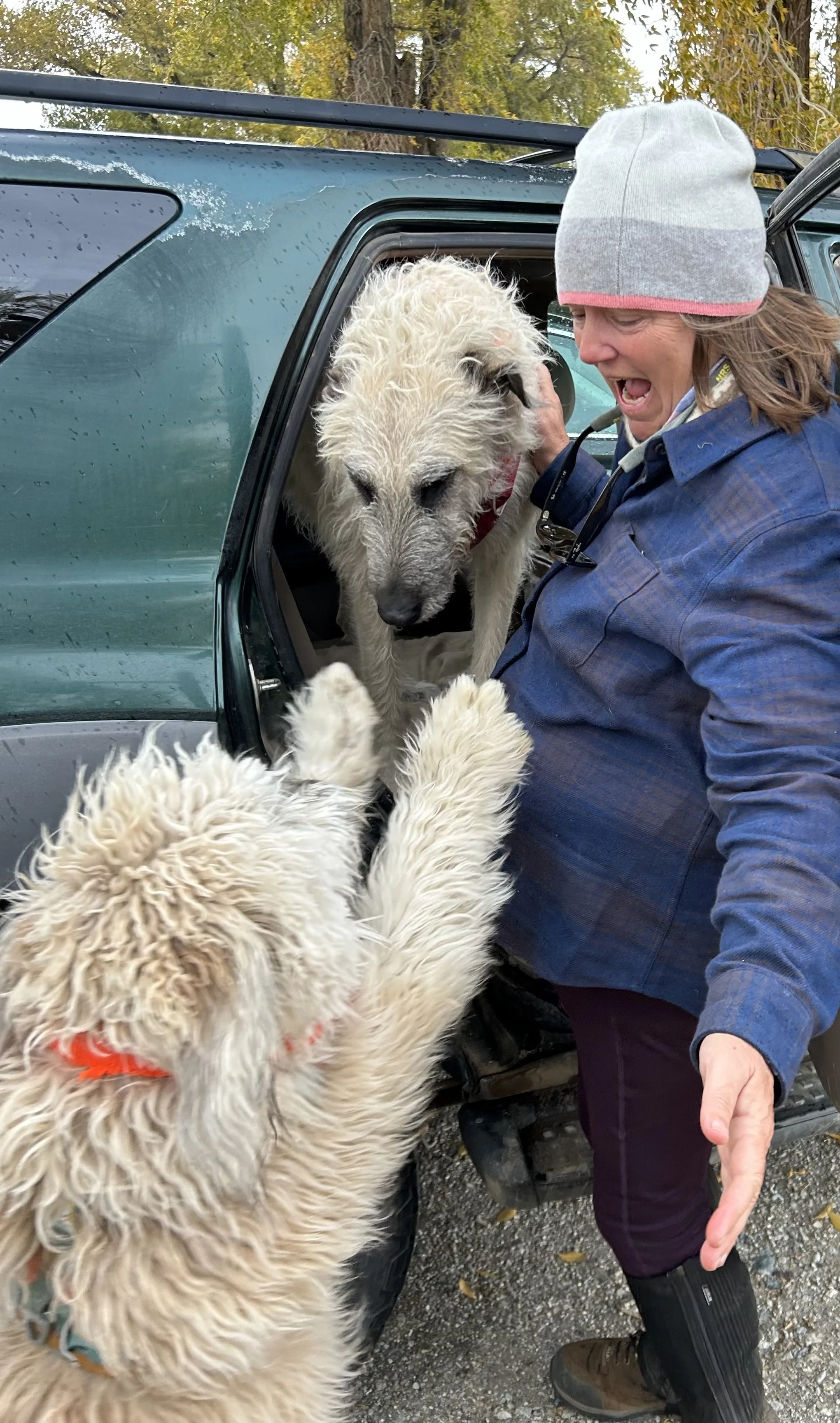
Look at him. He isn’t even jumping on me. He is simply throwing his arms into the air with happiness.
Do you think joy is a baseline? I have been exceedingly joyful for most of my life, but that doesn’t seem to be the norm for everyone.
You write about having a writing practice. Do you also have a joy practice?
I do. In one sense, that is what the “glimmers” are. My entire writing process I based on glimmers, and when I am collecting glimmers I am collecting joy. Not that all glimmers are beautiful—some are ugly or sad—but collecting glimmers is part of my joy practice.
CMarie Fuhrman, whom I adore more every time I speak with her, says that joy is fuel for the resistance. You cannot sustain resistance without joy. You cannot engage with fascism unless you have joy as literal fuel in the tank. That feels true to me.
Some people suggest that if we are joyful right now, we must not be paying attention. But I am paying attention. No one is going to tell me otherwise—and I still need my joy.
I need joy to get out of bed and do the things I must do: to resist and to elevate other people who are resisting. The beauty of the earth and of the beings who inhabit it—human and more-than-human—creates that fuel.
Without joy, we risk turning ourselves into the very people we are resisting. I cannot remember the last time I saw anyone in the administration smile or laugh.
No. People often ask how those individuals are going to be punished. Certainly, it would be good to see accountability, but being who they are already seems like a form of punishment. They appear to be punishing themselves with their own minds. No one has ever looked more unhappy.
That doesn’t make their actions any less terrible, of course. But they certainly don’t appear to be enjoying themselves.
When you write about animals as teachers, what must a human being surrender in order to become their student? Is there a danger that we will impose ourselves upon animals—that we will simply make them human?
That is an important question. As you know, there are places in this book where I speak for the animals. It is a pleasurable writing exercise, and I think it can be pleasurable for the reader, too.
I believe I am fairly attuned to an animal’s emotional life, but I don’t fool myself into believing an animal would express its feelings in the way I imagine—let alone in complete sentences.
The most important thing is to treat animals as unique, individual beings responding to the stimuli in their environment, just as we do. They have complex reactions shaped by the combination of their life experiences and whatever is happening in the moment.
People have told me, “You write animal characters so well.”
I say, “To me, it is no different from writing a human character.”
When writing animals, however, you must remember that their sensory experiences may be very different from ours. Human beings are highly visual. Unless someone is visually impaired, sight provides an enormous percentage of the information we take in. For many animals, scent comes first. They do with their noses what we do with our eyes.
I think it is important to write them with the understanding—whether that understanding appears explicitly in the prose or simply remains in the writer’s mind—that you are representing them to the best of your imaginative and emotional ability.
I teach a seminar at Davis called “The Literature of the More-Than-Human World,” and we have many conversations about anthropomorphism. We ask whether we are appropriating animals’ minds in the way we might discuss writing across cultures. Perhaps we are.
CMarie Fuhrman says something about anthropomorphism that I love. She says, “If I write, ‘The fox moved slyly across the backyard,’ you will say that I am being anthropomorphic. And I will say to you: It was the fox who taught me about slyness.”
I love that so much.
When you look at animals now—when you see how whales are trying to survive or how bears are trying to survive—no one could convince me that human beings know better. Full stop. We certainly don’t know more about survival.
We have opposable thumbs and a great many tools. But when it comes to basic survival skills, we aren’t scoring very highly right now. The animals are trying to survive around us.
Even if we sometimes misrepresent them, I believe it is imperative to write about animals at a time when they are being exterminated at such a staggering rate.
I may risk misrepresenting something my horse, Óski, might say to me. But taking that risk is preferable to remaining silent about the intelligence, good nature, and generosity of a horse.
I love the moment when you seem to merge with a horse moving at full speed. As a reader, I’m on that horse with you. What does it feel like when you are no longer separate beings but have become one?
People say that horses co-regulate. Someone told me there are three animals capable of co-regulating with another animal—including a human being—an elephant, an orca, and a horse. I don’t know whether that is scientifically true; I haven’t researched it. But I do know there is something involving the heart rate, and perhaps the electromagnetic field, that draws people to horses.
I won’t claim that I’m not afraid. I am afraid, especially at my age. I have taken two very bad falls in the past five years. I’m riding horses incredibly fast over uneven terrain in the middle of nowhere, where no ambulance could reach me. I would be crazy not to feel fear.
But I trust my horse. That is what all of this is about: trust. The horse trusts the rider, and the rider trusts the horse. That is really what I’m writing about in this book.
If I take my phone out of my pocket to take a picture, the horse’s ear turns back as if to say, Hey, lady, I thought we were doing this together.
I have to be completely present with the horse, and the horse has to be completely present with me. We are communicating constantly—perhaps telepathically, but also through my legs, my seat, and the rest of my body. The horse communicates through the position of his head and ears and whether he pulls against the bit. Everything is communication.
When you achieve that harmony and come upon good ground—a smooth trail, a beach, tidal mud—you begin moving faster and faster. You can hardly believe how fast you are going.
Somewhere in that experience, the fear disappears. What remains is a kind of ecstasy.
For me, certain conditions must exist. I need to have established some relationship with the horse, even if we have developed it over only two hours. And I need relatively reliable footing before I can truly let go. In Iceland, there are lava rocks and other things that can trip a horse.
But then there comes a moment when everything lifts. You almost feel as though you are no longer touching the ground. That is partly co-regulation, perhaps, but it is also a kind of ecstatic trust.
That is surrender, the word you used earlier. You surrender to the experience and think, Well, if these are the final five minutes of my life, they’re pretty damn good. I’ll take them.
What was it like to receive the letter saying that you could have Óski?
Salka was the horse who taught me. Now I will be the one teaching Óski.
It was wonderful to receive that letter. Icelanders are very stoic. They don’t effuse, and they don’t particularly want you to effuse, either. Several weeks passed after the conversation where I asked Oski´s owner if he would consider selling him to me. I walked away from it thinking, He’ll write to me or he won’t.
There were plenty of practical reasons it would have been perfectly fine not to own a horse who lives on another continent. If Óski’s owner had decided not to sell him to me, I would have been okay. There are always more horses to ride and to fall in love with.
But when I received the letter, I said yes.
I have said yes to Iceland again and again because it has made me so purely happy—perhaps in a way I had never experienced before. I have often been happy. I have a happy and extraordinarily fortunate life. But this is a kind of bliss I may never have known before.
So I said yes again: Yes, I will own a horse who lives on another continent.
Óski has a wonderful life. When I’m not there, he lives with three hundred of his best friends. But receiving that letter was extraordinary. It meant a great deal that his owner trusted me. He told me he knew I would take good care of Óski.
I had taken a week’s worth of lessons from that man, so we knew each other a little. His trust mattered to me. I think about the fact that he trusted me, every time I am on Óski´s back.
Was bliss the medicine that brought you out of long COVID?
Yes. It was certainly the flight I describe in the Salka chapter. But it was also the process of relearning my own body and learning to trust it again.
I am a better rider now than I have ever been, even though I am older and perhaps even clumsier. I am simply a clumsy person. I fall down all the time. I am sensitive to a horse´s communication, and I have a great deal of stamina, but as a human being, I am very ungraceful. I’m all right in the water, but on land I’m a klutz.
Despite how much I have always loved it, I was never a particularly good rider. But I can truly ride these Icelandic horses. For the past five years, becoming better has been my principal focus. I have worked extremely hard and taken lesson after lesson. I haven’t fallen in two years—I should knock on wood.
I had to relearn my body. As you age, that becomes harder because you are losing certain abilities at the same time you are gaining others. You can’t simply whip yourself into shape. There are unavoidable losses in things like balance, which matters enormously on a horse. No matter how strong you become, how much you strengthen your legs, or how much yoga you do, some losses will come after sixty.
Long COVID left me barely able to push myself off the couch. I couldn’t breathe. I couldn’t remain upright past four in the afternoon. It was terrible.
I needed to want something. My acupuncturist recognized that when she told me, “Go home and find something to live for.”
I had to want something badly enough to fight my way back.
I wanted this. On that first trip, I was weak and yet I wanted it to go on forever. Afterward, I wanted to do it again and again and again.
Pam, I’ve taken a great deal of your time, so I’d like to end with a question we ask all writers: What is your best advice for emerging writers?
I think many beginning writers—and I certainly did this—carry an idea of writing that the world has imposed upon them. They have been taught how a writer is supposed to behave, how a writer should hold a story, or what literature is supposed to sound like.
I often tell the story of a teacher who once said to me, “You will never amount to anything until you learn how to write like Dostoevsky.”
It is such an absurd statement. My advice is the exact opposite: Don’t try to write like Dostoevsky.
If you have any hope of making writing your life—and anyone can—it will happen only if you become exactly the writer you are inclined to be. Listen to your truest voice and write from it, whatever that means for you and whether you are writing fiction or nonfiction.
Your best chance is to become precisely the writer you are. Don’t let other people tell you what a writer is or what kind of writer you should be.
We see this again and again at IAIA. It is a wonderful place to watch this principle in action. Sometimes I hear the premise of a book and initially think, Hmm, I’m not sure about that. Then the book comes to fruition because the writer had a vision and kept walking toward it.
It took me a long time to relax into the voice I have. But everyone who is inclined toward writing—everyone who feels a book or story pressing to be told—also possesses the means to tell it.
Be true to that intuition.
In workshop, if someone says something about your story that makes no sense to you, you can simply think, La-la-la-la-la. I’m not listening.
The workshop comments you should listen to are the ones that resonate with your inner voice—the ones that identify something you already knew but did not yet have the patience, energy, or wherewithal to put on the page.
And then, simply, read. None of us reads enough, especially when we are trying to become writers.
I think about the books that have mattered most to me during the past five years and how deeply they are influencing what I am writing now, in one way or another. The more you can read, the better. It is obvious advice, but it is true.
I feel that all your books are in conversation with Kiese Laymon’s work, particularly Heavy, because of your commitment to truth and vulnerability.
I love Heavy so much. I could not love it more.
The funny thing is that when it was published and everyone was reading it, it fell into a category of books that I sometimes avoid. When everyone is reading a particular book, I think, Well, I don’t need to read it. Everyone else already is.
So I didn’t read it.
Then, a couple of years ago, my friend Leigh Newman asked, “Have you read Heavy?”
I said, “No. Everyone else was reading it.”
She told me, “It is going to redefine memoir forever. Every memoir will be measured against it.”
I thought, Oh, shit. I have to read it.
Then I read it and loved it so much.
That first chapter—
Oh, my gosh.
The entire book is extraordinary. What strikes me about your writing, too, is its honesty. I don’t know whether we give ourselves permission to reach that level of vulnerability. It requires courage, and perhaps you have to give yourself permission to believe you possess that courage.
When I was writing Without Exception, my previous book, I had to write extremely quickly because it needed to be published before the election. I wrote it much faster than I would ordinarily write a book.
Throughout the process, I kept telling myself, Well, it can’t be all that pretty, so you’re going to have to make up for that with honesty.
That is also my dating life in a nutshell. It is how I have gotten through the world: what we lack in prettiness, we make up for in honesty.
I said that about the book to make myself feel better about turning it in before I believed it was ready. But that idea carried over into this book, too. I began to wonder whether honesty might be one of my strengths—and whether it might be an important strength.
No one in my graduate program would have told me that honesty mattered. They would have said what mattered was learning to sound like Dostoevsky.
But perhaps honesty is not merely compensation for prose that isn’t “pretty.” Perhaps it is a strength in its own right.
Kiese’s book is so deeply and complexly honest. I always say that the most important quality in memoir is self-inquiry, along with the narrator’s willingness to be accountable. You have to acknowledge that you play a role in your own life.
Heavy does that more powerfully than almost any other book I know. Kiese can be self-critical, but that self-examination allows us to see even more clearly the systems that have victimized him. The book brings together self-revelation and systemic racism in an extraordinarily complex way.
That is what I strive for. Heavy is not merely honest; it is complexly honest. That seems like a very good thing to work toward.
Pam, thank you so much. I’m always grateful to you as a teacher and mentor. Your honesty is a superpower. Thank you for being so honest, supportive, and generous.
Thank you for the interview, Rey. I really appreciate it.
Rey M. Rodríguez has an MFA in fiction from the Institute of American Indian Arts. He recently released his debut book of poetry, Todos Somos Sagrados / All Are Sacred (El Martillo Press 2026), and he is working on a novel set in Mexico City.