An Exclusive Interview with IAIA Alumni Crisosto Apache, editor with Julian Tanya, of “The Starry Field: A Gathering of Two-Spirit and Indigiqueer Poetry”
by Rey M. Rodríguez
Like an afternoon rain that we have been praying for because the land is so dry and the need is so great, a book comes along that quenches us and redeems us. One such collection is The Starry Field: A Gathering of Two-Spirit and Indigiqueer Poetry edited by Crisosto Apache and Julian Tanya.
Storyteller’s Corner had the privilege of interviewing Apache in a wide-ranging and exclusive interview that I hope will invite the reader to read this book, for many reasons, but mainly because of its invitation to walk in beauty.
Crisosto Apache is the 11th Poet Laureate for Colorado (2026–2027), a recipient of the 2026 Academy of American Poets Laureate Fellowship, Montalvo Arts Center’s Lucas Artists Fellowship, a three-time Pushcart Prize nominee, and a board member for The Offing Magazine. Originally from Mescalero, New Mexico, on the Mescalero Apache reservation, Crisosto is Mescalero, Chiricahua (Chair-a-cow-ah), and Diné (De-neh), with maternal and paternal clanships in the Salt Clan and Towering House Clan.
Apache holds an MFA from the Institute of American Indian Arts (IAIA) and serves as an Associate Professor of English and Creative Writing at the Rocky Mountain College of Art + Design.
Crisosto’s publications include the forthcoming 2nd edition of GENESIS (South Broadway Press), Ghostword—which won the Publishing Triangle’s 2023 Betty Berzon Emerging Writers Award and was a finalist for the 2023 Colorado Authors League Award in poetry—and is(ness), a winner of the Colorado Authors League Award, both published by Gnashing Teeth Publishing. For the past twenty years, Apache has advocated for the Two-spirit and Indigiqueer communities through local and national grassroots non-profit organizations.
Although not interviewed here, I wanted to mention Julian Talamantez Brolaski (Julian Tanya). Tanya is a poet and country musician, the author of Wild and Blue (forthcoming Wave Books 2027), Of Mongrelitude (Wave Books 2017), Advice for Lovers (City Lights 2012), and gowanus atropolis (Ugly Duckling Presse 2011). Tanya plays with the band Juan & the Pines, and their first full-length solo album It’s Okay Honey came out in 2023. Julian was the 2023–2024 Bagley Wright lecturer, a 2021 Pew Foundation Fellow, and the recipient of the 2020 Cy Twombly Award for Poetry. Its poems were recently included in Queer Nature (2022), When the Light of the World was Subdued, Our Songs Came Through: A Norton Anthology of Native Nations Poetry (2020) and We Want It All: An Anthology of Radical Trans Poetics (Nightboat 2020).
Crisosto Apache, welcome to Storyteller’s Corner of Chapter House, the literary journal of the Institute of American Indian Arts. We’re thrilled to have you here.
The Starry Field: A Gathering of Two-Spirit and Indigiqueer Poetry is a stunning piece of work. I’d like to begin with your own journey. How did you become a writer, and what brought you to this work?
That started a long time ago. I began as a painter. I never intended to become a poet or a writer. When I was in high school, I was really drawn to art, and my art earned me a scholarship to attend the Institute of American Indian Arts in 1989 and 1990.
I took some elective classes to fill out my enrollment, and one of those classes was with Arthur Sze. He laid a really great foundation for how I came to understand poetry. It wasn’t focused only on the classics; it was a much more contemporary approach. What he gave us became a platform for how I understood poetry then and how I understand poetry now. I still follow his work. He was an amazing teacher, and I still think about some of the things he talked to us about back then.
That’s really where the journey began. He convinced me to change my major from 2D design to creative writing. I had to give that some thought. But I was a poor young kid, and I didn’t have the resources to store my artwork. With visual art, you need a studio and all of that. Writing is portable.
That helped make the decision.
Arthur Sze also talks a great deal about translation, and I feel that the idea of translation runs throughout The Starry Field. How do you use English to translate profound Indigenous concepts when English may not contain the cultural meaning carried by the Indigenous language itself? That seems enormously complicated.
Right, and I think that’s the beauty of how I came to understand translation. Arthur talked a lot about translation even back then, and that encouraged me not to be afraid to use my Indigenous languages—Apache and Diné. I use them in my poetry all the time.
What I like about what Arthur says about translation is that there is no single authoritative version. Translation is about what the writer sees and what the writer uncovers at the moment they are interacting with a particular language.
That’s the beauty I see in using my language. It is so conceptual and so open that anyone who engages with it can sense that. At least in my experience of using my Indigenous language alongside English, the concepts aren’t limited to the corresponding word in English. They are conceptual and universal. They can stretch in many different directions. They’re very moldable.
That leads me to two Indigenous words that seem to run through the book— the Ndé (Apache) word “Guzhú” and the Diné word “Hozhó.” Their English translations are powerful, but translation can’t fully capture their essence—particularly for someone who isn’t a Native speaker and doesn’t possess the cultural context behind them.
Could you spend some time talking about those concepts and what they mean to you?
From my understanding, the Diné concept is often translated as “walk in beauty.” That’s the translation most people use, but I think it goes much deeper than that. It has to do with how you live—how you think, feel, and walk in the world. It encompasses belief systems and the foundations of how someone lives in balance with the world, even how you understand your existence as a human being.
It extends from the moment you wake up to the moment you go to sleep—and maybe even into the moments when you dream. It encompasses your perspectives and how you view life.
There is a similar idea in Apache. When I was younger, my grandmother explained it to me through an image.
Imagine perfectly still water. You place a single drop into that water, and ripples begin moving across the surface. The concept is about how you put that motion into play and how that motion extends outward. If what you put into motion isn’t right—if it is out of balance—it can eventually come back to you.
I’ve always thought that was a beautiful metaphor for how one lives. If you put another drop somewhere else, it creates another vibration that interacts with the others. Whatever you say and whatever you do creates an everlasting ripple. And that ripple should remain in balance throughout your experience.
That image is stunning because I feel as though this gathering of poetry does exactly that. It adds another ripple, another vibration, to our larger conversation about how we should interact with one another. Was that part of what you hoped the book would accomplish?
There really hasn’t been an anthology that focuses on new voices in this particular way. Julian and I went through our own books, looked online, and searched everywhere to see whether there was an anthology that really focused on new writers and new voices—not simply established writers.
We couldn’t find one. In many of the anthologies we looked at, the contributors were already established writers.
Our intention was to look for voices that hadn’t really been highlighted and to see what ideas could emerge from them. This became a wonderful project for exploring how new voices could expand the canon and landscape of Indigenous, Indigiqueer, and Two-Spirit writing. That literary territory itself hasn’t been fully explored.
So this gathering became a platform for discovering new voices within queer and Indigenous poetics.
It feels like this is only the beginning.
Yes. And if you look at the collection as a whole, it isn’t simply a book about queer poetry. Its scope is much more expansive than that.
One of the things we tried to do was move beyond simply labeling it a queer, Indigiqueer, or Two-Spirit anthology. The poems we chose speak not only to how an individual defines themselves, but also to the vastness of Indigenous cultures.
There isn’t one Indigenous experience. The book represents a broad range of Indigenous people—not only people living within reservation or traditional cultural settings, but people living in urban environments as well, and the different ways they understand themselves as Indigenous or as descendants of Indigenous peoples.
There were so many poems that struck me deeply. I didn’t read this simply as a collection of Two-Spirit or Indigiqueer poetry. I see it as work that belongs at the center of any discussion of contemporary poetry.
That’s one reason I find the collection so groundbreaking. I think anyone who reads it can be transformed by it because the work comes from such a profound place of beauty. And if you genuinely interact with beauty, you will be changed.
We thought about that. The book is divided into four sections, and we wanted each section to focus on a particular set of ideas.
The first section is “Lunarescence,” a phrase coined by one of the poets in the book, Deborah Miranda. We loved her poems because they seemed to establish a beginning. There was this sense of a light-bearer—someone leading the way and providing light so others could follow.
We also thought of the poems as a kind of music represented through moonlight. Moonlight has a particular sound. We may think of it as something quiet, but there is still a vibration in that light if you can sense the interaction.
If you’re in the desert and fortunate enough to be there during a full moon, you are transformed by moonlight. There’s a power to it that is almost unexplainable. I felt that same power in the poetry in this section.
Moonlight has a lot of emotion associated with it. I think that’s true of any kind of light. Light is a vibration, and there is something about the way light interacts with us that creates an emotional connection. Through those vibrations, you can feel a kind of music in the light.
I’d like to talk about the title, The Starry Field. You deliberately call the book “a gathering” rather than “an anthology.” What does the word gathering mean to you, and why was that distinction important?
We spent a long time trying to figure out the title. During the process, we actually had to change it. The original title was A Glittering Field, but as we moved through the development of the book, we discovered other publications that had used titles such as “The Glittering Way” or “The Glittering World.” We thought our title might be too close, so we went back to the drawing board.
We wanted to retain the idea of a field, but we also wanted to emphasize the idea of a gathering.
When you look at language, poetry, or any form of art, it is a kind of gathering. People are influenced and inspired by what other people create. Once you begin interacting with those different forms of creative expression, you become part of a network and a conversation.
We wanted that idea to be expansive so that people wouldn’t feel left out—that they could become part of the conversation.
That’s why we chose gathering rather than anthology. An anthology can feel very specific to the work being published. A gathering is associated with everyone participating in that group, crowd, or congregation.
We were also trying to build a kind of lineage or foundation, something other texts throughout history have attempted to do. And we weren’t focusing solely on Indigiqueer or Two-Spirit literature. Even though that is the foundation of the work, we wanted the collection to bridge those gaps so that people could encounter the book and recognize that it is about something much larger than Two-Spirit and Indigiqueer poetry alone.
That distinction feels important because—and I may be wrong about this—some of the language we now use to talk about Indigiqueer and Two-Spirit identities exists in relationship to colonization.
Before Western civilization arrived, these identities were simply ways of being. And that’s how I experience much of the poetry in this book. It is about ways of being in the world. It is storytelling that is fundamentally human.
The terminology may be helpful now because it gives people a way to understand those experiences. But would that terminology have been as necessary without the imposition of Western beliefs, including forms of Christianity that demonized particular ways of being?
One of the things we know about colonization is how aggressively it attempted to eradicate the belief systems of Indigenous peoples—not only in North America, but throughout the world. There was this imperialistic idea that one dominant culture could tell everyone else how to be or how to exist.
But not all of those belief systems were eradicated. Many tribes and tribal communities throughout North America preserved them, sometimes hiding those beliefs in order to protect them.
That is important to this collection. Two-Spirit people were considered sacred and held prominence within many cultures. Westernized society imposed guilt and shame that prevented people from fully existing as they had before.
I think we are still trying to reclaim and empower those concepts because they belong to these tribal cultures. These are beliefs that have existed since time immemorial.
Western culture has often ostracized people who are different—not only queer, homosexual, or gay people, but many different kinds of people. One of the ideas we wanted to bring into this gathering was the importance of embracing and reclaiming these ways of understanding ourselves. We wanted to show that everyone can participate in that idea of inclusion.
Maybe what I’m reaching toward is something even more fundamental. Before colonization, there was a different understanding of how people existed within the community.
At the essence of what I encountered in this book is a powerful way of loving—of accepting people for who they are without judgment and without trying to diminish them. That is something we seem to have lost.
I felt it profoundly throughout The Starry Field. In some ways, this is a book trying to teach us how to love.
I think that’s what we are getting at in the second section, which we call “Beauty Way.” It’s this idea of accepting people for who they are, unconditionally. We thought that was a way to signify what the second section represents.
We begin the section with words from one of the poets in the gathering:
“Of emergence with warrior twins wielding thunder by their side in search of kin hidden within our mother’s soils.”
That is from the poet Kobi Natachu.
We thought those words offered a beautiful way into “Beauty Way,” which highlights the idea of how you walk through the world and how you treat other people. It goes back to Diné cosmology and the concept we were talking about earlier—the idea of living and walking in beauty.
When we looked at these poems, we saw them as witnesses to how and where we belong within the universe. There is something very pure in the idea that the universe asks us to interact within a state of balance rather than continually fighting or resisting that balance.
There is a natural balance to everything. If we look around and are observant enough, we can see that natural power.
Look at the way the wind moves through the air. Look at the way weather interacts with the natural environment, or the way animals exist without human intervention. There is a balance there.
But human beings so often fight against that balance. We want to control everything.
That isn’t necessarily how things should be.
And I think that is what the second section is asking us to consider.
All of the sections have their own innate power, but “Beauty Way” feels especially profound. In this particular moment of madness, it feels almost like a way out—a way toward understanding how we might interact with one another differently.
There are extraordinarily powerful poems in that section, and I think they offer people hope.
So much has impacted Indigenous people in the contemporary world: the loss of language, the loss of culture, the struggle to reconnect with belief systems and ways of living that were harmonious.
We’re trying to regain some of that and engage with it through poetry. Poetry can exist within those spaces. You can look at language as a place and language as an expansion.
All of that is within us. It’s inherited. As Indigenous people, those ways of living and being are instilled within us, and we believe we can access that memory if we really pay attention to who we are.
I’ve only had the opportunity to read the collection once, and I already know I want to go back and read it much more slowly. There are so many poems I need to sit with—to read several times.
I’d like to return to this question of Indigenous language. As editors, how did you approach poems that reclaimed Indigenous languages while also using English to express what the poet wanted to say?
That was one of the things that took the longest. We had to sit with these poems and think about how they might speak to one another and how they might speak to the reader.
These poems come from many different experiences, many different tribes, many different moments. We had to ask ourselves: How do we represent these many voices within a single collection?
I think that becomes particularly important in the third section, which focuses on recognizing pain and loss—recognizing that we come from places where there has been tremendous adversity.
But we’re also acknowledging that adversity in order to reestablish and reclaim ourselves.
That section focuses on ululation—the sound that people make in moments of celebration, loss, mourning, or pain. We thought of that as a kind of collective language. That voice, that sound, can contain all of those experiences.
It comes from a tongue that we understand. It represents so many different facets of our identities, which is why I think it becomes relatable beyond one particular community. It pours over the border or boundary of what we think something is.
Crisosto, that section brought me to tears.
I had never encountered the word ululation before, but when I read it, I immediately recognized the sound. It was the sound I made immediately after my father died.
After reading this section, I began thinking about grief on a much larger scale—the grief of communities that have lost so many people and so much of their culture, language, and history. I became very emotional reading those poems and reflecting on that word.
I’m grateful that you chose it because there is something universal about that sound for people who have experienced profound grief. It is almost primeval. It’s a sound you would never ordinarily make, and you cannot fabricate it. It comes from somewhere beyond language.
There is also a kind of relief in recognizing that it is all right to make that sound, to release that vibration.
Because it is so deeply human.
That was one of the things we thought about when considering language: What is something collective that can represent pain, loss, and grief, but also celebration? What can we connect to memory?
Julian and I talked about that extensively, and we kept returning to that sound.
And I’m glad we did, because we shouldn’t remember only the bad things. We can remember the good things, too.
Exactly. I think in any community experiencing grief, there is also humor. There is always someone who makes a joke or says something that reminds you there is still beauty in life.
There is beauty even in the darkness.
That is why the third section feels so groundbreaking to me. I didn’t know the word ululation before encountering it here, and I’m grateful to have it now. I’m struck by what can emerge from understanding it.
I think if people really sit with these poems, they may ultimately find joy in them.
We were very deliberate in putting this gathering together, but I think even we were surprised by what emerged.
When we began the project, we weren’t sure what the final book would look like. We simply knew we wanted to create a collection focused on new voices.
As the project developed, though, we realized we had an opportunity to do something larger—to bridge gaps, to focus on community, and to consider how much we have in common rather than how different we are.
We began thinking about some of the fundamental experiences of human existence. Dividing the gathering into four sections allowed us to highlight those experiences through the poems while also crossing boundaries.
I don’t think these poems speak only to Indigiqueer people. I don’t think they speak only to Two-Spirit people.
They embody the experience of being human.
If you removed the labels identifying a particular community, I think the poems would still speak to readers through the ideas represented by the four sections: the focus on light; the way we walk through the world; the recognition of pain alongside the celebration of life; and, finally, that interior space we all share.
Those are things we are all part of.
I couldn’t agree more. Unfortunately, labels can sometimes cause people to think, “That’s not for me. That’s not my community, so I shouldn’t read it.”
I felt exactly the opposite while reading this book. This is a community that has been uniquely marginalized, and yet it has so much to teach all of us.
That’s another reason I love the word gathering. A gathering feels like a call. You’re inviting people: Come together. Join us.
Right. And you’re not only inviting people. Once they arrive, they become part of it.
I keep returning to the idea of transformation. Originally, we called the book The Glittering Field. That came from the Diné emergence story and the idea of the Glittering World—a transformative world that takes us in a new or different direction from the worlds that came before.
We wanted to capture something immersive like that and make it inclusive. And I think that’s why we’re so proud of the final title and especially glad that we kept the word gathering. That word became very important to us.
Let me ask something broader. Indigenous writers seem to be receiving greater attention from publishers and literary institutions than they did a generation ago. Do you see that attention producing meaningful structural change? Or is there still a danger that Indigenous literature will be treated as a literary moment or trend?
That’s a good question because it’s something we encountered while working on this project.
Initially, we approached several publishers, and we received very different responses. One response suggested that they didn’t think this particular “niche” would be of interest. The fact that they immediately placed us within a niche was interesting to us.
I think that is something many presses still struggle with: How do you represent Indigenous people without automatically putting them into a subcategory or treating them as a subject?
Litmus Press really worked with us to understand the scope and breadth of the project. They didn’t put us into a category. They understood that our intention wasn’t simply to present a collection about one particular subject. The work could translate into many other areas and conversations.
But the literary field can still be strange in that respect. Sometimes institutions lose sight of what they are actually trying to represent because they begin with this idea that Indigenous people already belong within a particular category. Then they simply continue working from that assumption.
They silo Indigenous writers.
Exactly. They put everyone into one silo, as though they’re all the same.
I think that still happens. There is still so much that the Western world needs to learn about Indigenous people, Indigenous artists, and Indigenous writers.
And I think there is still a great deal for Indigenous writers themselves to learn and uncover about how we tell our stories. We have wonderful examples of writers doing that work, and we continue to learn from them. But as writers and artists, there is still so much for us to process because Indigenous people have endured so much, and not all of that history has even been uncovered.
If we haven’t yet had the opportunity to learn everything there is to know about ourselves, how can we expect the outside world to know more than we do?
So what would you like editors, publishers, MFA programs, literary journals, and universities to understand differently after reading The Starry Field?
One thing I would say is that, as broad as this gathering is, inclusion and consideration remain challenges.
It is still difficult for Indigenous people to be fully included and understood, and Indigiqueer and Two-Spirit identities are still going through that process of recognition and acceptance. We are still trying to establish that Two-Spirit voices have something important to say.
There isn’t enough support yet. There are efforts toward inclusion, certainly, but there is still a great deal of work to be done. We hope this gathering of writing—and the ideas represented within it—can help move that work forward.
At the end of your introduction, you address some of the challenges Indigenous people—and, in many ways, the entire country—are facing right now. We seem to be confronting an increasingly limited idea of what it means to be human, along with attempts at erasure by government and other institutions.
What advice would you give Indigenous poets and writers trying to create work in this particular moment?
If I could give one piece of advice, it would be to have courage.
Continue telling your story. Continue developing your voice. Those are the voices other people depend upon.
For me, it took a long time to become confident in the voice I carry now, and I value that voice. If I once struggled with that confidence, I know there are other people asking themselves the same questions: How do you build the courage to say what you have always wanted to say? How do you tell the story you have always wanted to tell?
I would also say that if you are an established writer, continue reaching out to writers whose voices are less known. And if you are just starting out, don’t be afraid to reach out to established writers.
We’re always climbing. We’re always moving forward. But every once in a while, we have to look back and see who is behind us.
Just because we are carrying the torches and moving forward doesn’t mean we no longer have a responsibility to uplift those who are following behind us.
That feels completely consistent with the spirit of this gathering: We need each other. We are interconnected.
To the extent that Chapter House can play a role in that, I hope writers will see it as a place where they can express their voices and feel safe doing so.
Because courage at this particular moment can also be dangerous.
We are living in dangerous times.
You reference the violence directed toward queer, Indigiqueer, and Two-Spirit people. It can literally be dangerous to be who you are.
Right. And we can extend that even further. Look at what is happening with ICE and the mass detention of people. In some ways, we are taking a step backward as a society.
There is fear—a fear of expressing yourself, a fear of saying who you are—because people are still enduring many of the same kinds of adversities we have experienced historically.
And the people being targeted are so often people of color, marginalized people, people who have historically been singled out and ostracized.
It’s painful that this is where we are. But we still have voices, and we should continue developing those voices and supporting one another. We need to give each other the confidence and support to speak with our voices, our minds, and our hearts.
The climate of fear right now is immense. It makes people unsettled. We see it in the news, but we also see it in the places where we live. It is frightening.
I hope putting out a gathering like this can offer people some hope—that there are still people who want to make space for these voices, for people who have something they need to say.
Is there a question you wish I had asked that I didn’t?
No. I think the questions you’ve asked can continue to support a larger conversation.
I especially appreciated your comment at the beginning that this collection isn’t about only one subject—that it transcends those boundaries. I think it’s important for people encountering a gathering like this to look beyond the obvious.
This isn’t only about Two-Spirit or Indigiqueer identity. It also speaks to who we are as Indigenous people and to experiences that connect us more broadly.
It has been a privilege to have this conversation with you. Thank you for offering us the opportunity to highlight this book and for all the work that went into creating it.
The Starry Field is a remarkable gathering, and we’re honored to play some small part in uplifting the work and the stories within it.
We’re glad you reached out and that we had the opportunity to talk about the book and celebrate this moment with you.
I think it will be a great moment when the book is finally released and everyone has the opportunity to interact with it.
The privilege is ours. Thank you, Crisosto.
Rey M. Rodríguez has an MFA in fiction from the Institute of American Indian Arts. He recently released his debut book of poetry, Todos Somos Sagrados / All Are Sacred (El Martillo Press 2026), and has finished a novel set in Mexico City and is seeking representation.
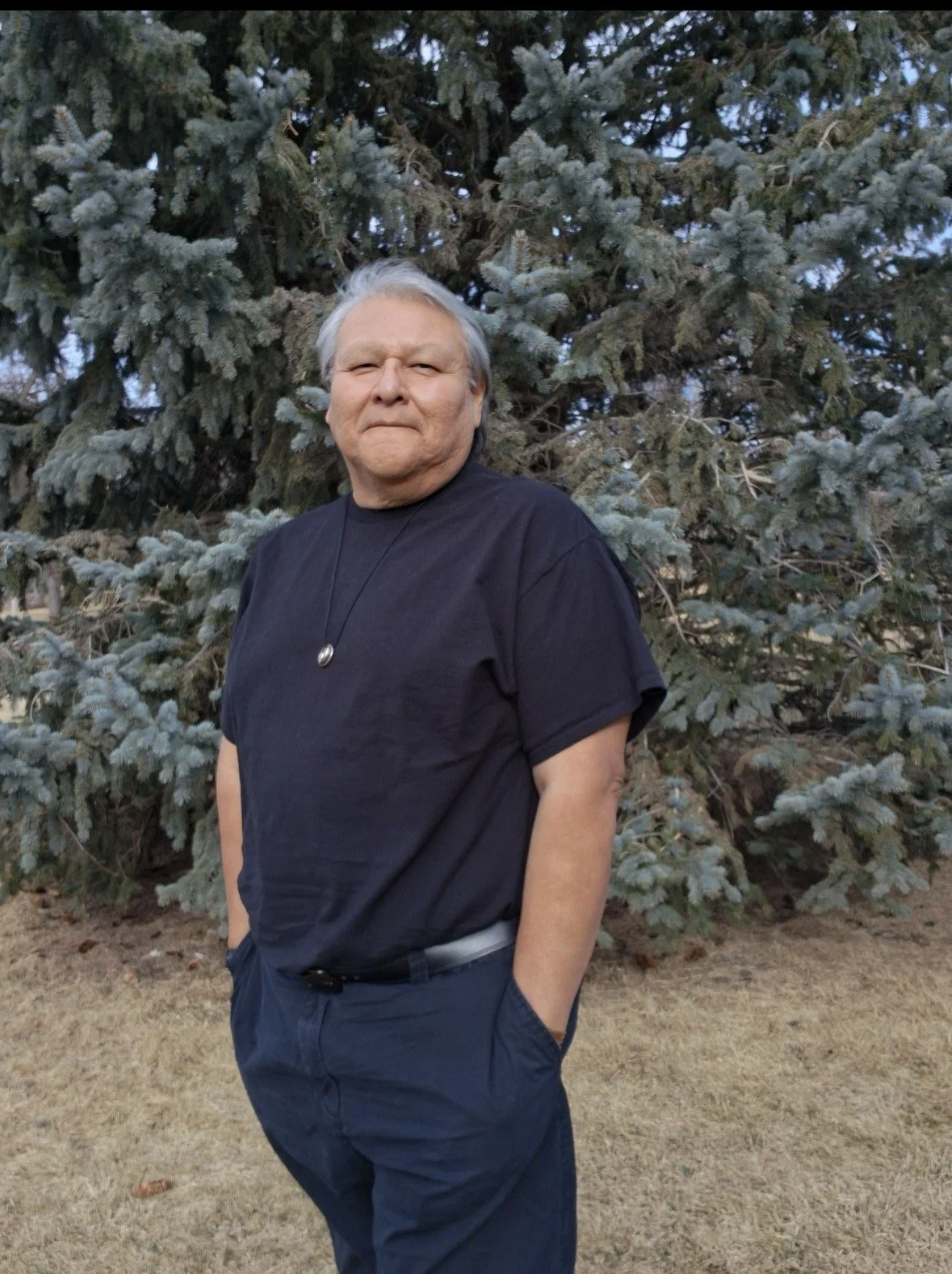
Crisosto Apache

Julian Tanya