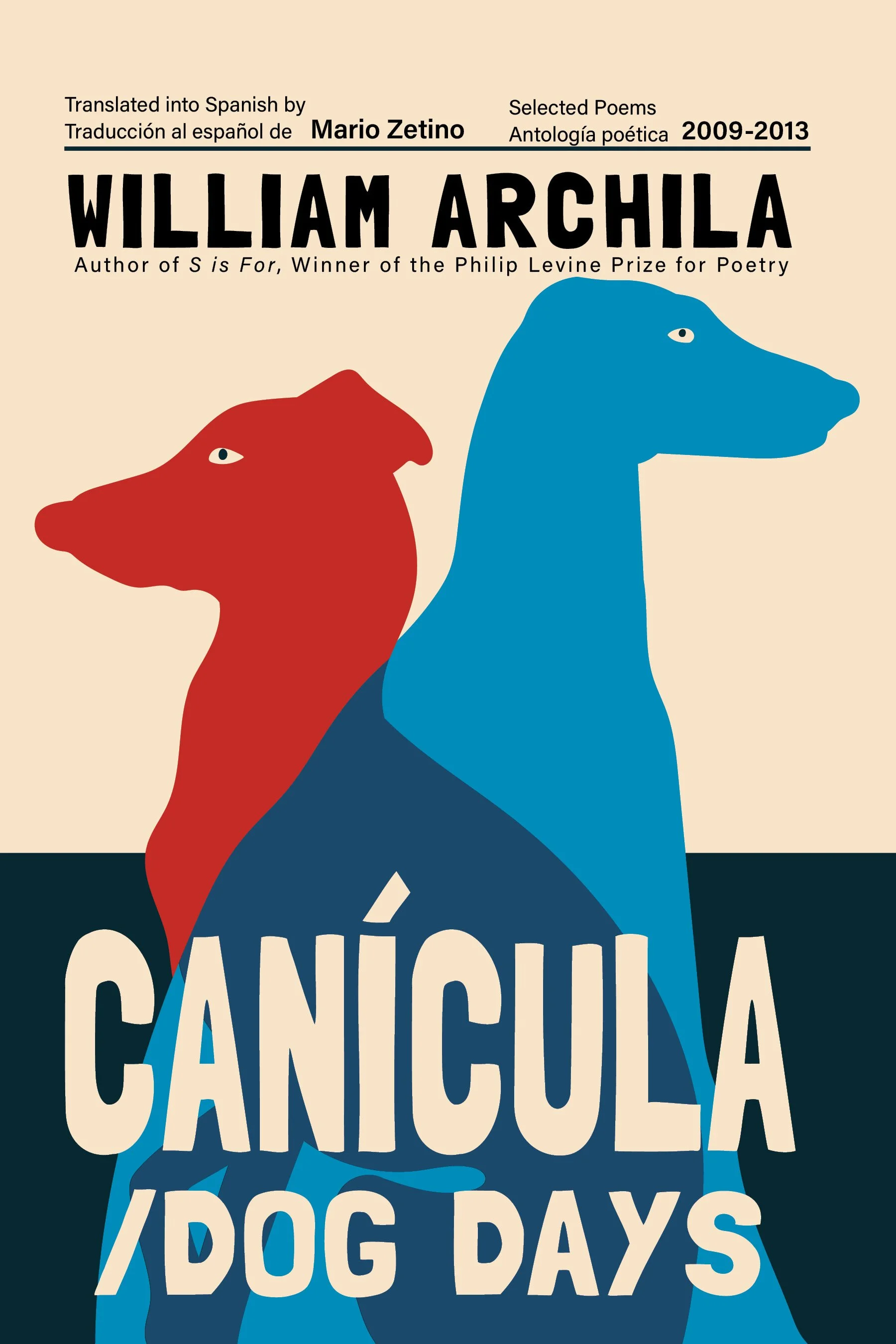
Book Review of William Archila’s Canícula / Dog Days
Book Review of Canícula / Dog Days
Author: William Archila
Translated into Spanish by Mario Zetino
(Ren Hen Press 2026)
By Rey M. Rodríguez
Oscar Wilde wrote two famous reflections in his 1897 prison letter, De Profundis, that perfectly capture the connection between suffering and the sacred. He wrote, "Where there is sorrow, there is holy ground." He went on to write, "To me, suffering seems now a sacramental thing, that makes those whom it touches holy." I thought about these reflections upon reading William Archila’s remarkable and recently published bilingual poetry collection, Canícula / Dog Days (Ren Hen Press 2026). The book brings together his first two books, The Art of Exile (Bilingual Press, 2009) and Gravedigger’s Archaeology (Red Hen Press, 2015).
It is difficult, if not impossible, to comprehend the pain and suffering inflicted upon the people of El Salvador during the 1980s, and that continues to this day. Indeed, those who lived through the horror have much to teach us. Archila was one of them, and his outstanding poetry pulls back the veil on the sorrow and, by so doing, introduces us to the sacredness that he and many other immigrants, who experienced it and then found a home in Los Angeles, can enlighten us with.
Archila is one of the most important Salvadoran-American poets of his generation, who easily takes the mantle along side other Central American poets such as Roque Dalton, Javier Zamora, Claribel Alegría, Alfonso Quijada Urias, Roberto Sosa, and others, as he blends memory, grief, jazz, violence, joy, exile, identity, and meloncoly to shake our collective conscience that things may be challenging now, but that if we are not careful they can and may become worse as they did during the 1980s in El Salvador.
In this bilingual collection, much wisdom emerges from the struggle of living through a civil war and then migrating from El Salvador to Los Angeles. I wanted to write this review because the history and knowledge that Archila offers are precisely what is needed to understand the madness of the moment we are living in the United States. Failing to listen to writers who cross borders only ensures we will continue to repeat past mistakes. Consider the poem, “What I Learned from a War Too Small to Notice.” In the first stanza, Archila writes:
To lie awake all night under the bed, stare
at the springs, study of coils,
ironwork’s constellation disarmed
into a shattered landscape, light bulbs
doused with the sound of artillery.
The daily life of a boy in El Salvador during the Salvadoran Civil War, which was a conflict between the government, backed by the United States, and the so-called leftist guerrilla coalition known as Farabundo Martí National Liberation Front, involved constant uncertainty. People experienced military road checkpoints, nighttime raids by soldiers or security forces, guerrilla activity in rural areas, bombings, firefights, disappearances, and random acts of violence. In rural areas, innocent people confronted army patrols one day, and guerrilla forces the next. Forced recruitment was commonplace from both the government and the guerrillas. Thousands fled to the mountains or to the United States for safety. One of the worst atrocities, called the El Mozote Massacre, involved the killing of hundreds of civilians by government forces. No one felt safe. City life looked normal on its face, but explosions and political assassinations happened regularly, curfews existed, armed soldiers were ever present, and labor organizing students, priests, nuns, and journalists often faced death threats and even death.
Later, in the poem, Archila acknowledges this context and writes:
My childhood of 1980
learned to take cover during shootouts,
mold itself into the cut-corner
of the curb, lie half-drowned in the street’s gutter,
resembling a half-rotting animal.
Archila’s poetry illuminates these horrific experiences so that the reader can begin to empathize with the trauma felt by a boy on a Salvadoran street. The words illustrate the extremes that can occur when an autocratic, anti-democratic regime comes to power. Before the ascendancy of the MAGA movement, it seemed virtually inconceivable that the US democracy could experience the same collapse of basic institutions. But here we are, masked ICE agents heavily armed, traumaticizing our neighborhoods, voting rights being gutted, environmental laws dismantled, whole Black congressional districts being erased, Indigenous sovereignty being ignored, and the Justice Department weaponizing the law against individuals who criticize the administration.
In essence, Archila is a poet-witness not only of his time in El Salvador but also of his life as a migrant to the United States and of what it feels like to be an outsider in this country. His insights are universal truths for all of us, like when he writes about Federico García Lorca in “Poet in New York,” or John Coltrane, “On First Listening to Coltrane,” or John Lennon in “The Night John Lennon Died.”
In “Poet in New York,” we understand the outsider perspective in the stanza, “I want to stay here, standing in front of you, / exchanging the dirt in our pockets, / songs we carry from our countries, /.” I read this to mean that two poets, Lorca and Archila, from different lands, exchange experiences about what it means to be a ‘foreigner' in the United States and the power of culture to inform each's identity, despite the new surroundings.
Then, in “On First Listening to Coltrane,” Archila expresses the pull of musical genius in Coltrane to excite a child’s imagination. He writes, “I loved him, full-body wail of a tenor, large and round, / his crooked fingers on brass, choking the hollow horn with God caught in his throat, . . . it hit me / like a hundred iron wheels steamed down / the tracks . . . .” Coltrane’s musical magic inspiring a young man to see himself through his expression of his art.
Finally, in “The Night John Lennon Died,” Archila uses the full magistry of his craft to tell the complicated story of migration for all involved in the process: the boy’s joy of seeing his father, whom he hasn’t seen for a long time and who “became a kitchen helper”; the mother doing her best wearing “her best clothes–Lee corduroy jacket, Levi’s Jeans”; and a father who is defeated “with the wet apron & yellow gloves.”
Why is Archila’s work so important? I argue that he confronts the suffering of what it means to come to the United States, but, in so doing, he magnifies through his poetry the sacred in all who have come to the United States from Central America and elsewhere. What would this country be without the sacrifices that so many have made to create a new life in this land? Archila’s work humanizes this experience and teaches us of how sacred the act of migration is and those who do it by incorporating a child’s perspective of what the transition feels like, the magistry of jazz, a U.S. creation, to bridge the gap between countries, references to Lorca, who was ultimately slain by his government, to show the dangers of not defending an experimental democracy, and finally the reference to Lennon who called us to imagine a better world.
Why does Archila’s work matter? It matters because there are people like Raquel Molina, who swab down toilets, wipe down seats, and vacuum the aisles of airlines, in this case, Boston’s Logan International Airport. She is an immigrant from El Salvador with a valid Social Security number and permission to work in the United States. But last summer, as reported in the New York Times, Ms. Molina was fired without warning from her $19.75-per-hour cleaning job. She, like thousands of others, has been living legally in this country under Temporary Protective Status, a humanitarian program that shelters people from troubled nations. In this case, El Salvador, a country that the U.S. destabilized. The Trump Administration, instead of honoring and protecting this class of people, decided that Ms. Molina and many like her no longer have clearance to work—after almost three decades of working in the airport.
Archila’s work, written in Spanish and English, makes Raquel Molina and many like her seen. His poetry shines a light on their sacredness and what their sacrifices have meant for this country. During this moment of madness and unmitigated cruelty, we need Archila’s words, bringing all of the art and craft that he can muster, to remind us that Ms. Molina is not defined by her legal status, ability to wipe a toilet, or TPS designation, but instead is a human being deserving of the dignity and due process that we all merit.
Rey M. Rodríguez has an MFA in fiction from the Institute of American Indian Arts. He recently released his debut book of poetry, Todos Somos Sagrados / All Are Sacred (El Martillo Press 2026), and he is working on a novel set in Mexico City.