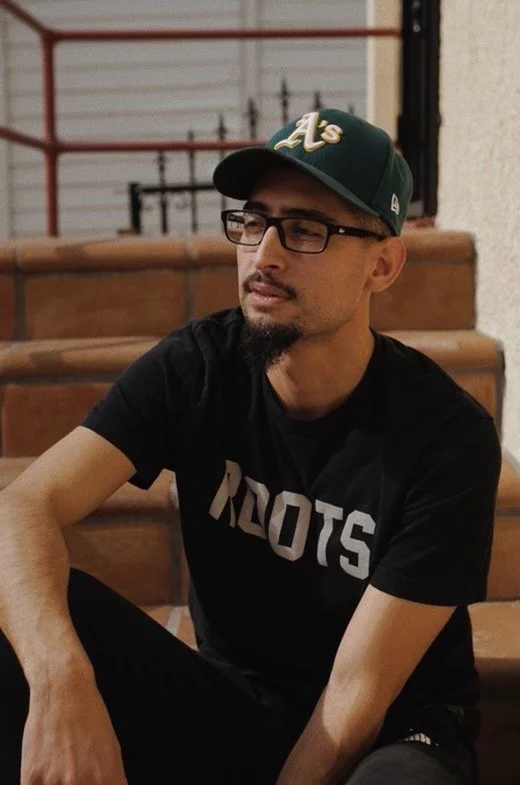
Interview with Alan Chazaro, author of “These Spaceships Weren’t Built for Us.”
By Rey M. Rodríguez
Alan Chazaro is a Bay Area-raised poet, journalist, and educator now living in Xalapa, Veracruz, Mexico, whose work bridges hip-hop, Chicano identity, and speculative imagination. He is the author of multiple poetry collections, Piñata Theory, This Is Not a Frank Ocean Cover Album, and, most recently, These Spaceships Weren’t Built for Us.
In this wide-ranging conversation, Chazaro reflects on a nonlinear path to poetry that begins outside the classroom and finds its way, through community college and University of California, Berkeley’s Poetry for the People program, into a fully realized artistic practice. He speaks candidly about invisibility, code-switching, and the layered identities of Chicano life, while also offering a powerful meditation on craft, intuition, and the radical openness of poetry as a form.
At the center of the discussion is his collection These Spaceships Weren’t Built for Us, a work that situates itself within and expands the terrain of Latino futurism. For Chazaro, the metaphor of the spaceship becomes both critique and invitation: a recognition that existing institutions were never designed with certain communities in mind, and a call to imagine and build new vessels for survival, creativity, and joy.
What emerges is a portrait of a writer deeply attuned to community, who understands poetry not as an isolated art, but as a collaborative, generative force. This interview offers not only insight into Chazaro’s work but also a compelling vision of what it means to write and live toward a more expansive world.
Alan Chazaro, welcome to the Storyteller’s Corner of Chapter House, the literary journal for the Institute of American Indian Arts. How did you get into writing?
Hip-hop, specifically, was a huge influence on me. West Coast hip-hop was really the origin of my journey as a writer—first as a listener, and later, as a teenager, as a participant, predominantly through graffiti.
School and academics were not central in my life growing up. I grew up in the San Francisco Bay Area, in an apartment with my dad and my older brother, and there wasn’t a lot of structure. There also wasn’t much academic modeling. My dad was an immigrant, and even though he briefly attended community college in California while working as a dishwasher, he told me he dropped out of middle school in Mexico. So school just wasn’t encouraged in my household in an institutional way.
I think that’s why rap and graffiti spoke so powerfully to me as a young Chicano in the Bay Area in the ’90s and 2000s. I had a yearning to express myself creatively, but I didn’t know what that looked like outside of what I had in front of me. Those elements gave me the tools to excavate my identity, to think about community and voice. Spray-painting a wall as a teenager—hopping fences, doing that with friends—was empowering and liberating in a way school never was for me.
I was getting kicked out of classes in high school. I was literally flunking in middle school and high school, and I had to go to summer school every year to make up credits. As a senior, my counselor told me I was on the verge of not graduating and I had to repeat classes that I failed as a freshman. It wasn’t until community college that I really began to see the academic value of writing. That was when all those years of informal hip-hop expression gave me this magical ability to share my views on the world. That really came into focus in community college, when I wrote my first traditional poem, let’s say.
Were you listening to any Chicano rap, or was it primarily—
You know what’s funny? I think about this a lot. I grew up around a lot of Mexicanos, immigrants, undocumented kids, and people from all kinds of backgrounds. The Bay Area and California are so diverse. I grew up in an apartment building with predominantly Vietnamese, Chinese, and Filipino people. A lot of my friends were Mexican; their parents didn’t speak English.
But for whatever reason, I mostly grew up with Bay Area rap, and that didn’t really include Chicano rap, to be honest. It was more E-40, Andre Nickatina, Too $hort, and the Luniz. I think because I didn’t have a strong sense of a traditional Mexican family at home, I didn’t grow up with corridos or that kind of musical culture being passed down. The Bay Area became my culture and my language, and that was deeply informed by hip-hop, and there just weren’t really any local Chicano rappers on the radio at that time. In high school, I got into Woodie, but that’s about it.
Wow, that’s great. I’m always curious about that. I just interviewed José Olivarez, and Chicago—really Calumet—very much informs him as a writer. He’s so deeply rooted in that place. I’m always curious about how where you grew up shapes you, especially as a Chicano, because it’s so complex. You’re of the place, but you’re not, but you are—if that makes any sense.
No, totally. I think about that a lot, for many reasons, as a writer and as a person. Even within California, being a Chicano from the Bay Area is so different, in my experience, from being from L.A. or San Diego.
I’ve found that the Bay Area, in general, is weirder—in the best way. We’re unafraid to be ourselves in a way that not every region is. If you listen to rap from L.A., for example, it’s often aggressive, territorial, grounded in those particular experiences of certain affiliations. Bay Area rap has some of that street energy, too, but it also has people wearing genie costumes and pretending to be former presidents like Ronald Dreagan. G-Shock used to wear a plastic nose and big, goofy glasses. Del the Funky Homosapien would rap an entire verse using only words that started with the letter “V.” That’s some weird, very creative stuff, especially for West Coast rap in the 90s and aughts. Bay Area rappers are inventing their own slang and making up their own styles in ways that aren’t always the norm in a lot of other hip-hop communities. In the Bay, you can get the street stuff and the player stuff, but you can also get the political and creatively out-of-the-box stuff from a diverse spectrum of artists. And I think that range and versatility were instilled in me as a listener and writer, from a very young age. Just understanding that people can be complex and artistically fluid beyond the stereotypical expectations, especially as a Chicano kid.
I think it’s important because people want to lump us all together into one idea of what it means to be Chicano, but it’s so much more complex than that.
Definitely.
There’s so much diversity, and that’s part of the excitement of this moment—being able to read different artists, especially in poetry. So that leads me to the question: Why do you write?
I think it goes back to that early feeling of getting into graffiti and not feeling like I had a place. In many ways—and I think this is probably true for a lot of young Chicano people—I felt invisible for a long time.
I don’t mean that in the sense that my dad or parents didn’t care about me.I mean invisible more in a societal sense. In school, I never really felt engaged. I didn’t feel like my teachers engaged with me in the way they did certain other students. Some of my peers were in AP classes and honors classes, and you could tell they had a different relationship to the classroom, to learning, to self-expression, to scholastic confidence.
So when I got to community college, I was looking for a place of value beyond just friends and family, which are, of course, deeply important and gave me a lot of love and a sense of myself in the world. But I wanted to branch beyond that, as I think we all do as writers. How do we reach other people? So I think my writing came out of that feeling of invisibility and voicelessness.
I want to push a little on the word “voicelessness,” because of course, you had a voice. Was it more that no one was listening?
Maybe. I’m a middle child, for one, so there’s that. And growing up as the son of immigrants, I think there’s often a certain inability—not through fault, but through circumstance—to guide you through systems your parents themselves didn’t grow up in.
I want to honor that my parents didn’t grow up in the United States. So many of the things my brother, sister, and I were dealing with—being the first to go to a university or applying for a scholarship, for example—we were figuring them out as we went. Our parents didn’t really have that context in their own lives to guide us in an informed way. My dad would never sit down and ask, “How was your day? How are you doing?” And I think a lot of us grow up like that, especially as Chicanos.
Because I grew up in the Bay Area, I had friends from all kinds of racial, ethnic, religious, and economic backgrounds. I would go into other people’s homes and see relationships that did look like that traditional family model. So all of that—California, Chicano identity, seeing different realities—made me realize that my reality wasn’t the only reality. You start to think, Oh, I want that, or How do I get that? You start building and dreaming in different directions.
I grew up with a lot of Mexicanos, but I also grew up with Samoans, Taiwanese kids, Indian families—all sorts of cultures. To me, that’s beautiful. You pick and pull the best from everything around you when you grow up like that. And in that sense, yes, I did feel voiceless, because I could see that some of my peers seemed to have a stronger voice in their spaces than I did in mine.
How did Berkeley get it right in terms of helping you find your voice?
Berkeley was amazing. I went to community college first, at Foothill, in the South Bay, near where I grew up. Once I committed to the academic side of myself, I was like, Berkeley all the way. I got into a few UCs, and after visiting them, it was clear Berkeley was the one.
Berkeley felt like part of the Bay Area fabric. There’s Telegraph Avenue with all the shops, the graffiti, the hippies, all these layers of people from different backgrounds packed into one little area. When I visited UCLA, for example, which I was interested in, Westwood felt like a totally different vibe. It was manicured, separate, institutional—very clean, affluent, and, to me, very white. Berkeley, by contrast, felt like the Bay Area I grew up in. There were houseless people, academics, professors, poets, rappers—all kinds of people walking among one another as soon as you stepped on or off campus.
I joined a program called “Poetry for the People,” created by the late June Jordan. The ethos of that program was that we are all poets, no matter where we come from. People from the city of Berkeley who had no formal connection to the university could take classes with us. That was the energy I had always wanted to embody as a writer and as a person. That program was the beginning of my believing: Damn, I could be a poet. It didn’t matter who I was or who we were—we all had stories to share. That’s really where my journey began.
That’s wonderful. Let’s get into your book. Let’s start with the title: These Spaceships Weren’t Built for Us. It feels speculative, but also deeply grounded in lived experience. How did you come to the title, and what does it signal about who “us” is?
Titles are everything, especially for poets. They’re the framework, the doorway into a set of ideas, identities, and experiences.
This is my fourth poetry collection and my second full-length, so I’ve already had the opportunity to write about different parts of myself and the world around me. With this book, I came in with a very intentional mindset of thinking beyond the now, beyond the present. It started with what I’d call my random-as-hell interest in outer space when I first began writing the book.
Because it was my second full-length collection, I wanted a new entry point into my poetic consciousness. I kept asking myself: What’s new? What’s different? What’s expansive? Somehow I landed on outer space. The more I sat with that idea—space as interior space, headspace, public space, physical space, outer space—the more it opened up. I started researching NASA, its history. I went to the NASA museum and center in Houston. I was deep in that process of ideation.
The image of spaceships and traveling beyond our world became important to me. And it connected back to that earlier feeling of invisibility and being overlooked—not only as an individual, but as part of the Bay Area Chicano community. In many ways, I’ve always felt that the institutions of the United States were not built for us. History proves that over and over again. ICE is one very contemporary example. We are so often literally or metaphorically being removed from things.
So that’s the core of These Spaceships Weren’t Built for Us. It suggests that we have to build our own spaceships. We have to create our own vessels for survival, for imagination, for sustainability, for health, for joy. That’s something I’ve had to do in my life, and something many of us in diverse diasporas have had to do. That was really the basis of the title, and of many of the poems in the book.
I was thinking about Latino futurism when I read it. There’s an anthology called “Latinx Futurism,” and then there’s E. G. Condé’s work on Taíno futurism. Your book feels in conversation with all of that—with futurism, with what the world could be had it not been tainted by racism 500 years ago.
I was also struck by your dedication: “for future readers in a future world.” I thought that was beautiful. Why was it important to dedicate the book that way?
That’s a great question. One major layer of this book is that I began writing it about eight years ago, when I was still living in Oakland and teaching high school. I worked at Oakland School for the Arts as a full-time English and art history teacher, and I had been a high school teacher for a decade before poetry really became central in my life.
Being around young, creative, hopeful, quirky, growing artists and thinkers every day for ten years deeply shaped my sense of hope for what’s to come. On top of that, my son—my first and currently only son, Maceo—was born while I was writing this book. So the dedication carries both of those worlds in it.
Some of the poems in the book were written spiritually in conjunction with my students. When I was first thinking about the book conceptually, I would literally talk to my first-period students about it before class started. They were painters, singers, dancers, writers, musicians, and I felt privileged to be able to say, “Hey, I’m thinking about this book—what do you think?” They would draw with me, imagine with me. That collaborative creative process was deeply important.
Some of those students have since gone on to become writers themselves. One of them, Leila Mottley, became a New York Times bestselling author and was selected for Oprah’s Book Club. She was maybe fifteen or sixteen at the time I was working with her. She’s just one example among many students I got to spend time around during those years
So “for future readers in a future world” is an ode to all of that. The future is already here for us. The book is for them as much as it is for me, or for anyone reading it now. It’s for the future Leila Mottleys, the future Maceos, my kids’ kids. It’s like a dispatch sent into outer space for those readers as much as for us today.
Oh, there’s no doubt it is, and will be. I have to ask about craft and form. Your poems move between lyric, narrative, and experimental forms. How do you decide what form a poem should take?
I write poetry, but I am a journalist, which has become my day job over the last five years. Poetry, I’ve been doing much longer, going back to Berkeley, so more than fifteen years.
That distinction matters to me because journalism and poetry require completely different mindsets. As a journalist, I ask: What information do I need to provide? What structure do I need to convey that clearly? It’s literal, factual, and deliberate.
Poetry is the free-flowing, intuitive side of myself. Usually, I begin with an idea, a feeling, a texture, some kind of vibration I’m receiving. I sit with that energy, and the poem emerges however it wants to emerge.
Sometimes, I can sense early on that it wants to be an ode, or another particular form, and then I’ll ride that wave. But often it’s much freer than that. I receive whatever I’m receiving in that moment—whatever I’m thinking about, grappling with, reacting to—and I let it take shape. Occasionally, I’ll go back and reformat it or sculpt it differently, but I try to let it live organically. If I did that in journalism, I’d be out of a job in two days. Journalism needs structure. Poetry, for me, finds its beauty in openness.
That’s wonderful. Can you talk about your use of code-switching or linguistic hybridity? How intentional is it as a political or aesthetic choice?
At this point, I really try to honor intuition and organic expression. And going back to what we were saying earlier about place—José being from Chicago, different writers being shaped by where they’re from—the Bay Area is such a hybrid, multidimensional place. There’s a lot of code-switching, a lot of cultural mixing, a lot of movement between worlds in every moment.
You learn to exist as this amoebic version of yourself, and I think that’s beautiful. It’s a skill. It’s a gift. Add to that the fact that I’m Mexican American, a dual citizen, able to exist in Mexico too, and to understand not only Spanish but regional Spanish, particular slang, and different registers. There are all these levels of code-switching. Every moment of my life is a code switch. I’m basically just a giant walking code switch.
So when I write, that hybridity comes out naturally. I honor it however it arrives. So many of us were born into a world where we had to learn to code-switch just to survive in different spaces. Because of that, it often doesn’t even feel like a conscious choice. I’m just writing what comes to mind as it comes to mind. Of course, I revise. I love revising. I might swap in a word, intensify an image, soften a moment. But for the most part, I want the language to remain true to how I grew up and how I move through the world.
It’s a beautiful moment, I think, that we’re being accepted for that. I have friends in their seventies who came up in a time of such intense racism that they could never speak Spanish openly. I grew up with some of that, too. So I feel I stand on the shoulders of people for whom it simply was not permitted.
That’s why I’m so excited now by the ability to write what you’re thinking in the language that feels right. Sometimes, Spanish is the perfect word. You want to include it. If readers understand it, great. If they don’t, they can look it up. You don’t have to constantly translate yourself. That, too, feels liberating. What are your thoughts on that?
I one hundred percent agree. And I should definitely acknowledge that I grew up in the millennial generation, so I think for my generation and Gen Z—and hopefully beyond—we’ve been able to live in a more fluid and more liberated time than prior generations.
It’s an advantage now, in many ways, to be many things at once. And it’s a privilege to be able to hold many identities, many languages, many selves. The internet has helped with that—but more importantly, people have fought for that. People have given up their lives, in every sense, so that we can live in a time where we can be many things at once.
What the internet has done is expose us to more than ever before, so we now live in a kind of post-regional reality. You can grow up in New York and still have a California sensibility because you can listen to California music, watch California artists, absorb California language online—and vice versa. All of those things together have dissolved boundaries that once felt much more physical and firm. I think that’s beautiful.
I was talking to Luis Rodríguez—he went to Japan, and there were Japanese cholos there. It was amazing.
Exactly. And because of the media and the internet, we can see those things all the time now. We become aware of other people and other cultures in a way that accelerates that kind of osmosis. In the past, you would have had to travel to Japan to witness that or hear about it directly through someone else’s lived experience. Now I can open YouTube, and suddenly discover something incredible from Peru. As an artist, that enters your bloodstream. I’m so glad we get to write in these times.
There are so many poems I want to talk about, but I love “My Mexican Abuela Taught Me How to Land on the Moon.” Tell me a little about that poem—what inspired it? It has such a rhythm to it, and it’s one of the poems that really spoke to me.
Thank you. That was one of the earlier poems in the book, and one I kept returning to because I cared about it deeply. It’s funny you mention it, because a friend of mine back in the Bay Area, Brandon Vu—a Vietnamese American writer—just emailed me a few days ago to say the same thing: that it was his favorite poem in the book.
Maybe it resonates because my abuelita passed away close to a decade ago, and she was central not only to my sense of self but to my sense of myself in Mexico. Both of my parents were immigrants, and my mom, though she didn’t live with us growing up, was always a part of my life. She used to take my brother, my sister, and me to Mexico often. She was deeply proud of being Mexican in a way my dad wasn’t. My dad adapted more quickly to life in the United States. But my mom never became a U.S. citizen. She later moved back to Mexico, where she currently lives. And I think her connection to Mexico was rooted in her mother, my abuela.
When my abuelita passed, I flew down to Xalapa, Veracruz, and spent her last days with her in the hospital. She was this very warm, funny, classic abuelita—scolding us for not wearing jackets in the cold, regañándonos for everything, but loving us fiercely at the same time.
That poem is really about the ways she taught me to move through the world with an open heart. She was the kind of woman who would tell us to ‘persignarnos' when we passed a church. If she saw someone in need, she would urge us to give away our food, our toys, whatever we had. In Mexico—especially in the ’90s and earlier—the distance between the haves and the have-nots feels more visible, more immediate. You see poverty and struggle right there in front of you.
So as a child, and then as an adolescent, and then as a young adult returning there, I began to understand privilege and movement through the world in a much deeper way. The fact that I can even fly to Mexico and back is not lost on me as a privilege not everyone gets to have.
My abuelita is Mexico to me. Even though she’s no longer physically here, she remains spiritually present in my life. The poem grapples with that—her final moments, her enduring presence, and all that she gave me.
I love that she really hasn’t gone anywhere. She’s still here with you.
Exactly. That’s how she raised us. Honestly, when I’ve lost grandparents, I’ve never felt sadness. I’ve felt joy because I got to spend so much of my life with them. And some of these were grandparents who never left Mexico. My grandpa is still alive, and he lives down the street from me now, in Mexico, where I moved in 2024. I’m so happy that my son gets to spend time with his bisabuelo and that this connection continues.
So when his time comes, I’ll be proud that I got that time with him, just as I did with my abuela. Carrying forward their joy, their pride, their beauty—that’s what matters to me. That’s why I don’t experience their passing as a loss.
That’s beautiful. Let’s talk about “16 Reasons Why a DACA Dreamer Will Be the First Person to Build a Do-It-Yourself Spaceship from Simple Materials.” That poem just blew me away. I once helped a DACA student get into Princeton, and my heart goes out to DACA students. And then there are students here who aren’t even protected by DACA.
It’s deeply messed up right now, and in many ways it always has been, especially for undocumented immigrants of all backgrounds.
Again, I consider it a privilege that I grew up in the Bay Area and in California when I did. My best friend from middle school through community college was undocumented. His brothers were undocumented. His parents, his tíos, his tías—the whole family. His older brothers were friends with my older brother. They were neighborhood kids. I spent a lot of time at their house growing up.
My dad worked full-time. He never remarried, never had a girlfriend, so I had a lot of unsupervised time on my own as a kid. I would go to my friends’ houses a lot, and Adrian’s mom would be there, cooking, taking care of us all. In many ways, they became family to me. I actually just saw him a couple of weeks ago in Mexico City. He and his family were deported more than a decade ago. But I’ve stayed in touch with him and his family that whole time, and we talk pretty much daily.
When people close to you grow up like that, you understand things beyond the headlines. When I hear rhetoric about immigrants being criminals or whatever else, I know firsthand that it’s false. It’s a blanket stereotype, a hateful way of seeing people.
A lot of my closest friends lived under those conditions. I had citizenship, so I had access to the United States and Mexico in ways they didn’t. I always try to stay mindful of that. Many of my undocumented friends worked harder than anyone I knew. They couldn’t get driver’s licenses. They needed forged papers to get jobs. They were taking buses, working two jobs in high school, hustling constantly. Meanwhile, I knew other kids with every advantage who were lazy and spoon-fed. The contrast was so stark.
The friends working the hardest were the ones being targeted by the police and the government. It felt completely backwards. So that poem is really a celebration of the innovation, hustle, and grit of the people I grew up with. Those are the people who could probably build a spaceship faster and better than anybody else. That’s the irony at the center of the poem.
I love line sixteen: “Who else has already traveled between worlds and survived to tell its secrets?” Bam. That’s incredible.
It goes back to that earlier idea of invisibility. Undocumented immigrants in the U.S. are made invisible on every level, and because of that, the way they move through worlds—plural—is profoundly different.
Let me ask you this: What is poetry to you?
Poetry is the truest and most unfiltered extension of ourselves in written form. And I think it’s innate to all of us. Everybody is a poet from birth. It’s just a matter of recognizing that and accessing the beauty of it. Poetry is a verbal extension of who we are in the world.
That’s fantastic. I teach a workshop for kids of color who want to go to law school, and I always begin by asking, “How many of you are poets?” Maybe one or two hands go up. Then I say, “You know what the right answer is? You’re all poets.”
I don’t know why we’re taught that we aren’t. Who decided that? And why do we accept it?
It sounds corny, but it’s true. Working with high school students for ten years, I never met one who didn’t have the kernels of a poetic voice. Once you help create the space for them to access it, it comes out. It always comes out. Sometimes the students you would least expect turn out to be the most poetic once they’re given permission—and once they give themselves permission—to be poets.
Totally true. Any advice you’d give emerging writers or poets?
There’s the classic advice, which still matters: honor what you know. Believe that your truth matters.
I didn’t grow up reading or seeing many male Chicano poets—though they absolutely existed. I just didn’t access them until much later. But I knew I wanted to write as a Bay Area, Chicano, millennial voice. I stuck to that. It was intuitive, a gut feeling. I never really wavered from it, even when family members, teachers, or others tried to steer me toward something else—whether gently or not.
You have to be down for yourself. Don’t let anybody silence that part of you. Even if it takes two decades or three decades to fully arrive there—which, for me, it did—don’t let that part of yourself die.
I’m a big believer in never giving up your creative life. It’s very easy to do, or at least society asks you to.
Is there any poem you want to elevate—one you feel hasn’t been given its flowers?
Are you asking from my book, or just in general?
Your book, but I’ll also take a poem that has informed you.
I’m in a particular headspace right now because I’m preparing to teach a poetry workshop on gratitude—how poetry can help us live more generously within gratitude. This morning I was rereading Pablo Neruda’s “Ode to Broken Things.” I know Neruda is a classic answer, but he’s one of the masters of the ode.
That poem is really staying with me right now because it thinks about how grief coexists with joy. Everything in our lives breaks, sooner or later, whether we want it to or not. The poem just sits with that fact—the broken vase, the broken spirit, all of these broken things—and allows them to be broken.
My first book was Piñata Theory, and piñatas are objects built to be broken. There’s something beautiful in that. Through breakage, something else can emerge. So today, at least, I’d name that poem. But it changes for me all the time—day to day, hour to hour.
And what’s the title again? I’ll include it with the interview.
“Ode to Broken Things.” https://allpoetry.com/Ode-To-Broken-Things
Alan, it’s such a privilege to talk with you. I feel like we’re on the same spaceship. I’ve been thinking a lot lately about joy and grief, and how they inform one another, how both can be carried in ways that are not always as heavy—or as light—as people imagine.
Congratulations on a beautiful book. I’m so grateful to have had the chance to talk with you.
Thank you, Rey. I appreciate it, man. Same to you.
Rey M. Rodríguez is a writer, advocate, and attorney. He lives in Pasadena, California. He is working on a novel set in Mexico City. His poetry collection, Todos Somos Sagrados/All Are Sacred (El Martillo Press), will debut in May 2026. He has attended the Yale Writers' Workshop multiple times and the Palabras de Pueblo workshop once. He participated in Story Studio's Novel in a Year Program. He is a second-year MFA student in fiction at the Institute of American Indian Arts. His poetry is published in Huizache, Anger is a Gift, and Altadena Poetry Review. His other interviews and book reviews can be found at La Bloga, Chapter House's Storyteller’s Corner, Full Stop, Pleiades Magazine, and the Los Angeles Review. He is a graduate of Cornell, Princeton, and U.C. Berkeley Law School.