
The Star
Blanca Estela Morales
The cathedral steps were slippery after days of bone-chilling rain. Always slow to walk up and down stairs, I take my time, eyes tracking the slate blocks leading to its front door, careful not to misstep. Forever clumsy, always relying on the traction of lug sole boots to keep me upright.
The door’s weighty ornamentation resists the pull of my hand, as if the church itself were scorning me — miffed at my latent return. Turning the other cheek.
Once inside, the all-too-familiar scents of varnished wood, cracked plaster, and incense permeate the air. I take a deep breath and calibrate in the entryway, peering into the cavernous nave. I feel sheepish. Prodigal daughter.
The smell of varnished wood transports me to cherry pews set against the lush, verdant carpet of St. Augustine in southeast Houston, when I was a small child. I have been to Mass enough to anticipate every step of the ceremony. I don’t yet know how to read, so not even the missal can entertain me. The tedium is hell for a preschooler.
Tugging at the folds of the corduroy dress my mother sewed me, I peer at my legs covered with white tights under socks with delicate lace cuffs. It must be a cold day. I’m a sickly child, all asthma and bogged sinuses, so I also wear a thick turtleneck under my dress. The fabric encircling my neck feels like a noose, an unsubtle reminder that I am here against my will.
When the adults are beckoned to kneel, I crouch on the footrest next to my mother and watch her hands clasped in prayer, eyes closed, elbows on the back of the pew in front of us. Looking at the carpet, I imagine I’m a princess on the lam, floating on a raft across a sea of shimmering emeralds, running far from her demons. Her mother, the beautiful queen, prays for her daughter’s safe return.
When the adults stand back up, the fantasy breaks. My mother scoops me off the footrest and back to my seat. I’m so bored, I could cry. So, I do.
“Don’t cry, mi niña,” my mother says. Am I not here, I, who am your mother?
Cracked plaster smells like Mexico, the country where in another version of my life, I was born and raised. It is not my motherland, but it is the land of my mother,her mother, and her mother before her.
I’m slightly older now, holding my mother’s hand in the crypts of the Basilica of our Lady of Guadalupe in Mexico City. She doesn’t tell me the drawers we are walking past are filled with the dead, but I intuit it. At the end of hallways with rows of stacked cadavers, hang life-size portraits of saints. Dark images that stretch high above my head, their sinister eyes follow us as we walk the cold aisles. An unsettling change in the air makes the roof of my mouth go dry. This indescribable feeling returns when I see Goya’s Black Paintings at the Prado years later. I am still haunted.
After paying her respects to the dead, she takes me upstairs to the Basilica. My mother points to a rectangle of fabric bearing the image of the Virgin of Guadalupe, set in a gold frame above the altar, and tells me the story of Juan Diego: how the Virgin Mary appeared to him on the hill of Tepeyac and requested that a church be erected in her honor on the very place where we now stood.
To prove her appearance to the archbishop, Juan Diego followed the Virgin’s wishes and picked flowers at the top of the hill, which he gathered in his cloak, or tilma. When he opened the tilma before the bishop, Castile roses tumbled out like glittering rubies, revealing the pristine image of the Virgin of Guadalupe imprinted on the cloth.
I stare in awe, not understanding the magnitude that this image has remained unchanged for half a millennium, but with the subtle intuition that I am witnessing a miracle of life. The stars on the Virgin’s cerulean mantle dance across my eyes.
Later, when I am close enough to observe her portrait on the wall of my parents’ house, I count the dozens of diamonds pinned against the blue-green canopy. Forty-six stars, one for every constellation in the sky on the day of her appearance: December 12, 1531.
We keep images of the Virgin in our home, first out of cultural habit, now out of reverence. She graces the cross above the front door, a wooden cross in the kitchen, a portrait overlooking the bed, her bust on my altar. In the absence of my mother who lives 2,000 miles away, the Virgin of Guadalupe, mother before my mother was my mother, guides me, as she did Juan Diego.
Am I not here, I, who am your mother? said the Virgin of Guadalupe to Juan Diego.
I’m a junior in high school. It's Sunday morning, and half asleep, I wait in my car in the parking lot of St. Andrew’s until the last minute before I am late for Catechism.
Through gritted teeth, I promised my mother I would be confirmed in the Catholic Church. But I disagree with the priest’s sermons and suspect he would not approve of my burgeoning sense of self. My mother tearfully reminded me that I cannot marry without being confirmed. I secretly vow to never marry in a church, especially this one.
My friend parks his Honda Civic next to me, and hopping out, taps his knuckles on my window in quick succession. “Wakey, wakey,” he yells over the glass with a grin. Resolute, I open the door and stumble out. I am resentful and only happy to spend Sunday mornings in his company.
“Ready to be burned at the stake?” He jokes, and we walk arm-in-arm to the portable building behind the white-washed church. We sit together at the back of the classroom, rolling our eyes in surly distaste as we are forced to learn about the sacraments.
Afterwards, I meet my mother and sister in the parking lot, and walk to our usual pew for Mass. I turn around to scan for my crush sitting a few rows behind us with his own family. We lock eyes for a second, and a glow washes over me. The smell of incense mingles with the warmth in my chest and forever reminds me of furtive glances from behind thick eyelashes and curly hair.
“No hagas eso,” my mother taps my arm. Don’t do that, she means. “It’s rude to turn your face away from God.”
Standing inside the St. James Cathedral in Seattle, it’s two days after my 37th birthday. My mother’s words bristle in my mind, and I take care not to turn my face from the altar. It’s been years since she admitted to fabricating this nonsensical rule — to keep me from rudely watching parishioners filter into church, she said. But I can’t shake my guilt.
Who am I to turn away from God?
I approach a ceramic pedestal filled with holy water, and tentatively dip my fingers in, following this gentle ritual that goes farther back than my memory allows. I cross my right thumb and pointer finger into the shape of an x, and tap my forehead, sternum, left shoulder and the right, before bowing my head to a patriarchal god I have never met.
Who taught me the sign of the cross? Was it my mother? My mother is not here for me to ask her.
Liminal words reverberate from within: Am I not here, I, who am your mother?
A golden star floats above the altar in celebration of Christmas. It looks exactly like the Star card of my tarot deck, the one I pulled along with the magician on my birthday. Frisson buzzes in my chest as I observe its incandescent glow.
This effervescence reminds me of locking eyes with a crush. It reminds me of my runaway imagination. It reminds me of the veneration I feel before the Virgin’s image, watching her stand tall on a crescent moon, covered by her cloak of stars at Tepeyac. The Star’s light begets the light — to combat the darkness that sometimes finds me, much like the foreboding dread that followed me in the depths of her Basilica.
My head held high, I envision millions of gilded atoms arranged in random patterns of stardust, fleeting and glowing across the universe. I can see myself under a crown dotted with forty-six stars, alchemizing a life of my own creation, veiled in a glimmer floating towards me from a cerulean pool of sky.
I am my own mother, my own creator, and my mother is here, guiding me. I may not know God, but I know the mother from whom he came.
It was two years ago, and my best friend is visiting from Texas. Traipsing around Seattle in a weedy stupor, we stumble upon St. James. “Let’s go inside and light a candle. Our mothers would be so proud of us,” he says with a wink.
Inside, I feel the prying eyes of a judging god watching us from the wings. Two misfits in youth, now adults, burdened by a fabricated yet tangible guilt we have carried in this life. We skirt the perimeter of the church quietly and respectfully, observing the iconography as we pass.
We pause before the Virgin of Guadalupe, watching from the right-hand corner of the nave. I am pleasantly surprised to see her portrait here, in a city so far from my mother’s land. We light a candle each, say a prayer for our mothers, and place our offerings before her, basking in the comforting warmth of our divine mother’s gaze upon us.
Today, I stand tall in absolution and feel her gently carrying me in the Star’s flood of shimmering light:
Am I not here, I, who am your mother?
ABOUT THE AUTHOR
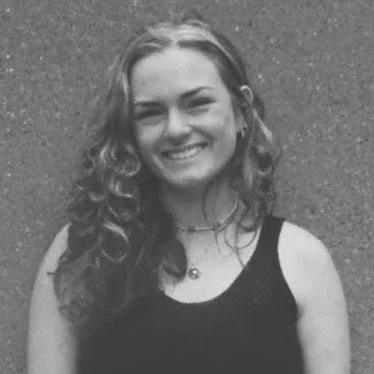
Blanca Estela Morales is a Mexican American writer and marketing professional based in Seattle. Her writing explores themes of identity, memory, and the mysteries of consciousness through poetry and personal essay. This is her first publication.