
The Naha Stone
by Kirby Wright
Detail of photograph by Danielle Shandiin Emerson
WHEN MY MAKUAHINE Keku‘i‘apoiwa was hapai with me, she was ono for the royal eyes of an ali’i. She plucked out the cold eyes of a manō and devoured them. The kahuna said eating shark eyes was an omen that her child would become a killer of chiefs. King Alapainui heard this prophecy. His warriors searched Maui for the eater of eyes. Keku‘i‘apoiwa fled by canoe to Hawai’i, giving birth on the sand. The Kohala chief Nae‘ole raised me in ‘Āwini, third valley from Waipi‘o. There were few children. I learned the meles of kūpuna, songs from ancestors who settled Kaua’i. It is rumored I am the son of Kahekili, ali’i ‘ai moku of Maui. Does he call me his son? No. But that matters little. I am keiki hanau o ka 'aina, child of the land and the sea. I am between boy and man but more man than boy. I am low chief of Kohala, defender of western and northern shores. I have studied combat in the ahupua’a Halawa, under the guidance of Kekuhaupi’o. Challenge me. Dare to make me bleed. I am trained to deflect flying spears, to block blows from clubs, and to dodge the thrusts of daggers. Feel the tip of my ihe and the slash of my leiomano. I will break the backs of your fiercest warriors and sacrifice them to the gods. Fear me. Oppose me and die. I have had dreams of leading a great army from island to island.
Kalaniwahine, kahuna of Kohala, sees islands appearing at sunset but vanishing by sunrise. She warns never to stand in the path of the Ka Huaka’i a ka Po, Marchers in the Night, the ghosts of dead chiefs and warriors marching mauka to makai on moonlit nights. She knows the leaping off places, those lava pinnacles reaching deep into the ocean where spirits leap from this world into the next. Listen. Kalaniwahine speaks:
I see a baby born under a white rainbow growing to manhood. He is no ordinary kane. He is the man who will move the sacred Pohaku Naha. Kamehameha is the child of the white rainbow. He was chosen by the gods.
I am ali’i of north Hawai’i. My army is four lau strong—sixteen hundred bloodthirsty killers. I command the Ka Haumale warriors, the Hueloku, and the Ona Hena. My men are experts with whirling spears, bone-breaking clubs of stone, and daggers. All can fight hand-to-hand and have been trained for the quick kill. Today I will meet my challenge. Prophecy demands I move the Naha. I lifted stones as a boy in ‘Āwini and Halawa, always testing myself with bigger and bigger pohaku. Muscles thickened in my arms, calves, and thighs. As a boy I moved stones most men could never lift.
I leave Waipi’o by canoe today with Kekuhaupi’o, my bodyguard, and twenty warriors. Together we fought Kahekili’s army led by his feared black warrior.
*
The twin hulls of my war canoe glide between swells. Waves slam the lava walls of the coast. We reach the cliffs of Waimanu and enter a black sand bay. The Hamakua trails rise above us. The air smells of the fragrant ‘iliahi blossoms in the high forest. Our pace quickens. We must reach Hilo before the sun spills over its valley walls. I must embrace the papalina la’ahia of the sacred stone before the sun falls into the sea.
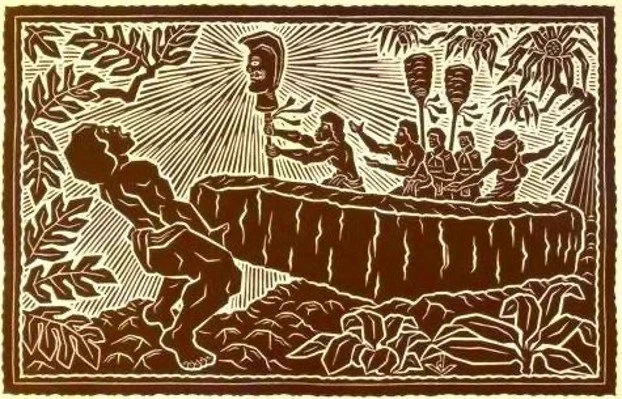
We reach a rocky shore. Chiefess Ululani and the maka’ainana of Pi’opi’o greet us. We carry our canoe up the beach and rest the hulls on naupaka. The ali’i Keawokahikona watches. He has ‘ehu hair and a body scarred by war. Kalaniwahine admits he tried but failed to move the stone. Am I man enough to fulfill the prophecy? I am only sixteen. But it was I, Kamehameha, stepping forward when the black warrior shouted his challenges. I dodged his ihe thrusts before plunging my pāhoa into his chest. Ululani leads us into a lo’i valley. She stops at a circle of red dirt—the Naha rests at the center. This black pohaku seems as big as a chunk sheered from a cliff, its pahoehoe face daring me to move it. It is as long and wide as my canoe. I stand before the sacred Naha connecting me to first ancestors, when the freshly planted ohi’a ‘ai, mai’a, niu, kalo, ki, and kukui struggled to root in tough lava soil. The Naha was Pele’s child. It was carried to the Great Heiau beside Kauai’s Wailua River. The ali’i Makali’inuikuakawaiea did not want it to remain on that island. He lashed it to his hulls of four canoes and warriors paddled it against powerful currents and across wide channels to Hilo. I touch its face. The Naha is cool. Baby boys were placed on top. If the baby cried? An omen he would never lead. If he remained silent, he was destined to become a great man.
Kalaniwahine peers into my future. If I overturn the Naha, Hawai’i Nei will move under my power. Under the pohaku my hands go. Fingers search for a crevice. I find one. The eyes of Pi’opi’o are upon me. I find a crack in the stone. “You are sacred,” I whisper, “and the chief who frees your kapu is king. I am ni’aupi’o, smoke arching in the wilderness between mountain and sky. I will lift your greatness to prove my blood.” I press my nose against black lava. I smell the blood of battle. I embrace and lift. I see newborns becoming warriors. I see war canoes gliding between islands. I see Makahiki shores filling with maka’ainana. Lava cuts my hands. Falling blood gives me Ku’s red eyes. My feet join the earth, swelling my legs and arms with mana. I feel part man and part god, a being between worlds with the strength to rule the ocean and the islands from Tahiti to Hawai’i and beyond, to that distant place where the sun falls outside a land as wide as the ocean. Shoulders and thighs burn lifting this great weight. The great pohaku shifts, wanting to free itself. It moves skyward, balancing on one end. I push. The Naha tumbles over.
Keawokahikona raises his spear. “Pai’ea,” he calls, “the prophecy is true. You are king of Hawai’i. My spear is forever yours.”
June Beck is a writer, photographer, and mixed-media artist. His work centers on indigenous experience and queer methodologies. His poetry has previously appeared in the Adroit Journal and ALOCASIA.