
Roundabout
by June Beck
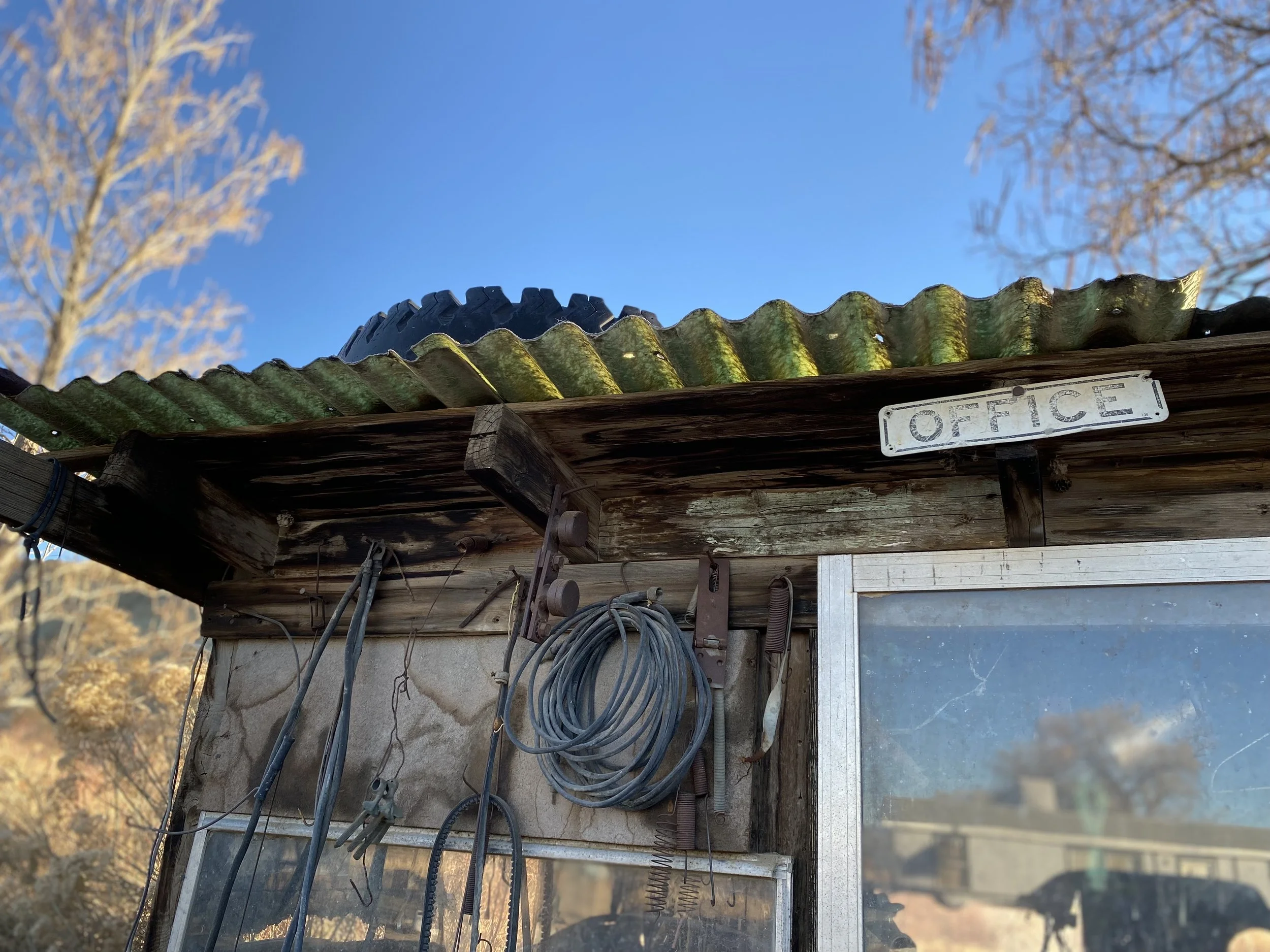
Detail of photograph by Danielle Shandiin Emerson
His body was eerily similar to my own. We had the same nipples, were full-chested with small calves, and had the posture of an arching rainbow. He was 3,016 feet away. I’ve never slept with someone from my tribe before. But today, there was a need. On the rim of my homeland, I yearned to be in the arms of someone of my kind, to be wholly decipherable. Like in Billy Ray Belcourt's "Native Too" poem: "I wanted to smell his ancestors in his armpits: the aroma of their decaying flesh, how they refuse to wilt into nothingness.” That was the goal anyway. To heal through anal. Brisk winds broke against my windows like anxious spirits. The thin glass saved me from possession. I was living in an increasingly whiter world. That is to say, it was snowing.
“Yes, officer.” The man stood above me as snowflakes flitted through the fist-width opening in my driver’s side door. “Good, you look like your pictures.” His eyes panned the length of my body. I invited his gaze, leaned back in my seat, and made room for him to climb in.
Suppose I am to believe what my people say about the land being an extension of ourselves, spiritually and physically, a poetic expression. Why then should it not be at the forefront of all my decisions? Traditionally, we understand what it means to live well; the rules are embedded in language, culture, and stories. Home is a given. Unfluid. From birth, the materials that bound me to my mother were returned to the land where she was raised. Regardless of whether that land is in dispute, under foreign jurisdiction, paved over, or bombed, I am tethered there forever. It’s a pulling sensation—a feeling not easily understood except by those who experience it. If I just moved back home, my life would finally make sense. I yearned for a foothold, an elder, or a teacher—to say, “Look here, this is the way.”
The man wore black jeans and a heavy, tan Carhartt jacket. Frozen ephemera clung to his outer shell like smoke in a fleece. The holey garment, more decorative than functional, stretched to fit over his broad shoulders. I knew nothing about him. It was common to meet, not speak, fuck, and leave. That was the culture of hookups, cyclical in its ambiguous dehumanization. And yet, beautiful. Who else spoke better in glances and symbols than faggots? A word I don’t use lightly—beautiful.
On Wednesdays at the club, I became the embodied definition of the word, but on the weekend, beauty and I were strangers, old colleagues who left on bad terms. Beauty makes people desperate. I loathed predictability.
In college, I once sucked face with a British aristocrat to a Taylor Swift song, drunk on Fireball, dressed as Meryl Streep from Mama Mia! That’s a story you tell your kids. Not, oh, on my way to Albuquerque, I stopped in Gallup and slept with a guy because I thought his dick could cure my homesickness. That’s how I met your father.
Where did reconnection end and fetishism begin? I used to joke that my intersectionality gave me a genetic predisposition toward lusting over men with long hair. But how could I say that when I never once found myself attractive? Nothing about me was carved from marble. I paled in comparison to the stranger’s outward beauty. My head ached with guilt, and I debated turning around and dropping him off. Almost as if he sensed my apprehension, music started to play.
Low drum beats and rhythmic rattling sauntered from my radio. Peyote songs like the ones my father hummed transformed my Honda into a Hogan on wheels. It was like I was a child again, struggling to stay awake in a ceremony, sitting around a big fire. Who the hell was I sitting next to? Most people our age didn’t know the songs or the language. He mouthed the words and tapped his foot to the beat—sacred sex playlist—perfect every time. I didn’t know how to feel.
“You're cute,” he said, in my ear, “but I do the fucking.” He was the fire that stung my eyes. I couldn’t look away.
Outside, the blizzard enveloped the car as we drove. Tiny flurries dissolved in the light of my high beams as we pulled into a park at the edge of town. A black SUV idled a couple of rows back. “What do you think?” he whispered. Uncertainty stared back at me in the car’s tinted and glossy windshield. Was it worth the risk? Men were chanting in unison now, and I didn’t know if they prayed for safety in battle or healing from illness. He was half naked before I stopped his hands from moving farther up my thigh. “Not here. We should go somewhere more low-key.”
Around this time last year, I was seeing Jeremy. We met at a gallery opening in Santa Fe and had both graduated from the same university. He curated exhibitions for a private art collection in town. We stopped dating after I spent Thanksgiving with his family. He booked an Airbnb near his childhood home in a wealthy Seattle suburb. The neighborhood reminded me of the one the Stratford sisters lived in from Ten Things I Hate About You. Sadly, equal levels of betrayal in both stories. After our relationship ended, I took an indefinite leave from grad school, moved back in with my sister, and spent most of my days browsing previously unexplored sections at the library. I finished maybe forty books that winter. Poetry, short story collections, literary criticism, smutty comics, manga, and a shit ton of romance novels. I was searching for meaning. Risk. The timeline I followed no longer made sense. Maybe it never did.
“Turn here,” the stranger said.
“What?”
“Now!” He grabbed my steering wheel and swerved. I pumped the brakes.
“What the hell!”
“We are here. Get ready to be bred, motherfucker!” Not an ounce of shame, only arrogant self-satisfaction, showed on his face.
“God, please never say that again.” He caught my finger before I could jam it into his side.
“Nice try, slowpoke.”
“You grow up, asshole.”
He was already on his feet and opening my door when he said, “Get out, we need to leave now before all the aunties take their seats.”
Flood lights blinded me as he pulled me out of the car. Jeremy never handled me like this. He always looked to me for direction, for permission. His indecisiveness was the trait I resented most.
“I hope you like baseball.”
Kids screamed as we stomped up the bleachers. Trace clumps of snow fell from the scaffolding and onto their tiny noggins. Below us bloomed a world of monsters, magic, duty, and strife—conquest and honor. I was jealous. Sports never seduced me. Individual players, sure, but never the games themselves. Every time I dribbled the ball, my opposing wrist would unintentionally bend and bob. The universe needed to correct itself. If I wanted to play sports, I had to do it with a limp wrist!
Families around us were wrapped in blankets and brought along seat cushions and chips to snack on. They knew better than to be unprepared. Daughters sprawled on their mothers’ laps in puzzling formations like tiny brown sculptures framed in gray aluminum—The Gallup Museum of Contemporary Art. My ass would hurt in the morning, and not in a good way.
“What are we doing here?” I asked. The man rocked in his seat, trying to find the best viewing position. He was tall, but not giant.
“You tell me,” he said—three words, a seemingly impossible request. I think my silence frightened him, or he saw the terror in my own eyes, because he stopped concentrating on the game. “You didn't seem comfortable back in the car. I got the sense you don't do this often. That's alright with me. I'm okay getting to know you better if that's what you need—an emotional connection or whatever.” I tried to interrupt him, but he continued. “It's hot. Kinky even.”
“Are you always thinking about sex?” I asked.
“Nope,” he said. “But you are the first guy I've met who didn’t immediately want to suck my dick, so call me curious.”
I choked on my saliva. He laughed at my naïveté—a generous reading. However ill-judged. Thoughts of unbalanced power dynamics and my potential identity as a sex tourist polluted the animalistic parts of my mind before I had the chance to think that far ahead.
“If you didn’t show up, I would have come to the game anyway. Thanks for keeping me company.” He pulled me closer to him, and a sick thought corrupted my mind.
“What are your clans!” I blurted out, and some high school girls giggled behind us.
“Don’t worry, weirdo, my mom’s white. Matrilineally speaking, I’m not Navajo.”
“Tell me anyway.”
“Pop’s is Bitterwater, I think, and Gramps’ is Kiyaa’aanii.”
No relation. Good. No one would be snagging their distant cousin today.
There was no choice but to watch the game now. Shouts from the stands came in Navajo and English. “Yéigo shitsilí!” and “Hurry the fuck up!” respectively. It was refreshing to hear Navajo spoken that way. Unprecious, irreverent, and free. Each team had scored two runs. A lengthy Zuni guy repping his tribe’s seal on his baseball cap took his place at home plate.
The league looked to be composed of men in their mid-twenties and thirties, wearing makeshift uniforms with Sharpie lettering. Beyond the field, brilliant red rocks peeked through blankets of snow like children caught in an avalanche. I hated how my mind worked. How easy it was to see darkness in the most beautiful things.
The first throw whistled past the batter like a bullet. Everyone was silent except for a dexterous middle-aged man holding a massive plastic plaid serving tray. “Frybread for sale!” A couple of people gestured for him to take their order. Resourcefulness was the backbone of our culture. I had to respect that.
The second ball ricocheted off the bat’s barrel and sputtered to a stop in the muddy sludge surrounding home plate. Strike two. People groaned and craned forward in their seats. The pitcher paused to catch his breath. His body was a lean instrument with one target. I was already standing. We all were.
I didn’t see a thing, but I could hear it—like the sound of wood hitting metal. Crack! A roar of applause echoed throughout the valley. People jumped and cheered. The stranger’s focus never left the ball in the chaos.
“Hurry, let’s go.” The man grabbed my hand and wouldn’t let go.
“Where are we going?” I asked, confused.
“To find the ball. I think I know where it landed.”
“That doesn’t make sense,” I said, unsure where the urgency in his voice was coming from. He didn’t bother finishing the conversation, turned away from me, and leapt over the side railings.
Wherever we were in Gallup, the desert was never far from the people. Unlike in Phoenix, my home, where the city suffocated much of the land with its asphalt and six-lane highways. Up here, the soil could breathe. Water was allowed to absorb and fill the spaces between the rocks. And all around us was proof of that magic. We moved uphill and passed small juniper trees, their branches licked by snow.
“Can you please tell me why we are doing this?” I yelled.
“Just over this ridge now.” His dark frame disappeared over the mesa like a sunset. “I told ya!” He reappeared, holding the scuffed, dirty baseball.
“Congratulations.” A single word was all I could muster. My voice rose with a wheeze of panic and my chest strained to expand. I was having an asthma attack. The man noticed something was off and ran to meet me, gasping for breath below the summit.
“Are you okay? What can I do?” The worry in his voice surprised me. Without instruction, he swept off a nearby boulder and made a place for me to rest.
“Do you have an inhaler?” The rock underneath me was still damp from the snow. He placed the ball in my hand like he was prepping for a scenario where he needed both arms free.
“In the car,” I murmured.
“Give me your keys,” he said back.
“I’m not giving you my keys.”
He chuckled. “Don’t be racist. I’m not going to steal your car. What happened to those longing looks you were giving me?”
“Shut up!” I blushed and rolled my eyes, tossing the keys at his chest. “It’s in the middle console,” I shrieked after him.
“Okay!” His voice faded rapidly down the hill.
My lust had brought me here. No cruising story I had ever read, in academic journals or otherwise, ended with death by asthma. I laughed at myself, unconcerned about who might hear. Beyond my quickened breathing, the air around me made whooshing sounds, as if I were at the beach and the desert was replenishing itself with seawater again.
Storm clouds framed a mountain I didn’t know the name of. Its jagged peaks contrasted with the wispy, spirit-like vapor of the shifting swell.
Below me, the flood lights flickered off, and the field went dark. I turned to lie down in the fetal position and allowed my body to compress into its essential parts—a rock on a larger rock. Any lost hiker would find me and assume they were on the right path.
“What the fuck are you doing?” His harsh voice tore my body erect. “I was gone for five minutes, and you’ve already relinquished yourself to death.” He tossed me the aerosolized medicine. “Pull yourself together.” I flipped him off as I huffed in the albuterol, feeling instant relief. “Let’s get the hell out of here. I’m freezing,” he said and helped me to my feet. “You can’t die yet. I still need to fuck you.” His words were hollow, like he forced himself to say them.
I took a second hit of my inhaler. “I fear the time for intercourse is over.” My body hungered in a different way. We arrived at the car under a darkening sky. The parking lot was quiet and still, and our stomachs growled underneath our cotton shirts.
“Wanna go to Blakes?” he said.
Maybe God is real? I thought to myself.
After eating, we decided to return to the park. The whole car smelled like grease and French fries. I drove slowly, careful not to skid on any ice that may have formed in the past hour. The heat was on full, and it was nighttime now. I wondered if that’s why they called it the evening? For balance.
“It’s like the sun slipped out the back door, huh?”
“Yeah, just like my father.” He paused for a minute and spoke in a whisper. “He never came back.” His face was deadly serious, then quicker than a green light, it softened into a grin. “I’m just kidding! Jesus!” The asshole arched his head back in laughter, tugging on the soft tissue of his cheek. “How damaged do you think I am, huh?”
Mortified, I turned to face the road. The hills looked like sleeping giants. Warm yellow streetlights turned on and stretched for miles in every direction, and cars occupied the driveways of the houses we passed. Dinner time. The interstate pulsed red with traffic.
“Is it always like this? People racing back and forth?” I asked. He nodded. How many times was I one of those random drivers? Too many times to count, that’s for sure. “So, you’re kinda traditional, huh?”
“What makes you say that?” he replied.
“The music you played when I first picked you up. Do you know Diné Bizaad?” I hoped that using the language’s official name would make me seem more legitimate in his eyes. As if to say, “I know stuff, too.”
“I don’t listen to music I can’t relate to.” He took a long sip of his soda. He drank like a man. Not like me.
“What were they singing, then?”
“I can’t tell you. You’ll think I’m soft.”
“There are worse things to be. Teach me how to be your good Navajo wife!” I teased. He flipped me off and rubbed his temples.
“It’s a love song,” he said, shyly. I couldn’t help but chuckle. I was way off. Not all songs were protection prayers.
“I’ll kill you,” he said, flexing his jaw.
“No, no, no, it was a nervous response. I’m sorry.” The car went quiet. I rolled down the window and checked for wind. There was none. “Put it on again.”
“No.”
“Come on. Let the land listen.”
“You’re irritating.”
“I’m waiting.”
He begrudgingly agreed, and almost automatically, the sky opened up, and the clouds covering the moon dispersed.
“See,” I said.
I always avoided driving on the back roads at night. Except this time, I wasn’t scared; there was music and snow, and in the light of the full moon, the world glittered and glowed. His presence gave me the courage to explore.
The playground equipment became a monument of celestial glory. When we parked, he asked me about high school. If I knew then I was gay. I nodded. He said his older sisters knew, but his parents died before he could tell them.
“Who raised you, then?”
“My grandfather. He taught me the songs.”
I enjoyed listening to him. He didn’t mask anything in the dark.
“I'm sorry,” I said. “My mom died too.” He asked what happened. “She had ALS. Her body deflated before my eyes. Two years, and she was gone. Young for her age, only 56.”
I told him about my first year of high school. “I was the perfect stoic Indian. My voice gave me away, so I chose silence over being bullied.”
He didn’t laugh. “Why do you do that?”
“Do what?” I asked.
“Speak about yourself like you’re always talking to a large group of people. Like you’re reminding yourself of your Nativeness. So you say it out loud.”
“I don’t know.” No one ever put it to me like that. I guess it became common practice when I went to college. Positionality statements turned people into government agencies—vague acronyms. I’m a BIPOC, first-gen, low-income, Indiqueer, from what is currently known as Phoenix, Arizona—part-time purple state. Hello.
“Doesn’t it get exhausting saying the obvious all the time?” His words halved me. There was nowhere to run. No one talked like that in the real world. My father’s words echoed in my mind. He hated hearing intellectual jargon. My eyes adjusted to the dark, and the clarity startled me.
His eyes studied my body’s archive. My tree rings, my years of drought and scorch marks. I ungracefully changed the subject.
“Why did you want the baseball so bad?”
He laughed, turning it in his hands. “Sorry, I didn’t mean to hit a nerve. Ummm. I guess I don’t like to rely on memory alone. Things are so easily forgotten. I want something I can hold. Feel the stitching, you know? That way I know it’s real.”
“I never feel real,” I said honestly. He lifted his hand to my cheek and pulled me in for a kiss. He tasted like ketchup and Cherry Cola. That wasn’t all, though. His upper lip was wet and slightly salty, as if he were crying.
“You’re not bad,” he said. And kissed me again, more passionately than before. He was good. Really good. I knew there was more to his story that he didn’t want me to know.
I crawled over the center console and straddled him. He held me and cupped my ass. My hand inched under his shirt and stopped along a jagged line of raised skin.
“Stop! Stop!” He pushed me off.
“What, I’m sorry. I thought that’s what you wanted.”
“I do. I just need a minute.” He opened the door and walked to the snow-covered swing set. I followed him, still shirtless.
“Hey, are you okay? What’s up?”
He hung suspended in the air and lifted his shirt. “You didn’t see this before, I’m guessing?” A red scar traced a path across his abs and stopped below his ribs.
“What happened?”
“I was in a car accident a couple of months ago, and being compressed in small spaces still kinda freaks me out.”
How did I not see it before? “It’s not a big deal.” I took a seat in the adjacent swing. “Do you want a push?”
“What?”
“Do you want me to push you?” I palmed the air in demonstration.
“Why on earth?”
“I don’t know, it could be fun. Like, look where we are?”
He lifted his head to the sky, shielding his face from view. Above us, the warrior Orion and Taurus, the bull. Andromeda, and the blinding Venus. So many colors, infinite hues of burning red, green, and pink. Gold. Turquoise. I was cold and bare, with only one thought on my mind. Seeing his smile again.
“I’ll start slow.”
He stayed silent. His back was a rippling bunch of knotted muscles. I saw him wipe away tears and grasp the chains. I pushed him lightly. He said, “Faster. Harder.”
“Okay, you asked for it.” I guided his rise and put all my weight into pushing him. He was well above my head when I made my final running thrust. He soared over me, and the momentum sent me barreling into the snow. Too much speed. He laughed and kicked the air. Hollering all the way, he jumped off the swing and landed beside me.
“You should have seen yourself. You looked like a total fool.” He kept laughing and wrapped his arms around me. His hard chin dug deep into my scalp.
“Ouch. Get off, please.”
He hugged me tighter and wrestled me to the ground, flipping me out of the snow and onto his lap. Little snowflakes peppered his eyelashes and black hair.
“Your cheeks are red,” he said.
“I wonder why?” I said and sprinkled a fistful of snow onto his face. He didn’t flinch or move. “I can’t believe you got me to watch a baseball game. My friends would think you’re the second coming.”
He grinned up at me. “But I haven’t even come once yet.”
Our bodies fastened together like couplers between train cars. He hardened against me, and a muscle flexed in his neck. Lust flared in his eyes. I tried to avert my gaze, but he stopped me.
“Don’t look away.” His calloused hands moved down my back and found rest on my sides. Every place he touched me felt like a new sensation. My skin was ice, but my body was a furnace. Every part of him was warm and chiseled. I fingered his underwear’s elastic waistband and felt him buck in anticipation. Goosebumps crept out from beneath my pants and covered me entirely. A reaction to the cold, or his tongue, I didn’t know, nor cared. Following a path deeper into the desert, we found a clearing in the shrubbery and huddled together. The man’s name was still a mystery to me.
“May I?” I asked, and he chuckled.
“Of course.”
He raised his arms overhead, and I guided his shirt off, clearing his head with a slight tug. I was on my tippy toes. We both laughed. He held my hips and softly pulled down my pants. No zipper existed on his jeans, only brass buttons. Undoing each one freed more of him. His grey underwear left nothing to the imagination.
“Wait,” I said, scooping snow into my hands. I massaged the frozen water along his abdomen and felt his muscles tense under my touch. The scarred skin was softer than the rest of him. I bent over and took more in my hands and lathered his chest and lower back.
“Turn around.”
He rotated and opened his arms wide. I patted him down with an even layer of snow, starting with his shoulders and moving down to his legs and thighs.
“Look who’s traditional now.”
“Shut up, I think we both need it.”
Afterward, he rubbed snow over my heart.
“For your lungs,” he said. My nipples stiffened immediately. I watched him work, doing to me what I had done for him. We bathed each other, fortifying our bodies in the midnight rays.
There was nothing to translate. He couldn’t hurt me the way Jeremy did. His Navajo grandfather was my Navajo grandfather. Rodeo cowboy, railroad worker, coal miner, wood chopper, mountain lion, tumbleweed, slot canyon, tour guide, sheepherder, medicine man. Everything we could be, but weren’t. He wasn’t my brother. We weren’t related in any way, by blood or clan. But more than anything, we shared a history. I pulled down my underwear and walked into his open arms. He told me not to worry.
“I’ll be gentle.”
He wasn’t.
June Beck is a writer, photographer, and mixed-media artist. His work centers on indigenous experience and queer methodologies. His poetry has previously appeared in the Adroit Journal and ALOCASIA.