
AILOLO
by Elaina Erola
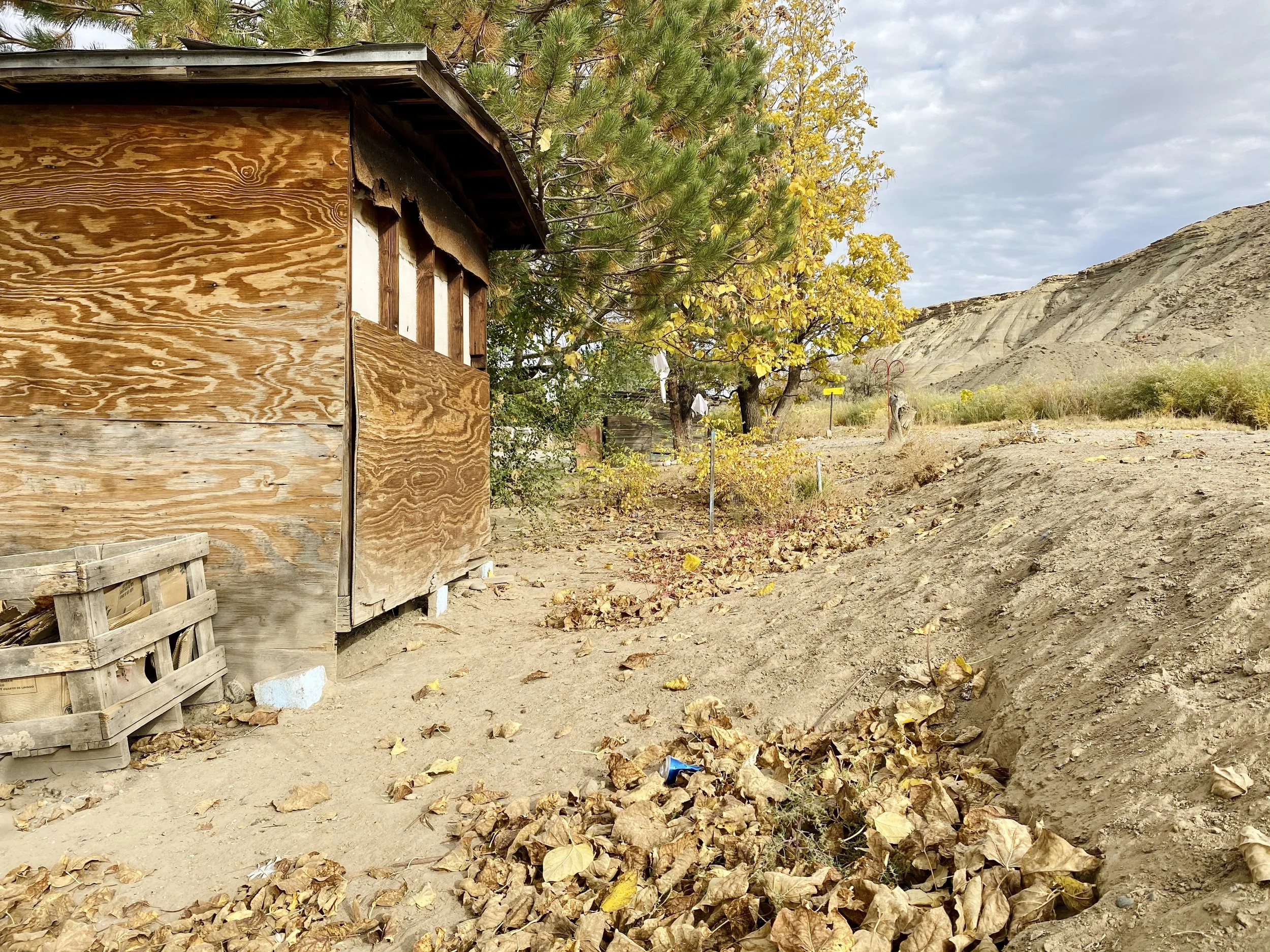
Detail of photograph by Danielle Shandiin Emerson
After RadioShack closed its first round of stores in 2014, I assured my employees that I would do everything I could to keep them working, to keep their hours steady. I had been sure our store would not be closing. I had been through this before with Starbucks in 2008.
“They’re going to look at the market first,” I would say to anyone who would listen. “We’re the only electronics retailer within two hundred miles. We’re the only Sprint location; we sell more Verizon than any Verizon store. We’ll be fine.” A few days later, an official list was emailed around, confirming all of this, but we were all a little shaken, a little worse for wear. Everyone, managers and employees alike, began updating their resumes.
Some of the phone calls I was having with the other managers carried a tone of surrender. Few were willing to stick around and see how this was going to play out. What surprised me was the boldness my colleagues showed. My friends were great at their jobs, but for many of them, this was one of the only jobs they had ever had. Some were hired right out of high school, opting to start making salaries instead of going to college.
It was still a difficult time to look for new employment. It had been six years since the economic crash, though rural Northern California was slowly rebuilding. Some of my colleagues were making lateral moves, leaving to manage Ashley Home Furniture stores or Dollar Generals. But something within me was finally breaking.
I had come to California eight years ago with a calling. Graduating in 2008 gave me the time to defer that calling, to immerse myself in a community that became my home, but my time was up.
I had acquired this liberal arts degree in Native American Studies, hoping I could learn who I was in the process. I longed to identify where this fight within me came from, the part of me that refused to quit despite the small world I had been born into. I identified with the connection to the land and the mountains. There was a resilience in me that sustained me through the trials at RadioShack, helping me become an expert in a technical field I once knew nothing about. As my sales rose, I learned to identify the needs of people.
It was the tenacity that kept me fighting as the only woman in my store, and then the only woman in management. The refusal to quit when I was being underpaid for the sixty-five-hour work weeks and the harassment. It came from the same place as my people, who refused to surrender their land and their language. It came from the same place as the Blackfeet who maintained their original reservation lands, and from the Blackfeet woman Elouise Cobell, who had taken on the United States government.
I knew of Elouise from my last visit to the Blackfeet reservation in 2009, shortly after I turned 21. As treasurer of the Blackfeet Nation, Elouise had just filed her lawsuit for misappropriation of government funding. Like all Native Americans, Elouise grew up hearing stories about how her relatives had to beg the Indian Agent to pay for food and medical care, the same agent my relatives had begged.
As treasurer, Elouise ascertained there were funds missing, and she fearlessly pursued them. By 2014, Elouise had passed away from a long battle with cancer, but her lawsuit lived on and would eventually culminate in the largest class-action settlement in history. I knew that Elouise and I were the same. What I wanted, what I had wanted more than anything, was to advocate. I wanted to work within Native American populations; I wanted to change the system we had been forced to function within.
But now, faced with re-entering the job market that I had avoided after graduating in 2008, I didn’t know how to do that. All I had to show for the last five years was RadioShack. Try as I might, I wasn’t sure how to position myself as an asset to the tribes. I now wished I had used this time for some kind of internship to bring me closer to my goal. But those operations tend to need people available during certain hours, and I worked ten-hour days, six days a week. I didn’t have time for anything. The business of survival was all I could manage while living paycheck to paycheck.
I had been the salaried, on-call property of this company. I had sold the hours of my life back into it for student loan payments and car payments. I couldn’t afford to give my time away for free, so I promised myself I wouldn’t make this mistake again. It would be harder, and it would take longer, but I wasn’t leaving RadioShack for another prison that looked just like it. This time, I was going to figure out how to do what I came to California to do.
It wasn’t easy deciding to stay, but once the closures hit the headlines, it was slow Chinese water drip torture. I knew it would be coming, I just didn’t know it was going to be as bad as it was. Having worked with the public all my life, I knew of society’s narcissism. I knew that people, as a body, can move with a savage vibration without regard for the consequences of their behavior. And I knew that the worst of it was always directed at the othered classes: the destitute, the indigent, the BIPOC, and retail workers.
The question came at us like buckshot.
“Hey! When are you guys going out of business?” said every single person who walked through the door, and it seemed impossible to correct the narrative. We’re not closing. No, the company is not declaring bankruptcy. No, you cannot have a discount. What was shocking was that these customers were our community. For years, they had been returning to us every month to pay a cell phone bill or purchase their Christmas presents. Yet, these questions were rarely out of concern for what would happen to us. Our customers had become vultures, hoping to score a discounted iPhone.
“I can’t believe this store is still in business,” they would say, “I can get everything I need on Amazon for so much cheaper. Your prices are too high anyway.” It became malevolent, coming from a place of disdain and morbidity. RadioShack became America’s ailing elderly relative, and the message was clear: just die already.
At that time, RadioShack had around 27,500 employees. Each one of those employees was a real flesh-and-blood person with their own nut to make, and yet the old trope was lobbed toward my coworkers and me once again.
“Just get another job,” they said, failing to realize how difficult it would be for a high school graduate who had been with RadioShack for ten, twenty, or thirty years to find another way to pay their mortgage or their childcare. How quickly they forgot the playground of their youth, or where they brought their children to purchase college supplies. How quickly our throats were cut for the faults of our shareholders.
I was out with friends at a crowded bar when my mother called me. I always picked up her calls. We spoke on the phone at least once a week, but sometimes we could talk up to three or four times a week, for hours. When I was lonely, I called her. When I needed advice, I called her. We had been traveling together my entire life, but in my twenties, we were planning trips to new destinations before she retired. Our trips were opportunities to connect while we lived three states apart, as I was building a new life and she was dismantling hers.
“Hello?” I answered while stepping outside onto the dark, cold sidewalk. I held one hand to my ear to block out the music of the live band inside.
“We are going to Hawai‘i,” she said.
My heart jumped. I had fallen in love with Hawai‘i while bingeing LOST after graduating and had been suggesting for years that my mother would love it. I got the impression the slow island vibe, rich food, and warm weather were for her at this point in her life, but she had been slow to come around.
“Wait, what? Where are you?” I asked. I could feel the bitter February cold hardening around my bare legs. Because of course, I had to wear a skirt to this show.
“I’m at the casino with mom,” she said. By mom, she meant my grandmother. “It’s her birthday,” she explained. If she was with Grandma, I knew she was on the Quinault reservation. It was only a short drive for them, and it was their favorite casino.
“Did you win a trip to Hawai‘i?”
“No, I won on the penny machines!” she exclaimed.
I laughed. “How much could you have possibly won on the penny machines?”
My mother was not an excessive gambler, but she had a talent for it.
“You remember that check I told you about?”
“Yeah, sure,” I said.
My maternal grandfather, a Blackfeet Indian, was born on the reservation in northwestern Montana. When he died, it had not been easy for my mother. She was extremely close to her father, and their relationship had been complicated. His per capita payments were in her name now. The payments were modest and inconsistent, but in 2013, she received $200.
She spent an inordinate amount of time considering what to do with the money before deciding to give it back to the Tribes. Of course, we were not Quinault. We weren’t even a Washington Tribe, but it was all the same to her. It was given in the spirit of gratitude, and the ancestors gave it back in spades. That night, my mother won almost $4,000 with a few pennies.
Pinpointing exactly what tribal advocacy looked like was not easy. Quite honestly, it sounded administrative and mundane. My home on the California coast made me fortunate enough to be surrounded by eleven Federally Recognized Tribes, but as I scanned their human resources webpages, I wasn’t seeing what I was looking for. The summoning inside me was growing stronger, but as I read the job titles for Administrative Assistant and Head Start Teacher, it wasn’t hitting.
So, I did what any millennial would do. I just Googled it, trying combinations of different keywords, hoping the internet would paint a picture for me, and it did. I saw that I could work for the Bureau of Indian Affairs like my cousin Georgia did in Seattle, but in Northern California that office was five hours away in Sacramento. I could work at the Indian Health Care clinic, but that didn’t seem to offer the global effect I was seeking. I found agencies on Federal Indian lands in parts of California I had never heard of, Temecula and Alpine.
I wondered if I might have to leave the area, which made me feel sick. There were few industries here, but I loved it. I was discovering myself in Northern California. I had made friends and knew a whole community of people through the music scene, the arts, and even through RadioShack. I was a watercolor painter here, with paintings of the boats and the ocean and the rivers. I didn’t know what there was to paint in Temecula.
When I had been working at my first RadioShack, a customer spotted me drawing during one of the slower closing shifts and let me know there was a new artist co-op in town that his wife had just joined. He emphasized that it was great for artists who only had one or two pieces, and that membership was free. I joined that winter and volunteered to pour the wine at their gallery on Friday nights.
When I worked at RadioShack in the mall, I befriended one of the maintenance men who happened to be a former commercial photographer. He spotted one of my framed paintings in the back of my car, on its way to a community art show, and offered to start photographing my paintings, carefully peeling them from their frames and then reassembling them, so I could sell prints. Now, the networking had paid off, and those prints and cards were in two of the local tourist spots.
My network was here. Not just my closest friends, but business owners, elected officials, city employees, and working professionals who I knew through my years at RadioShack. As I navigated this new territory, I knew I had the best shot of success where I had resources.
So home was on my mind as I drove north to Washington to meet my mother, then fly out of Portland, Oregon. I was no stranger to flying. I had been on many airplanes, especially on trips with my mother, but something was different this time. It was my first flight over the open ocean waters. As my mother and I boarded and found our seats, I pulled the straps of my seatbelt across my lap and glanced out the window. I had been attempting to ward off my concerns about this flight, but now, it seemed like that was going to be impossible.
Just one month before this trip, Malaysian Flight 370 disappeared out of the sky. I had never feared flying, and I wasn’t scared then. As the news coverage had become prolific with speculation about what could have happened, my fears were more about the now more distinct and tenable fear of existing in this world, and then suddenly not.
The world was wondering where the 239 passengers could have gone. Having lived within several miles of the coastline my entire life, no one was acknowledging the tenet I knew to be true. Those people were in the ocean, a mighty force that could swallow those 239 lives as well as a Boeing 777, and no one would ever find them again.
As the plane began to taxi, a complimentary drink service began, and we both ordered the Passion Orange Guava cocktail. The sweet tropical flavors hit the back of my tongue with an explosive, fertile richness that reminded me of how I used to drink POG at my best friend’s house as a small child. I realized the entire trip was going to be like this. An abundance of wealth. An embarrassment of riches. Hawai‘i would be unlike any place we had ever been before.
We lifted off, and I watched the endless blue outside my window. How would I feel about my life if this was the end of it, I thought. Would I be proud? Would I feel like I had done everything I wanted to do? Would my ancestors know that I had accomplished everything they had sent me here to do?
What would be the one thing that I wished I had done before it was over?
Going to law school was not a decision I made, so much as it was a fact I was unaware of, and then suddenly knew to be the truest thing I had ever known. My mother sat next to me, quietly reading on her Kindle as the roar of the airplane engine became too loud to talk over. My headphones blasted a Rihanna song.
Law school. I wish I had gone to law school. It was the answer to the question I hadn’t meant to ask, but now that I had the answer, I couldn’t get it out of my head. I had always been interested in law school, cherishing the moments I explained wireless contracts to our customers or the recycling laws in California that applied to all the batteries we sold. It wasn’t an answer I consciously chose; it was just there like a stop sign. Law school.
As the airplane overhead lights dimmed, I attempted to argue myself out of the idea. Law school was crazy. It would be expensive and hard. I had no background in law, or even any idea of what an attorney does. I didn’t even have an immediate family member who had graduated from college. I was the first. I had one friend who had attended grad school and was currently a philosophy professor at the university. I personally knew no attorneys, although two of my customers practiced locally.
I bargained, trying out the idea of becoming a professional or working artist and maybe obtaining an MFA in studio art. I revisited the idea of getting a master’s in social work or even something in a different direction, like running a marathon.
Law school was the only answer the voice would give me.
I spent the entire flight trying to reason my way out of it, but once I had the idea, it was like waking up on a train that had been moving for weeks. That somewhere in my future, I was already an attorney, and everything between that moment on the plane to Oʻahu and that other version of me was just another step in the journey to close the gap. The details of where or how or when were incidental. But there was also the threat that now that I knew, the time spent on that journey could not be wasted.
I could not fight it, because it had already happened.
As soon as my mother and I arrived in Honolulu, we felt provincial. The resort we stayed in was one of the nicest hotels we had ever seen, with a wide front porch and rocking chairs. Luxury cars lined up at the valet while a young, affluent-looking Japanese couple was photographed at the resort’s entrance. As we rolled our modest luggage up the walkway, we were asked to stand to the side while the couple finished their honeymoon photoshoot. We had arrived in our comfortable traveling clothes, as the guests who were draped over the porch and around the valet podium wore polyester blends, even in the heat.
We had a full agenda that week. As my mother and I struggled to find and arrive at the opera on time, identify the foods at my first lū‘au, and went shopping in the afternoons, I began to empathize much more with the locals on this island than the tourist crowd that I was technically a part of. Every face behind an ABC store counter, or serving us the exquisitely plated food, felt like someone I had more in common with than this well-to-do crowd. I couldn’t put my finger on it at the time, but an acute layering of classism and gentrification was evident in every conversation my mother and I had with a Hawaiian resident.
This was not a land that belonged to the visitors who ate in the restaurants, drank the coffee from the rich soil, enjoyed the beaches, but rather a place with a deep history of colonization, violence, and land dispossession. The latest in this turn of events was merely rising rent and a housing crisis, as families that had been there for generations were losing their land at a more rapid rate than ever. O‘ahu clearly belonged to its Native people, and yet they seemed to feel displaced there as well.
I ruminated all week on an essay by Ward Churchill that I had studied in undergrad, Stolen Kingdom: The Right of Hawai‘i to Decolonization, discussing the way Hawai‘i had been stolen from the Native Hawaiians and Kānaka Maoli people. I hadn’t thought about it in years, but the dichotomy was so plain in Hawai‘i. As these thoughts emerged, they mixed with the words: law school. It was just a whisper of two ideas, but I knew that somehow, they belonged together.
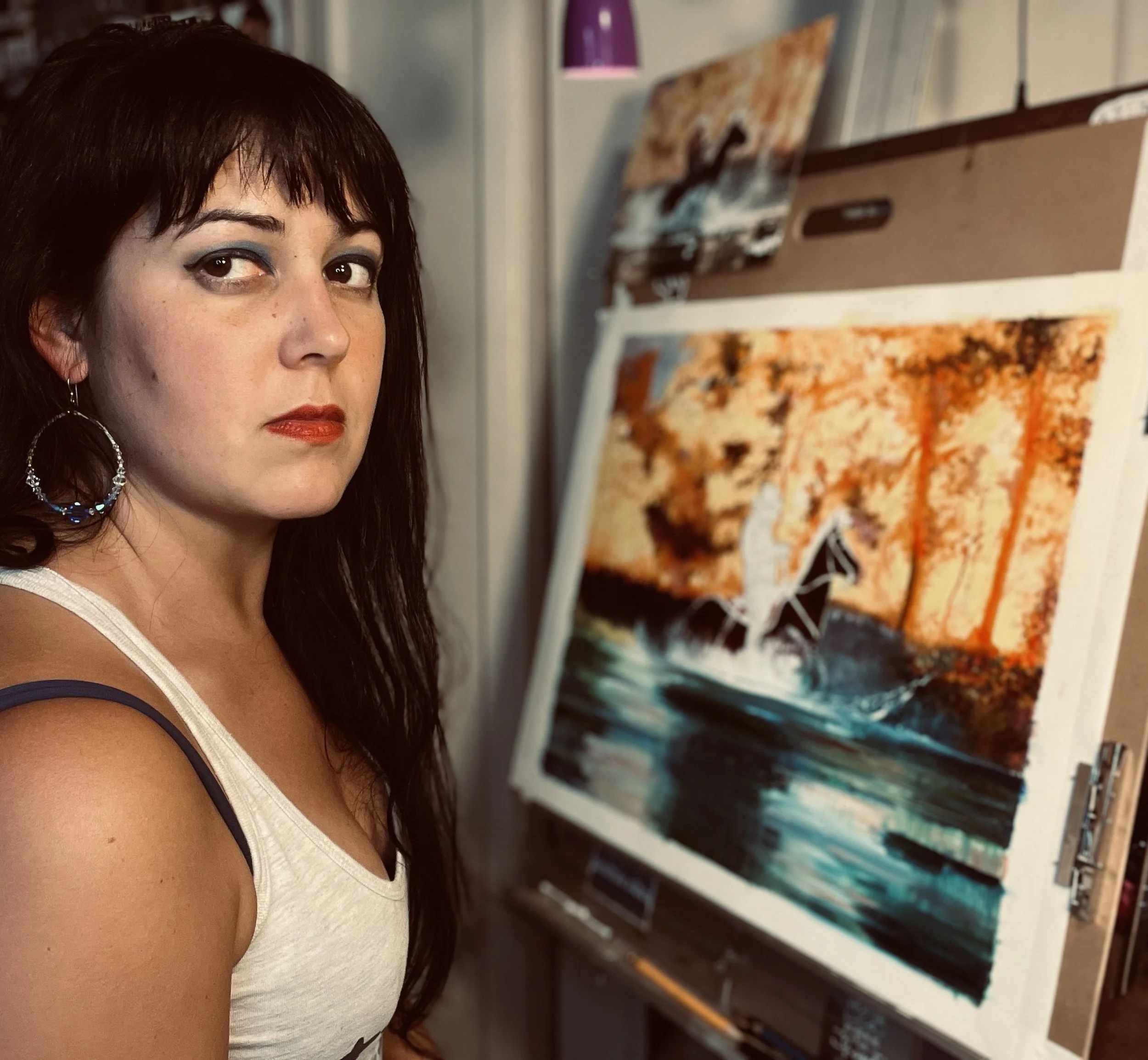
Elaina Erola is a watercolorist, attorney, and member of the Blackfeet Tribe, currently a candidate for the L.L.M. program in Environmental Law at Lewis & Clark. Her writing has appeared in Alternating Press, Yellow Medicine Review, the Society for Cultural Anthropology, Texas Tech Law Review, and is forthcoming in the Sewanee Review, and the Journal of Environmental Law and Litigation. In 2024, she was selected for PEN America’s Emerging Voices Workshop. In 2025, she joined the Tin House Winter Workshop and was selected as a summer 2025 scholar for their workshop in Portland, Oregon.